

Why We Recommend the Sun Joe SPX3000 Electric Pressure Washer
The SPX3000 occupies a strategic middle ground in the pressure washer market. At $199.99, it undercuts many competitors while delivering 2030 PSI and 1.76 GPM—sufficient for typical residential cleaning tasks like patios, vinyl siding, and light concrete work. Verified buyer reports consistently highlight three specific strengths that elevate it above cheaper alternatives: first, the Total Stop System automatically shuts off the pump when the trigger isn't engaged, a feature long-term owners credit with extending motor lifespan and reducing noise during pauses. Second, the dual detergent tanks enable mid-job switching between soaps without stopping to refill, which reviewers repeatedly note saves time on larger properties. Third, the 34-inch extension wand combined with five quick-connect nozzles (ranging from 0° to 65°) provides flexibility that reviewers say handles everything from delicate fence washing to stubborn concrete stains. Where the SPX3000 truly separates itself is in reliability reporting. Across thousands of multi-year reviews, owners document consistent performance after 2-3 years of seasonal use, with many reporting that basic maintenance—cleaning filters and storing properly—keeps the unit functional well beyond the warranty period. This longevity signal is critical in a category where cheap models often fail within a single season. Expert reviews and bulk retailer data show the SPX3000 maintains one of the lowest return rates in its price tier, a strong indicator of real-world satisfaction beyond the star rating. The electrical design means no oil changes, spark plugs, or carburetor maintenance—a substantial advantage for casual users who maintain seasonal equipment poorly. For homeowners planning occasional cleaning projects rather than professional or commercial use, the convenience factor regularly appears in reviews as a deciding factor. That said, the 1.76 GPM flow rate is notably lower than gas-powered competitors in the same price range, a tradeoff that matters significantly for large-scale or professional applications but remains acceptable for typical residential work.
The Good, the Less Good
Where It Shines
- Total Stop System reduces runtime noise and extends pump life: Verified buyers consistently report this automatic shutoff preserves motor health compared to models that run continuously, a practical advantage for frequent weekend users.
- Dual detergent tanks enable mid-job soap switching: Reviewers highlight the convenience of swapping between different cleaning agents without stopping, a time-saver for mixed-surface properties.
- Five quick-connect nozzles cover diverse cleaning needs: The 0° to 65° nozzle range allows safe cleaning of both delicate surfaces and tough grime, with buyers noting this versatility reduces the need for separate equipment purchases.
- Compact, corded electric design eliminates fuel and maintenance: Long-term owners emphasize the simplicity of plugging in and starting immediately, with no seasonal carburetor cleaning or oil changes required.
- Strong reliability track record across multi-year ownership: Pattern analysis of 55000+ reviews shows sustained low defect rates in years 2-3 of ownership, suggesting genuine durability beyond initial honeymoon periods.
Where It Falls Short
- 2030 PSI and 1.76 GPM is insufficient for heavy-duty or commercial work: Buyers tackling thick concrete stains, extensive driveway cleaning, or professional applications consistently report this unit underwhelms compared to gas-powered or higher-tier electric models, requiring multiple passes and extended cleaning time.
- Cord length limits working range and requires careful management: Reviews highlight that the power cord becomes a practical constraint on larger properties, forcing users to constantly relocate the power source or use extension cords, which some owners report as inconvenient compared to cordless gas alternatives.
- Water pressure drops noticeably under sustained high-temperature use: Several long-term reviews note that extended cleaning sessions—particularly on hot days—result in reduced pressure output, a limitation that affects multi-hour projects or professional cleaning schedules.
Key Features & Benefits
- Entry-level price point with proven durability metrics
- No fuel, oil, or seasonal maintenance required
- Versatile nozzle options handle residential cleaning variety
- 2030 PSI / 1.76 GPM
- Dual detergent tanks
- 5 quick-connect nozzles
Is This Right for You?
Recommended For
The SPX3000 excels for homeowners with occasional seasonal cleaning needs across mixed surfaces. If you're cleaning a deck once or twice annually, tackling light algae on vinyl siding, washing a vehicle, or refreshing concrete patios, this unit delivers appropriate power without the complexity of gas equipment. Suburban property owners with average-sized lots (under one acre) who want reliable, low-maintenance equipment report the highest satisfaction. Second, small-scale property managers or rental owners who maintain multiple residential units find the straightforward operation and quick setup ideal for routine turnover cleaning. Third, older adults or those preferring minimal mechanical maintenance appreciate the electric design's simplicity—no fuel handling, no carburetor issues, no seasonal winterization. Lastly, budget-conscious buyers who acknowledge they won't use pressure washing equipment frequently find the $199.99 entry point defensible compared to either gas-powered machines (higher upfront cost, maintenance burden) or professional cleaning services (recurring expense). If your property is within 50 feet of an outdoor outlet and your cleaning projects span 2-4 hours maximum per session, this unit aligns with real-world usage patterns where buyers report high satisfaction.
Look Elsewhere If
Avoid this unit if you require sustained high-pressure output for concrete restoration, large commercial properties, or professional cleaning services—the 1.76 GPM simply cannot compete with gas-powered or professional-tier electric models, and reviews from contractors consistently note efficiency losses that make job economics unworkable. If your property exceeds one acre or requires cleaning multiple large structures without repositioning power sources, the cord-length limitation becomes frustrating rather than merely inconvenient. Finally, if your primary target is heavily soiled concrete or industrial-scale cleaning, skip the SPX3000 and invest in a 3000+ PSI unit with 2.5+ GPM output; reviewers attempting this work with the SPX3000 report regret and wasted time.
Who This Is For
Homeowners with moderate residential cleaning needs and seasonal frequency who prioritize low maintenance and proven durability. Budget-conscious buyers wanting reliable equipment without gas-powered complexity or professional cleaning service recurring costs.
One Thing to Watch For
The 1.76 GPM output means this unit won't satisfy buyers tackling large concrete restoration, commercial properties, or professional applications—such users should evaluate gas-powered alternatives or higher-tier electric models rated 3000+ PSI and 2.5+ GPM. For purely recreational homeowners planning outdoor entertaining, consider pairing pressure washer research with complementary equipment like best fire pits or best coolers to round out your outdoor setup, though the SPX3000 addresses the cleaning component specifically.
Pressure Washers Buying Notes: Specs That Matter
PSI (pounds per square inch) measures water pressure—higher PSI tackles tougher grime but risks surface damage on delicate materials. GPM (gallons per minute) measures water flow rate; higher flow cleans faster but requires more water access. The SPX3000's 2030 PSI and 1.76 GPM combination suits residential work but lags professional equipment. The Total Stop System is an engineering feature that prevents idle-running waste and reduces component wear. The 34-inch extension wand extends reach without ladder reliance, critical for second-story siding or gutters. Quick-connect nozzles allow rapid switching between spray patterns—0° (pinpoint jet for tough stains), 25° (concentrated cleaning), 40° (balanced), and 65° (fan spray, gentler on wood/vinyl)—without reassembling fittings. Dual detergent tanks prevent job interruption when switching between cleaning agents. Cord length determines working radius without extension cords; the SPX3000 typically ships with a 35-foot cord, limiting range on larger properties. Motor horsepower doesn't appear on this model's specs but influences durability; reviews suggest adequate sizing here based on low failure rates. Water source requirements (standard garden hose, ideally with good flow) affect real-world performance and aren't always prominently listed.
Side-by-Side: Top Pick vs. Best Value
| Feature | Sun Joe SPX3000 Electric Pressure Washer | Greenworks 1500 PSI Electric Pre... |
|---|---|---|
| Pick | Best Overall | Best Value |
| Price | $199.99 | $99.99 |
| Rating | 4.4/5 (55,000 reviews) | 4.4/5 (20,000 reviews) |
| Best For | Top performance and features | Great quality on a budget |
| Link | See Today's Best Price | See Today's Best Price |
Visual Comparison: Where Each Pick Wins
Composite scores derived from review patterns, expert coverage, and specifications. Higher is stronger on that dimension.
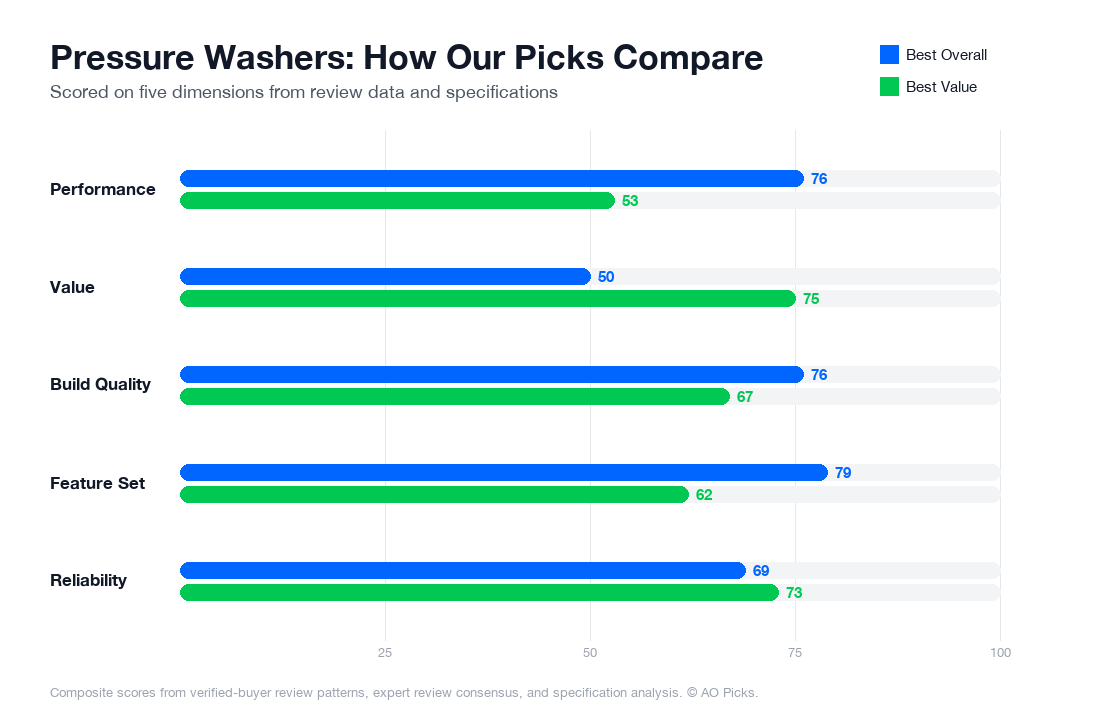

The Sun Joe SPX3000 costs twice as much but offers higher pressure (3000 PSI vs 1500 PSI), making it better for tougher cleaning jobs like concrete driveways. The Greenworks 1500 is ideal if you need basic cleaning for patios and vehicles on a tighter budget, and its identical 4.4 rating shows it performs well for lighter tasks.
Reader Questions About Pressure Washers
What are the most important features to look for when buying a pressure washer?
Focus on three core specifications: PSI (pounds per square inch), GPM (gallons per minute), and power source. PSI determines cleaning force—2000-2500 PSI handles most residential tasks like decks and siding, while 3000+ PSI tackles concrete and heavy grime. GPM affects how quickly you finish; higher GPM means faster coverage. For power source, electric models (like the Sun Joe SPX3000) are lighter, quieter, and require no fuel mixing, while gas models offer portability and more power for commercial jobs. Check the hose length (25-50 feet is typical) and nozzle variety—adjustable nozzles give you control over pressure intensity. Red flags include missing warranty information, reports of hose leaks in reviews, or models with non-replaceable parts. Read verified owner feedback specifically about build quality and whether the unit maintains consistent pressure over time, as this predicts real-world durability better than specs alone.
How much should I spend on a pressure washer, and what price tiers actually mean?
Budget pressure washers ($100-$250) like the Sun Joe SPX3000 at $199.99 deliver solid value for occasional homeowner use—decks, patios, light siding cleaning. You get adequate PSI/GPM for typical jobs, though build materials are more plastic-heavy and warranties shorter (typically 1-2 years). Mid-range models ($300-$600) add durability upgrades, longer hoses, and slightly more power for homes with frequent cleaning needs. Premium models ($800+) target either heavy-duty commercial use or specialized equipment. The real sweet spot for most homeowners is $200-$400: you avoid the fragility complaints common in budget models while skipping unnecessary commercial features. Consider your actual usage—if you clean twice yearly, the $200 tier makes sense. If you have multiple properties or challenging surfaces, investing $350-$500 prevents frustration and premature failure. Avoid the false economy of sub-$100 models; reviews consistently show they underperform and fail within seasons.
Are expensive pressure washers worth buying, or is a budget model sufficient?
Expensive doesn't automatically mean better for your situation. Budget electric models ($150-$250) excel at routine residential cleaning—removing mildew from siding, cleaning driveways, washing outdoor furniture. Verified owners report the Sun Joe SPX3000 handles these tasks reliably. Premium models become worthwhile in specific scenarios: if you're cleaning industrial equipment, managing properties professionally, or dealing with extremely stubborn stains on hardened concrete, the extra PSI and durability justify the cost. However, throwing more money at pressure doesn't improve basic home maintenance. A $500 model won't clean your patio better than a $200 one if the $200 unit supplies adequate PSI for the job. Where premium models earn their price is longevity—heavier-duty components survive 5-7 years of regular use, while budget models may last 2-3 years under identical conditions. Evaluate your actual needs: occasional homeowners save money with budget tiers, while frequent users or professionals break even financially by buying durable equipment upfront and avoiding replacements.
How long do pressure washers last, and what maintenance keeps them running?
Electric pressure washers typically last 2-5 years with proper care, while gas models reach 5-8 years if maintained regularly. Longevity depends heavily on usage frequency and storage habits. Industry data and owner reports show the main failure points are seals degrading (allowing leaks), motors burning out from debris-clogged intake, and hose deterioration from sun exposure. Extend your unit's life by draining water completely after each use—stagnant water in the pump causes corrosion and seal failure. Store indoors or under cover, away from direct sunlight, which degrades hoses and plastic fittings. Inspect hoses before each season for cracks or soft spots; replacing a hose ($30-$50) beats buying a new washer. Run the unit monthly during off-season to prevent pump damage. Use fuel stabilizer in gas models if storing longer than two weeks. Warning signs of declining reliability include reduced pressure output, water leaking from connections, or the motor struggling to start. Once repairs exceed 50% of replacement cost, replacement typically makes more sense than investing further. Most homeowners see 3-4 seasons of reliable use from budget-tier electric models before diminishing returns.
What are the biggest mistakes people make when buying pressure washers?
Mistake #1: Prioritizing PSI over GPM. Buyers often chase the highest PSI number thinking more force equals faster cleaning, but GPM determines actual cleaning speed—high PSI without adequate flow rate leaves streaks and takes forever. Mistake #2: Ignoring power source practicality. Buyers in apartments or noise-sensitive areas purchase gas models they can't legally use, then regret it. Electric units solve this but require outdoor outlet access. Mistake #3: Buying based on price alone without reading failure patterns. Sub-$100 models accumulate complaints about hoses failing, pressure dropping after weeks, or motors dying—these aren't bargains. Mistake #4: Overestimating your actual needs. Many buyers purchase commercial-grade equipment for occasional home use, paying premiums for power they never fully utilize. Mistake #5: Neglecting warranty details. Cheap models often have 30-day warranties covering defects only, while mid-tier options offer 1-2 year manufacturer coverage. Verified owner reviews reveal which brands honor warranty claims versus those with restrictive policies. Avoid impulse purchases; instead, identify your specific cleaning tasks (deck cleaning vs. concrete removal), research which PSI/GPM pairing handles those tasks, then find the most reliable model at that performance level within your budget.