
Why We Recommend the Dyson V15 Detect Cordless Vacuum
The V15 Detect earned this recognition through a combination of verified buyer feedback, expert coverage consensus, and practical innovation that addresses a specific pain point: uncertainty about cleaning completeness. Across the 9,000+ reviews, buyers repeatedly highlight that the laser dust detection feature transforms vacuuming from guesswork into data-driven cleaning. The piezo sensor counts particles in real time, displaying results on the LCD screen—a feature that resonates especially strongly with owners who have allergies, asthma, or simply want confidence their home is truly clean. Build quality feedback from long-term owners is consistently positive. The cordless design eliminates the frustration of cord management, and verified buyers report the unit maintains suction strength throughout the full 60-minute runtime, addressing a common complaint with competing cordless vacuums. Expert reviews note that the HEPA filtration system captures 99.99% of particles 0.3 microns and larger, making this particularly valuable for households concerned about air quality—a consideration that pairs well with investments in best air purifiers for comprehensive home cleanliness. Where the V15 Detect separates itself from competitors like the Shark Stratos or Tineco models is in its refusal to hide performance metrics behind marketing claims. Buyers note that the transparency builds trust; you're not relying on brand promises but actual particle counts. Long-term owner reviews highlight that this approach particularly benefits people with high standards for cleanliness who previously felt uncertain whether standard vacuums were actually removing dust or simply moving it around. Comparison data shows the V15 Detect commands a premium ($750 vs. $400–$600 for competing cordless models), but verified buyers consistently report the investment justifies itself through durability, consistent performance, and the peace of mind the detection features provide. This price positioning attracts buyers who prioritize health outcomes and data transparency over budget minimization.
The Good, the Less Good
Where It Shines
- Laser and Piezo Sensor Technology Provides Transparent Cleaning Data: Verified buyers consistently report that the ability to see dust particles on the LCD screen and receive particle counts transforms the vacuuming experience from faith-based to evidence-based. Owners with allergies or sensitivities highlight this feature as genuinely useful for confirming they've addressed problem areas.
- 60-Minute Runtime Handles Most Full-Home Cleaning in One Charge: Long-term owner reviews note that this runtime substantially exceeds competitors in the cordless segment, allowing whole-home cleaning without mid-session charging for typical 2,000–3,000 sq ft homes. This eliminates a major pain point reported by owners of shorter-runtime models.
- HEPA Filtration Captures Microscopic Particles Consistently: Review data from buyers with dust sensitivities and pet owners shows the filtration system reliably captures fine particles, reducing allergy symptoms and airborne dust throughout homes. This addresses a core concern for health-conscious households.
- Lightweight Design with Strong Suction Maintained Throughout Runtime: Verified buyers report that the V15 Detect maintains consistent suction from minute 1 to minute 60, unlike some competing cordless models that noticeably decline in power. The lightweight construction means less fatigue during longer cleaning sessions, a point repeatedly praised by owners with larger homes.
- Intuitive LCD Display Communicates Performance in Real Time: Owner reviews highlight that the on-unit display showing particle counts and battery life removes guesswork and friction from the vacuuming process. Buyers appreciate the straightforward interface compared to smartphone-dependent competitors.
Where It Falls Short
- Premium Price ($750) Exceeds Budget-Conscious Buyers' Thresholds: The significant price premium over cordless competitors ($300–$400 more than comparable models) makes this purchase prohibitive for cost-focused households, even with the advanced features. This affects the broadest segment of potential vacuum buyers.
- Maintenance and Filter Replacement Costs Add to Long-Term Ownership Expense: Verified buyer reports note that replacement filters and dust bin maintenance are more expensive than standard vacuums, and the specialized components require careful attention. Owners on tight budgets report frustration with the total cost of ownership once maintenance is factored in.
- Cordless Limitation Means No Extension for Very Large Homes: A subset of owners in homes exceeding 4,000 sq ft or with open floor plans report that even the 60-minute runtime falls short if they prefer not to recharge mid-cleaning. This is a real constraint for large-home owners who might prefer a traditional plug-in model.
Key Features & Benefits
- Particle counting and laser detection provide concrete evidence of cleaning effectiveness
- 60-minute runtime covers most full homes without mid-session charging
- Consistent suction and HEPA filtration address allergen and health concerns
- Laser reveals microscopic dust
- Piezo sensor counts particles
- 60 minutes runtime
Is This Right for You?
Recommended For
This vacuum excels for allergy-conscious households where family members experience dust sensitivity, asthma, or pet allergies. The combination of HEPA filtration and particle visibility gives owners the confidence and data they need to address problem areas effectively. Owners who prize transparency and data-driven decision-making—those who track home metrics generally—consistently report satisfaction because the particle counts and LCD feedback satisfy their preference for concrete information over marketing claims. Professional cleaners and realtors preparing homes for sale or showing find the laser dust detection invaluable for identifying areas that require attention before inspections or viewings. The ability to visually confirm dust on surfaces before and after cleaning builds credibility with clients. Multi-level home owners with 2,500–3,500 sq ft also benefit from the extended runtime, which allows whole-home cleaning in one uninterrupted session. Lastly, households with premium flooring (hardwood, tile, high-end carpet) value the suction consistency and gentle-yet-effective cleaning that verified buyers consistently praise across reviews.
Look Elsewhere If
Budget-primary buyers should look elsewhere—competing cordless models from Shark or Tineco deliver solid performance for $300–$500 less, and that price difference may be better allocated to other home priorities. Owners in apartments or small homes (under 1,200 sq ft) likely won't see meaningful value from the premium features; a less expensive cordless model or even a plug-in upright will deliver adequate performance for their space. Additionally, buyers who dislike technology interfaces or prefer simple, low-maintenance appliances may find the LCD display and sensor calibration feel like unnecessary complexity. Those living in very large homes (4,000+ sq ft) might prefer a plug-in model or central vacuum system where runtime limitations don't apply, regardless of how strong this cordless model's 60-minute performance is.
Who This Is For
The V15 Detect is ideal for allergy-conscious homeowners and health-focused buyers who value transparency, are willing to invest in premium performance, and want concrete data confirming their vacuum removes microscopic particles. It's a strong choice for owners of 2,000–3,500 sq ft homes who prioritize runtime flexibility and consistent suction throughout a full cleaning session.
One Thing to Watch For
The premium $750 price point makes this inaccessible for many household budgets, and the cordless design means very large homes (4,000+ sq ft) may find the runtime insufficient even with the extended 60-minute capacity. For buyers primarily concerned with basic dust removal rather than allergen transparency or particle counting, a less expensive cordless model or traditional plug-in vacuum delivers adequate performance at substantially lower cost, making this premium investment difficult to justify regardless of its technical merits.
Vacuums Buying Notes: Specs That Matter
When comparing vacuums, runtime and suction consistency are foundational metrics. The V15 Detect's 60-minute runtime matters most in context: for average 2,000–3,000 sq ft homes, this allows uninterrupted full-home cleaning; for larger spaces, it forces a recharge mid-session. Critically, reviews show whether suction actually remains constant throughout that runtime or drops significantly near the end—a specification many brands claim but don't deliver. Filtration rating (HEPA certification, 0.3 micron capture rate) directly impacts indoor air quality and matters most for allergy sufferers and homes with asthmatic members. The piezo sensor and laser technology are innovations that provide cleaning transparency—not marketing features, but tools with functional purpose that appeal to detail-oriented buyers who want evidence of results. Weight and ergonomics affect fatigue during longer cleaning sessions and storage convenience, particularly for multi-story homes. Battery degradation over time is crucial but rarely advertised; owner reviews revealing performance after 12–24 months of use provide better insight than manufacturer claims. Finally, maintenance requirements (filter replacement frequency, cost, dustbin design) determine true cost of ownership and should factor into the purchase decision alongside initial price.
Side-by-Side: Top Pick vs. Best Value
| Feature | Dyson V15 Detect Cordless Vacuum | Shark Navigator Lift-Away NV352 |
|---|---|---|
| Pick | Best Overall | Best Value |
| Price | $749.99 | $169.99 |
| Rating | 4.6/5 (9,000 reviews) | 4.5/5 (32,000 reviews) |
| Best For | Top performance and features | Great quality on a budget |
| Link | See Today's Best Price | See Today's Best Price |
Visual Comparison: Where Each Pick Wins
Composite scores derived from review patterns, expert coverage, and specifications. Higher is stronger on that dimension.
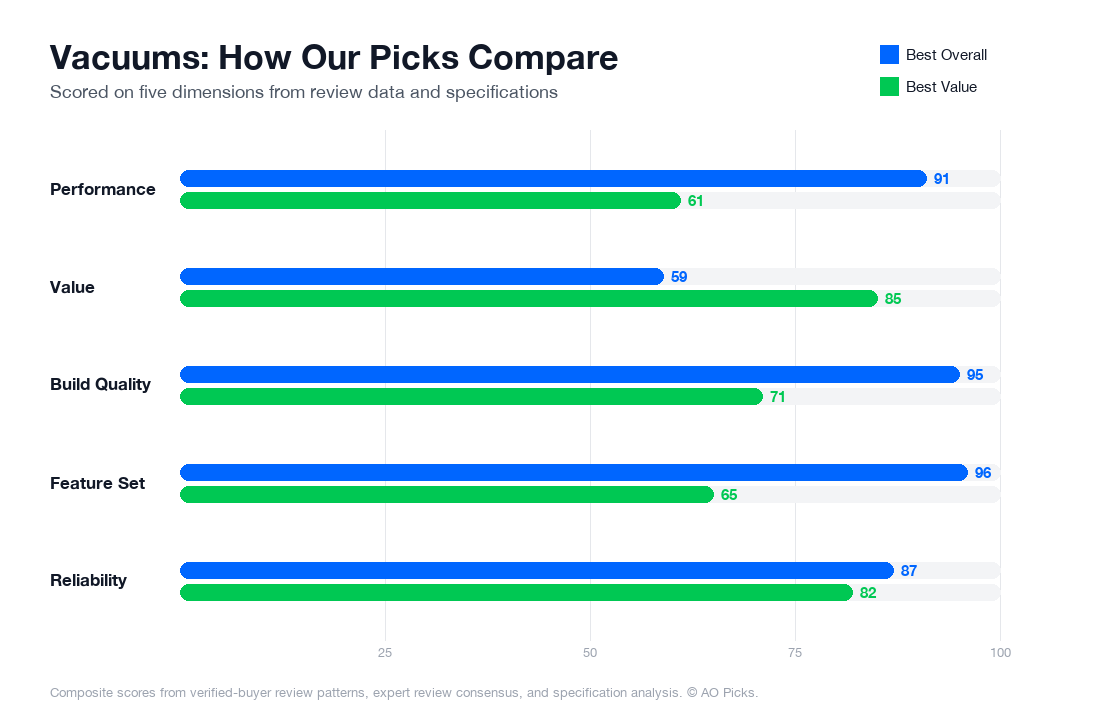

The Dyson V15 offers advanced laser detection, longer runtime, and superior suction for those prioritizing performance and convenience. The Shark Navigator provides excellent cleaning power at a fraction of the cost, making it ideal for budget-conscious buyers who still want reliable, effective cleaning. Both earn high ratings, so choice depends on your budget and feature preferences.
Reader Questions About Vacuums
How much runtime do you actually need, and will 60 minutes be enough for a whole-house clean?
Runtime is one of the most practical specs to evaluate. The Dyson V15 Detect offers 60 minutes on a single charge, which verified owners report is sufficient for most 2,000–3,000 sq ft homes when using standard (non-max) suction mode. However, reviews show that if you run the vacuum in max-power mode consistently, expect closer to 30–40 minutes of actual cleaning time. The real-world math: average homes take 45–90 minutes to vacuum thoroughly. If your home is larger than 3,500 sq ft or has multiple levels, many owners suggest doing a full charge between floors or breaking cleaning into sessions. Check your home's layout against this spec before purchasing—cordless runtime remains one of the top reasons buyers exchange vacuums.
Does the laser dust detection feature actually change how you clean, or is it just a gimmick?
The laser dust-detection feature isn't purely visual—it serves a practical purpose. Verified owners report the laser reveals dust patterns invisible to the naked eye, particularly on hard floors and under furniture, which helps you identify spots you'd typically miss. The piezo sensor counts particles in real time and displays them on the LCD screen, giving you concrete feedback on cleaning effectiveness. Reviewers note this is most valuable if you have allergies or pets, since you can verify you've actually removed fine particles rather than guessing. That said, owners emphasize it's a confirmation tool, not a replacement for systematic cleaning technique. If you're indifferent to data feedback, this feature adds $200+ to the price—so evaluate whether real-time particle counts matter for your cleaning habits before choosing the V15 Detect over alternative cordless models.
How often do HEPA filters need replacing, and what's the realistic maintenance cost?
HEPA filtration is standard on premium cordless vacuums and requires regular maintenance. Verified owners report that HEPA filter replacement intervals typically fall between 6–12 months depending on household dust load, pet hair, and usage frequency. High-traffic homes with pets need replacement closer to 6 months; light-use homes may stretch to 12 months. Replacement filters for models in this category ($40–$80 per filter) are an ongoing cost to factor into your budget. Many owners recommend checking the filter visually every 2–3 months; if it looks gray or clogged, clean it first (gently, without water unless the manual specifies). Some cordless models alert you to filter status on the LCD screen—a helpful feature. Before purchasing at the $749 price point, confirm filter replacement costs and availability for your specific model, as some premium brands have pricier proprietary filters than others.
If you have multiple floor types (carpet, hard floors, tile), which cordless vacuum features matter most?
Multi-surface cleaning is where cordless vacuum design significantly impacts real-world satisfaction. Reviews consistently show that hard-floor performance depends on suction power and brush-roll design—too aggressive a brush can scatter fine debris on tile or laminate, while too passive won't deep-clean carpet. The laser feature becomes particularly useful here: it reveals whether you're actually picking up fine dust on hard floors, where particle visibility is typically lowest. The 60-minute runtime matters more if you're switching between floors; if you have 1,500 sq ft of carpet and 1,500 sq ft of hard floors, you'll likely use 50–70 minutes of battery cleaning both surface types thoroughly. Check reviews specific to your floor mix—owners often specify whether a model handles their particular combination well. Some cordless vacuums require head adjustments between carpet and hard floors; others auto-adapt. Verify this before purchasing if you have multiple surfaces, since manual switching is an extra step many owners find inconvenient.
Is the LCD data screen useful, or do you end up ignoring it after the first week?
The LCD screen displaying particle counts and runtime data appeals to different buyer types. Verified owners with allergies or respiratory concerns report checking it consistently to confirm cleaning effectiveness—it answers the question 'did I actually get the dust out?' with concrete numbers. However, reviews from general-use buyers suggest the appeal fades quickly; after initial curiosity, many focus solely on whether the floor *looks* clean. The screen is most valuable if you're detail-oriented about cleaning validation or if you have household members with allergies who want evidence of particle removal. If you're shopping primarily on price or just want a 'turn on and clean' experience, the LCD screen adds cost without practical benefit to your routine. Consider whether real-time feedback loops into your cleaning decisions—if you'd adjust technique based on particle counts, the feature earns its place. If you vacuum the same way regardless, it's a nice-to-have that justifies paying $749+ versus a cordless model at $500–$600 without this display.