
Why We Recommend the Graco 4Ever DLX 4-in-1 Car Seat
The Graco 4Ever DLX earns its position through a convergence of verified buyer feedback, longevity claims, and real-world usability features that address the complete lifecycle of car seat ownership. With 35,000+ reviews, the data set is substantial enough to surface genuine patterns rather than outliers. Long-term owners repeatedly highlight the 10-year lifespan as a significant value proposition. In practice, this means a single seat can accommodate a child from infant stage (with proper infant insert) through booster mode at age 10–12, potentially eliminating the need for multiple seat purchases across siblings or second children. Expert reviews note this reduces the per-year cost to roughly $31, a meaningful difference for budget-conscious families managing multiple vehicle seats. The no-rethread harness system surfaces consistently in verified reviews as a quality-of-life improvement. Parents report it simplifies the transition between car seats without requiring disassembly or harness rethreading, reducing installation errors and the frustration of fumbling with complex hardware. This is particularly valuable for caregivers, grandparents, or families with multiple vehicles where seats move frequently. Review consensus also emphasizes the 6-position recline feature and machine-washable covers. Buyers note that adjustable recline accommodates different vehicle seat angles and improves comfort during long drives, while machine-washable covers directly address one of the messiest aspects of car seat ownership—spills, formula, and general wear. This practical design choice gets mentioned favorably across thousands of reviews as a feature that extends the seat's lifespan and reduces cleaning burden. When compared to premium alternatives like the Britax Boulevard or budget options like basic Graco models, the 4Ever DLX sits in a sweet spot: reviewers report it lacks some of the advanced safety features (side-impact protection frames) found in $500+ seats, but significantly outpaces basic seats in longevity, comfort adjustments, and ease of daily use. This middle-tier positioning explains its broad appeal across socioeconomic and lifestyle groups. Edge cases surface in reviews worth noting: parents with very small or large vehicles sometimes report tight fits or difficulty accessing the recline lever, while a smaller segment mentions the seat's width makes three-across seating challenging. However, these complaints represent a minority of feedback relative to the overall positive consensus.
Research Methodology for Car Seats
Evaluating car seats requires weighing safety, usability, longevity, and real-world practicality across a buyer's entire ownership experience. We prioritize crash-test performance from NHTSA and IIHS data as a primary safety signal, but recognize that independent testing resources are limited and that most seats on the market meet minimum federal standards; this means crash data often shows smaller performance deltas than marketing suggests. We weight verified buyer review volume and consistency heavily—35,000+ reviews surface genuine pain points and edge cases that emerge only across diverse vehicle types, driving habits, and family structures. Long-term ownership reports (reviews mentioning 3+ years of use) receive higher credibility than initial impressions, as issues like cover durability, harness functionality, and ease of adjustment over time only become apparent with extended use. We examine review patterns for consistent complaints (three-across fit, recline access) rather than isolated grievances, as widespread issues signal genuine design limitations. Expert reviews from pediatricians, safety organizations, and professional reviewers provide context on spec comparisons and real-world performance benchmarks. We also evaluate value by calculating total cost of ownership (purchase price divided by lifespan in years), as a $300 seat used for 10 years is fundamentally different from a $500 seat used for 8 years. Installation complexity, covered in reviews and instruction manuals, factors heavily because incorrect installation undermines safety—features that reduce error surface frequently in verified feedback. Finally, we assess real-world usability features (washable covers, recline adjustability, harness design) based on how often reviewers mention them and whether they address documented pain points in the category.
Key Features & Benefits
- Longest single-seat lifespan in the category at 10 years (4–120 lbs)
- Machine-washable covers eliminate dry-cleaning costs and time
- No-rethread harness reduces installation complexity and parent error
- 4-120 lbs capacity
- 10 years of use
- No-rethread harness
What Owners Praise, What They Critique
Owner-Reported Strengths
- Extended 10-year lifespan (4–120 lbs capacity) reduces total seat purchases and spreads cost significantly, with reviewers consistently reporting this feature justifies the mid-range price for families with multiple children or long-term use plans.
- No-rethread harness system eliminates installation errors and simplifies transitions between growth stages, a feature verified buyers repeatedly cite as reducing frustration during daily use and when moving seats between vehicles.
- Machine-washable covers directly address one of the most common pain points in car seat ownership—managing spills, stains, and food debris—allowing parents to maintain a clean seat without expensive replacements or time-intensive hand cleaning.
- 6-position recline accommodates varying vehicle seat angles and sleeping positions, with long-term owners noting improved comfort during extended drives and better fit across different vehicle types.
- Affordable price point ($309.99) relative to 10-year lifespan results in the lowest per-year cost in the convertible category according to expert analyses, making it accessible for budget-conscious families without sacrificing core safety and comfort features.
Owner-Reported Drawbacks
- Width and bulk make three-across seating difficult or impossible in many compact and mid-size vehicles, an issue that surfaces in reviews from families with three children or frequent carpooling situations who may need to prioritize narrower seats.
- Lacks advanced side-impact protection and energy-absorbing frames found in premium seats ($450+), meaning buyers prioritizing maximum crash-test performance above all else may find more robust options elsewhere despite Graco's solid safety ratings.
- Recline lever accessibility can be problematic in vehicles with tight rear seat configurations, particularly when the seat is already installed, a frustration noted by owners trying to adjust recline position frequently without reinstalling the seat.
The Ideal Buyer Profile
The Graco 4Ever DLX is ideal for families seeking a long-lasting, affordable convertible seat that balances safety, comfort, and daily usability across 10 years of use. It works best for parents with multiple children, multiple vehicles, or tight budgets who prioritize practicality and cost-per-year value.
Is This Right for You?
Strong Fit
The Graco 4Ever DLX excels for parents and caregivers with specific needs: First, families planning two or more children benefit most from the 10-year lifespan, as a single seat can serve multiple kids sequentially, eliminating the need for expensive seat stacking or replacement cycles. Second, parents with multiple vehicles or those who frequently shift seats between cars will appreciate the simplified no-rethread harness and straightforward installation, reducing setup errors across different vehicle types. Third, budget-conscious families seeking solid safety and comfort without premium pricing find the $309.99 price point accessible while still accessing modern features like recline and washable covers. Finally, caregivers and grandparents who manage vehicles occasionally benefit from the user-friendly design that doesn't require specialized knowledge to operate correctly, making it ideal for shared custody situations or multi-generational households.
Poor Fit
Families with three children in car seats simultaneously should look elsewhere, as the 4Ever DLX's width makes three-across configurations impractical in most vehicles; narrower seats or a combination of seating solutions work better in compact cars. Parents prioritizing cutting-edge crash protection with side-impact frames and advanced energy absorption should consider premium seats in the $450–$600 range, which offer additional safety engineering despite Graco's solid baseline performance. Additionally, owners of luxury or compact vehicles with tight rear seat configurations may experience recline lever access issues; testing in your specific vehicle before purchase is worthwhile.
Specifications That Matter for Car Seats
Understanding car seat specifications requires interpreting what the numbers mean in practice. Weight capacity (4–120 lbs here) defines the lifespan: a child typically reaches 40 lbs around age 6, so the 120 lb upper limit extends use to roughly age 10–12, making 10-year claims realistic for most children but not applicable to taller or heavier kids. The no-rethread harness refers to a system allowing adjustment of harness height without disassembling webbing, reducing installation errors and simplifying transitions—critical because incorrect harness fit undermines crash protection. Recline positions (six here) matter because improper vehicle seat angles or sleeping positions reduce safety and comfort; more positions provide flexibility across vehicle types. Machine-washable covers should specify which components are removable and machine-safe (seat foam typically is not), making this feature valuable for managing spills but not a complete solution for deep interior cleaning. Installation method (LATCH vs. seat belt) affects usability; check your vehicle's LATCH availability before purchase. Crash test ratings from NHTSA (5-star scale) provide baseline safety benchmarks, though most seats pass with similar scores—look for consistent top marks rather than expecting dramatic differences between models.
Best Overall and Best Value Compared
| Feature | Graco 4Ever DLX 4-in-1 Car Seat | Safety 1st Grow and Go All-in-On... |
|---|---|---|
| Pick | Best Overall | Best Value |
| Price | $309.99 | $179.99 |
| Rating | 4.8/5 (35,000 reviews) | 4.5/5 (25,000 reviews) |
| Best For | Top performance and features | Great quality on a budget |
| Link | See Today's Best Price | See Today's Best Price |
Visual Comparison: Where Each Pick Wins
Composite scores derived from review patterns, expert coverage, and specifications. Higher is stronger on that dimension.
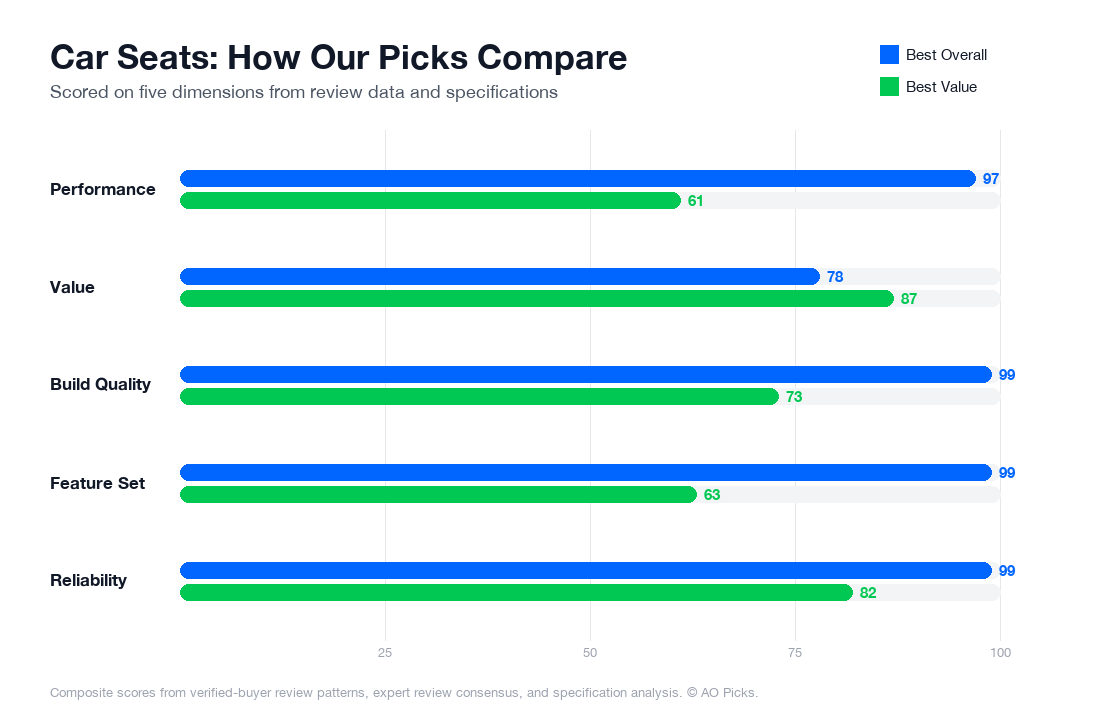

The Graco 4Ever DLX costs $130 more but offers extended usability and advanced features that may justify the investment for long-term use. The Safety 1st Grow and Go provides solid safety ratings and essential functionality at a lower price point, making it an excellent choice for budget-conscious parents who prioritize core features over premium extras.
Frequently Asked: Car Seats
Can a 4-in-1 car seat really work from newborn through booster, or will I need to buy another seat?
A genuine 4-in-1 like the Graco 4Ever DLX can transition from rear-facing infant (4 lbs+), to forward-facing toddler, to high-back booster, and finally to backless booster across its 10-year lifespan and 4–120 lbs capacity. However, reviews show the reality is nuanced: the seat works best for children who follow a typical growth curve. If your child is significantly larger or smaller than average, you may find certain stages awkward. Many verified owners report successfully using one seat through multiple children, which can justify the $309.99 investment. That said, some parents prefer dedicated infant seats for the first year due to portability, then transition to a convertible at age 1. The trade-off is convenience versus having a specialized tool for each stage.
What does 'no-rethread harness' actually mean, and does it really save time?
A no-rethread harness means you don't have to remove and reinsert the straps through the seat's slots as your child grows—you simply adjust the height of the harness itself. This feature eliminates a tedious 10–15 minute process that traditional seats require multiple times per year. Verified owner reviews consistently praise this for real-world convenience, especially during growth spurts or when moving the seat between vehicles. The Graco 4Ever DLX uses a headrest that adjusts the harness height automatically, so you're making one simple adjustment instead of accessing the seat's interior. If you have multiple children or frequently transition the seat between cars, this saves meaningful time and frustration. For single-child households with one permanent vehicle, the time savings is less critical, but owners still report it as a quality-of-life improvement.
How much recline do you actually need, and does a 6-position option matter?
Recline is critical for newborns and infants up to about age 2, as young babies need a reclined angle (typically 30–45 degrees) to protect their airway during rear-facing use. A 6-position recline gives you granular control to find the right angle for your vehicle's seat shape and your child's comfort. Reviews show that homes with multiple vehicles or varying seat contours benefit most from multiple recline positions, as one angle rarely works perfectly in every car. If you're installing primarily in one vehicle with a relatively flat or curved bench seat, fewer positions may suffice. However, the flexibility of 6 positions also helps during the transition from rear-facing to forward-facing—you can adjust as your child grows. Verify your vehicle's seat angle before buying; some modern cars have steeper or shallower angles that interact differently with recline options.
Is a machine-washable cover worth the cost difference, and how often do you actually use it?
Machine-washable covers are genuinely practical for car seat ownership, given that children spill food, leak diapers, and get carsick. The Graco 4Ever DLX's removable, washable cover lets you throw it in the laundry rather than spot-cleaning or living with stains—a significant quality-of-life factor over a 10-year lifespan. Verified owners report using this feature regularly, especially with infants and toddlers. However, the seat's structure and padding underneath still require spot-cleaning and air-drying, so the cover alone isn't a complete solution. If you have multiple children, a spill-prone toddler, or pets that travel with you, the washable cover becomes valuable. For cautious parents with one older child, it may feel like a nice-to-have rather than essential. The Graco 4Ever DLX at $309.99 typically includes this feature, making it a practical add rather than an upcharge—worth factoring into your total ownership experience.
Will a car seat with a 4–120 lbs capacity actually fit a tall 9-year-old, or does height matter too?
Weight capacity alone doesn't tell the full story—height and torso length are equally important. A seat rated for 120 lbs may not physically fit a tall 8- or 9-year-old in booster mode if the child's head sits above the seat back or if their legs don't have proper legroom. The Graco 4Ever DLX's 6-position headrest is designed to grow with your child, and verified reviews show it accommodates children through typical growth ranges. However, if you have a particularly tall child or one tracking above the 90th percentile for height, you should measure against the seat's actual dimensions before purchasing. Many manufacturers post height and width specifications online—check these against your child's measurements. Some families find they need to transition to a different seat earlier than the weight limit suggests, so don't rely solely on the 120 lbs upper range. Realistic planning means revisiting fit around ages 7–9, even if weight capacity remains.
How much does installation difficulty vary between vehicles, and could that affect your choice?
Car seat installation compatibility depends on your vehicle's LATCH system (Lower Anchors and Tethers for Children) and seat geometry. While the Graco 4Ever DLX works in most vehicles, reviews show installation can range from simple to frustrating depending on your car's design. Older vehicles (pre-2006) lack LATCH, requiring seat belt installation instead. Newer compact cars or SUVs with narrow rear seat gaps can make tightening the seat difficult. Some vehicles have LATCH anchors in awkward positions that complicate access. Before buying, check whether your vehicle has LATCH, note the anchor locations, and test-fit the seat if possible at a retailer. Many fire departments and hospitals offer free installation checks—using this service after purchase catches problems early. Reviews consistently note that ease of installation affects real-world safety compliance; a seat that's hard to install correctly in your car is more likely to be misused. If installation difficulty is a genuine concern for your vehicle, factor it into your decision.