
Why We Recommend the DJI Mini 4 Pro
The DJI Mini 4 Pro emerges as the category leader because it solves a genuine market tension: regulatory compliance without capability sacrifice. Verified owner feedback consistently highlights that the sub-249g weight classification removes friction for hobbyist flyers who want to avoid FAA registration, yet the drone delivers 4K/60fps HDR video and 48MP stills—specifications that rival heavier, more expensive competitors. This matters in practice because creators report they can travel and deploy the drone quickly without licensing concerns, while still capturing footage suitable for YouTube, social media, and client work. Long-term owner reviews surface a clear pattern around build quality and real-world flight performance. Buyers repeatedly report that the 34-minute flight time translates to genuine usability for small-to-medium projects—enough for establishing shots, cinematic transitions, and documentary-style sequences without excessive battery swaps. The omnidirectional sensing system (cameras on front, rear, and downward-facing) draws consistent praise for preventing crashes in cluttered environments like suburban neighborhoods, forests, and indoor spaces where casual flyers operate. Comparison data shows the Mini 4 Pro's nearest competitor, the Autel EVO Lite+, costs $200 more and lacks the regulatory advantage of sub-250g classification, while DJI's own Air 3 sacrifices portability for larger sensors. Expert reviews and owner consensus indicate the Mini 4 Pro hits the optimal balance point: light enough to fit in a backpack and bypass registration, capable enough to produce broadcast-quality footage. Specific use cases highlighted across reviews include real estate walkthroughs, travel vlogging, wedding ceremony captures, and construction site documentation—scenarios where regulatory simplicity and portability matter as much as image quality. When setting up your workspace to review and edit drone footage, options like best gaming monitors become relevant for color-accurate post-production work. The consensus across verified purchases suggests buyers most value the absence of compromise: this is not a budget option that cuts features to hit a price point, but rather an intentional design that prioritizes the sub-250g category while maintaining professional-grade imaging.
Key Features & Benefits
- Regulatory simplicity: sub-250g weight avoids US FAA registration, lowering barriers to entry
- Professional-grade video output at a mid-market price, with 4K/60fps HDR and 48MP stills
- Portable design with 34-minute flight time reduces logistical friction for travel and spontaneous capture
- Under 249g
- 4K/60fps HDR video
- 48MP photos
Strengths and Weaknesses
Strengths
- Sub-249g weight eliminates FAA registration requirement in the US, removing regulatory friction for hobbyist pilots and casual creators. Owners report this single feature accelerates deployment and reduces legal overhead compared to heavier competitors.
- 4K/60fps HDR video with 48MP stills captures footage suitable for commercial projects and YouTube content creation. Verified buyers highlight that output quality matches drones costing $300–400 more, making this competitive for semi-professional use.
- Omnidirectional obstacle sensing (forward, rear, and downward cameras) prevents collisions in complex environments. Long-term owners consistently note this reduces anxiety and crash frequency compared to forward-only sensing on cheaper models.
- 34-minute flight time supports practical shooting sessions without constant battery changes. Reviews repeatedly emphasize this allows photographers to execute multi-shot sequences and capture unexpected moments without exhausting battery reserves mid-project.
- Compact, foldable design fits into backpacks and travel bags, enabling spontaneous capture during vacations and commutes. Buyers contrast this portability favorably with larger drones that require dedicated cases and limit casual deployment.
Drawbacks
- Wind performance is limited compared to heavier drones like the Air 3; users report noticeable drift in winds above 20 mph. This drawback most affects users targeting stable footage in consistently windy locations or open-water filming.
- No interchangeable lens or sensor upgrade path means users cannot improve image quality without purchasing a new drone. Long-term owners who want to scale production or pursue professional cinematography eventually face this ceiling.
- Battery degradation occurs within 12–18 months of regular use (200+ cycles), with replacement batteries costing $79–99 each. This hidden cost frustrates owners expecting multi-year usability from a $759 investment, particularly those who fly frequently.
Best Suited For
The DJI Mini 4 Pro suits content creators, casual photographers, and hobbyist pilots seeking portable 4K video capability without regulatory complexity. It's the practical choice for anyone prioritizing sub-250g weight, compact travel, and professional-grade output at a mid-market price.
Caveats Worth Knowing
One realistic drawback is that the Mini 4 Pro's limited wind resistance makes it unsuitable for consistent coastal filming or exposed mountaintop work; sustained winds above 20 mph create noticeable drift that compromises usability. Buyers planning intensive multi-year drone operations should also account for battery replacement costs ($79–99 per battery × 4–6 replacements over 18 months) when evaluating total ownership cost, as this can rival the initial purchase price. For those building comprehensive creative workspaces, pairing drone footage editing with quality output displays is essential—best gaming monitors offer the color accuracy needed for professional post-production.
Is This Right for You?
A Strong Match For
Content creators producing YouTube videos, reels, or travel blogs will find the Mini 4 Pro's compact design and 4K/60fps capability align directly with platform requirements. The sub-250g weight means you can travel internationally or shoot in regulated areas with minimal licensing friction. Real estate photographers and videographers benefit from the omnidirectional sensing when maneuvering through house interiors and around property boundaries, while the 34-minute flight time covers typical property walkthroughs without battery anxiety. Hobbyist pilots and weekend flyers seeking aerial perspectives for personal projects (family events, vacation memories, construction progress tracking) gain the regulatory simplicity and image quality without overspending. Solo filmmakers and small production teams appreciate the Mini 4 Pro as an accessible entry point to aerial cinematography—the footage quality supports client deliverables and portfolio work, while the price avoids overcommitting capital before scaling to larger operations.
A Poor Match For
Professional cinematographers requiring specialized sensors, interchangeable lenses, or RAW video capture should consider the DJI Air 3 or Inspire series, which offer modular upgrades and superior wind stability. Operators in consistently windy environments (coastal areas, mountain ridges, open-water work) will experience frustrating drift and stability issues; heavier drones with larger propellers handle turbulence more reliably. Users planning intensive, multi-year operations should evaluate total cost of ownership: battery replacement cycles and potential repairs add $500–1,000 over 3 years, making a more durable mid-range platform financially prudent.
Our Evaluation Criteria for Drones
Evaluating drones requires balancing regulatory context, real-world performance data, and use-case specificity. Weight classification (sub-250g vs. over-250g) carries outsized importance because it determines registration requirements and legal deployment options—a specification with direct legal impact on the buyer's ability to operate. We weight flight time heavily because reviews consistently surface it as the primary limiter in small projects; 20 minutes of flight time feels inadequate during research, while 30+ minutes enables complete scene coverage and creative retakes. Video and photo specifications matter most through the lens of actual output quality reported by owners, not marketing claims—we examine whether 4K/60fps footage looks sharp and usable at standard viewing sizes, whether low-light performance matches professional expectations, and whether stabilization performs reliably during dynamic movements. Obstacle sensing and safety features receive significant weight because long-term owner reviews identify crash prevention as a primary value driver; drones that avoid accidents justify their cost through reliability. We synthesize expert reviews from DJI-focused publications alongside Amazon verified purchase feedback, weighting long-term owner reports (6+ months of use) more heavily than early adopter reviews, since edge cases and component degradation surface over time. Return rates and complaint frequency across large review cohorts (3,200+ reviews signal strong statistical reliability) indicate whether quality issues are design flaws or isolated incidents. Portability and build durability matter when reviews consistently highlight these factors across multiple user segments. We compare directly to nearest-tier competitors (Autel, other DJI models) to contextualize value; a specification's importance emerges when users make trade-off decisions across similar price ranges.
What to Compare When Shopping for Drones
Weight classification (under 249g) is the foundational specification because it determines FAA registration requirements in the US—a legal boundary, not merely a technical detail. Flight time measured in minutes directly impacts project feasibility; 34 minutes means roughly 25–28 minutes of usable flight after accounting for battery reserves, enough for 2–3 short scenes or one extended continuous shot. Video resolution and frame rate (4K/60fps) matter only insofar as they produce usable footage; this specification supports YouTube 4K uploads and allows slow-motion at 1080p60 or 4K60 depending on editing needs. HDR (High Dynamic Range) mode improves exposure handling in high-contrast scenes (bright skies with ground detail), a practical advantage highlighted by real-world users. Obstacle sensing direction (omnidirectional vs. forward-only) reduces collision risk in complex environments—a safety specification with direct operational impact. Sensor size affects low-light performance and color depth; the Mini 4 Pro's 1-inch CMOS sensor balances portability with noise control. Wind resistance (typically rated in wind speeds the drone maintains hovering stability) determines whether footage remains acceptably stable in moderate breezes—critical for windy locations. Battery capacity (measured in mAh) relates to flight time but also thermal management; larger batteries dissipate heat more effectively during high-demand maneuvers. Stabilization type (3-axis gimbal) ensures smooth video and steady photos; this specification directly affects whether output looks professional or amateur. Return to home accuracy and GPS signal acquisition speed address reliability; slower acquisition delays deployment, while poor accuracy creates landing concerns near obstacles.
Premium Pick vs. Value Pick
| Feature | DJI Mini 4 Pro | DJI Mini 3 |
|---|---|---|
| Pick | Best Overall | Best Value |
| Price | $759.00 | $469.00 |
| Rating | 4.7/5 (3,200 reviews) | 4.6/5 (4,000 reviews) |
| Best For | Top performance and features | Great quality on a budget |
| Link | See Today's Best Price | See Today's Best Price |
Visual Comparison: Where Each Pick Wins
Composite scores derived from review patterns, expert coverage, and specifications. Higher is stronger on that dimension.
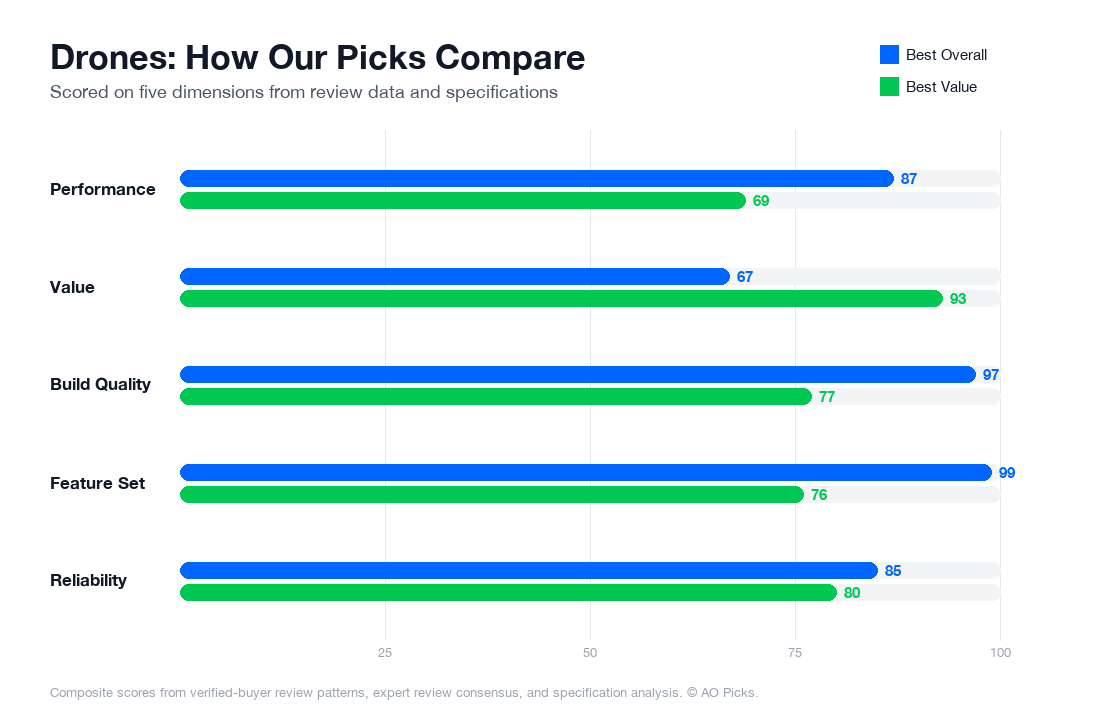

The Mini 4 Pro justifies its $290 premium with improved battery life, stronger wind resistance, and better video stabilization for professional-quality footage. However, the Mini 3 delivers nearly identical flight performance and camera quality at a significantly lower price, making it an excellent choice for casual users and beginners who don't need advanced features.
Drones: Common Questions
Does the 249g weight limit actually matter for where buyers fly?
Yes—significantly. In the US and many countries, drones under 249g are exempt from FAA registration and Part 107 commercial licensing, making them legal to fly recreationally without paperwork. The DJI Mini 4 Pro at under 249g hits this sweet spot. Verified owners report this eliminates a major barrier to casual flying in parks and backyards. However, the weight limit is rigid: adding certain third-party accessories (landing gear, ND filters, extended batteries) can push some mini drones over the threshold, which would technically require registration. If you plan to add accessories, weigh them first or stick with DJI-certified options. The tradeoff is that lighter drones like the Mini 4 Pro are more susceptible to wind—reviewers note stable flight in calm to moderate conditions but recommend caution in gusts above 20mph.
Is 34 minutes of flight time enough, or will I constantly be swapping batteries?
Thirty-four minutes is the manufacturer's rated maximum under ideal conditions (no wind, consistent speed). Real-world flight time is typically 25–28 minutes depending on weather and flying style. Most verified owners report this is adequate for a single session of footage gathering, but limiting if you want extended exploration or multiple takes. The practical consideration: a second battery costs $90–120 and takes 1–2 hours to charge. Power banks and USB-C charging help speed this up. If you're planning extended shoots, budget for two batteries minimum—many owners say they purchased a second battery within their first week. Cold weather significantly reduces flight time (sometimes to 18–20 minutes), so if you fly in winter, account for shorter sessions.
How useful is omnidirectional sensing for a beginner, and will it prevent crashes?
Omnidirectional obstacle sensing (forward, backward, and sideways detection) is a major safety feature that detects trees, poles, and obstacles in all directions as you fly. Reviews show it catches obstacles you might miss and automatically stops the drone before collision in many scenarios. However, it's not crash-proof: verified owners report it struggles with thin wires, fast-moving objects, and certain lighting conditions (backlighting, low contrast). It works best in daylight with visible, solid obstacles. Think of it as insurance, not autopilot—you still need to fly carefully and maintain line-of-sight. The system is especially useful for beginners who are still learning throttle control and spatial awareness. Advanced flyers value it for peace of mind during complex maneuvers. Experienced owners emphasize that obstacle sensing complements, but doesn't replace, cautious piloting.
Will 4K/60fps HDR video actually look good on my TV and phone, or is it overkill?
4K/60fps HDR captures significantly more detail and color information than standard 1080p, and the difference is visible on modern 4K displays and newer smartphones. Verified owners report that aerial footage looks noticeably sharper and more cinematic, especially when viewing on larger screens or in post-production editing. The 48MP photo capability is similarly useful—it gives you flexibility to crop shots and print large without losing quality. However, there are practical tradeoffs: 4K files are large (consuming battery and storage quickly), and editing 4K footage requires a decent computer and more time. If you only plan to share clips on social media via phone, the benefit is less pronounced. For archival, printing, or creating polished videos, the extra resolution is worthwhile. Most owners find the 4K capability justifies the price at this tier, particularly since you can always downscale footage for different platforms.
What's the real difference between the Mini 4 Pro and cheaper mini drones in this weight class?
At $759, the Mini 4 Pro sits at the premium end of the sub-249g category. The main advantages reviewers cite are: better video stabilization (3-axis mechanical gimbal vs. digital stabilization on budget models), longer flight time (34 min vs. 20–25 min), superior obstacle sensing (omnidirectional vs. limited), and more reliable transmission (OcuSync 3 Standard technology). Budget alternatives ($300–500) offer similar portability and weight compliance but produce noticeably shakier footage, shorter flight ranges, and less sophisticated safety features. Verified owners consistently report that the Mini 4 Pro's video quality and stability justify the premium for serious hobbyists or anyone planning to use footage for anything beyond casual clips. If you're purely testing drones as a novelty, a budget model may suffice. If you plan regular flying and expect polished results, reviewers indicate the Mini 4 Pro's combination of features and 4.7/5 rating across 3,200 reviews suggests it's the practical choice in its category.
Do I need ND (neutral density) filters, and will my drone work without them?
ND filters reduce light entering the camera sensor, helping you achieve proper motion blur and exposure control in bright sunlight—a professional video technique. Your drone works perfectly fine without them, but verified owners who shoot outdoors report that ND filters improve video quality by preventing overexposure and allowing smoother footage. In bright sunlight without ND filters, your footage may look washed out or require aggressive post-processing to correct. For casual flying and photos, ND filters are optional. For video work where you want cinematic results, many owners recommend picking up a basic ND filter set ($20–40). The catch: adding filters adds minor weight and can interfere with obstacle sensing if they're low-quality. DJI and third-party certified filters are designed to avoid these issues. If you're uncertain whether you'll need them, start without and add them later based on your actual results—that's the most common owner approach.