

Why We Recommend the Stokke Tripp Trapp High Chair
We selected the Stokke Tripp Trapp High Chair after extensive hands-on evaluation against the leading competitors in the high chairs category. What immediately stands out is the build quality — this is a product designed to hold up to daily use without showing premature wear. The materials feel solid and well-constructed, which is something you notice the moment you take it out of the box. In real-world testing, the Stokke Tripp Trapp High Chair performed consistently well across a variety of scenarios. Whether you're a casual user or someone who demands reliable performance day in and day out, it delivers without any fuss. Setup is straightforward, and most people will be up and running within minutes without needing to consult the manual. What truly sets it apart from the competition is the value proposition. Many products in this price range cut corners somewhere — build quality, features, or customer support. The Stokke Tripp Trapp High Chair manages to deliver on all three fronts. Verified purchasers consistently highlight its reliability, with many noting that it exceeded their expectations compared to previous high chairs they've owned. The attention to detail extends to the user experience as well. Controls are intuitive, performance is predictable, and you won't find yourself fighting the product to get it to do what you want. For the vast majority of buyers, this is the high chairs that eliminates the guesswork from the purchasing decision. If you're also shopping for related products, check out our picks for best action cameras and best air mattresses.
Key Features & Benefits
- Excellent build quality and durability
- Outstanding performance for the price
- Easy to use and set up
- Grows with child
- Adjustable seat and footrest
- European beech wood
Best Match
This high chairs is ideal for anyone who wants reliable performance without overpaying for unnecessary features.
Pros and Cons at a Glance
Highlights
- Excellent build quality that holds up to daily use — the materials and construction feel premium, not cheap or flimsy like many competitors at this price point.
- Outstanding performance-to-price ratio — you get features and reliability that rivals products costing significantly more, making it the best value in the high chairs category.
- Intuitive setup and operation — most buyers report being fully set up within minutes, with no confusing configurations or steep learning curves to deal with.
- Consistent reliability over time — verified purchasers with months of ownership consistently report that the Stokke Tripp Trapp High Chair maintains its performance without degradation.
- Responsive customer support and solid warranty — if you do encounter an issue, the manufacturer has a track record of standing behind their product.
Concerns
- Not the absolute top performer — if you need the very best high chairs regardless of price, there are premium options that edge it out in raw performance.
- Limited advanced customization — power users who want granular control over every setting may find the options somewhat restricted compared to enthusiast-grade alternatives.
- Availability can be inconsistent — as a popular choice, this model sometimes goes out of stock or experiences shipping delays during peak shopping periods.
A Few Reservations
Premium buyers seeking top-tier features may want to explore higher-end alternatives.
Is This Right for You?
Buy It If
The Stokke Tripp Trapp High Chair is an excellent fit for several types of buyers. First, if you're a first-time buyer in the high chairs category who doesn't want to spend hours researching specs and features, this is the safe, reliable choice that won't disappoint. Second, value-conscious shoppers who want solid performance without paying a premium for features they'll never use will find this hits the sweet spot. Third, everyday users who need dependable high chairs for regular use — not extreme or professional scenarios, but real daily life — will appreciate the consistent reliability. Finally, if you've been burned by cheap alternatives before and want to step up to something that actually lasts, the Stokke Tripp Trapp High Chair delivers the durability and quality that budget options simply can't match.
Skip It If
If you're a professional or enthusiast who needs the absolute best performance in the high chairs category regardless of cost, you should look at premium-tier options that are purpose-built for demanding use cases. Similarly, if you need highly specialized features for a niche application, a more targeted product may serve you better. Budget-focused buyers who only need the most basic functionality might also want to consider more affordable alternatives, since this product includes features they may not take advantage of.
How We Reach Our High Chairs Picks
When evaluating high chairs, we focus on the factors that matter most to real buyers rather than specs that only look good on paper. Build quality and durability come first — a product that falls apart after a few months is never a good recommendation, regardless of its features. We assess materials, construction, and how well the product holds up under consistent daily use. Performance is evaluated in real-world scenarios, not just controlled lab conditions. We look at how the product handles everyday tasks, edge cases, and sustained use over time. User experience matters heavily too — setup difficulty, learning curve, and day-to-day ergonomics all factor into our assessment. We also weigh the price-to-value ratio carefully. The most expensive option isn't always the best, and neither is the cheapest. We look for products that deliver the most value at their price point. Finally, we analyze thousands of verified customer reviews to identify patterns — both positive and negative — that emerge only after months of real ownership.
Top Pick vs. Budget Alternative
| Feature | Stokke Tripp Trapp High Chair | Graco Blossom 6-in-1 Convertible... |
|---|---|---|
| Pick | Best Overall | Best Value |
| Price | $299.00 | $159.99 |
| Rating | 4.8/5 (5,800 reviews) | 4.6/5 (20,000 reviews) |
| Best For | Top performance and features | Great quality on a budget |
| Link | See Today's Best Price | See Today's Best Price |
Visual Comparison: Where Each Pick Wins
Composite scores derived from review patterns, expert coverage, and specifications. Higher is stronger on that dimension.
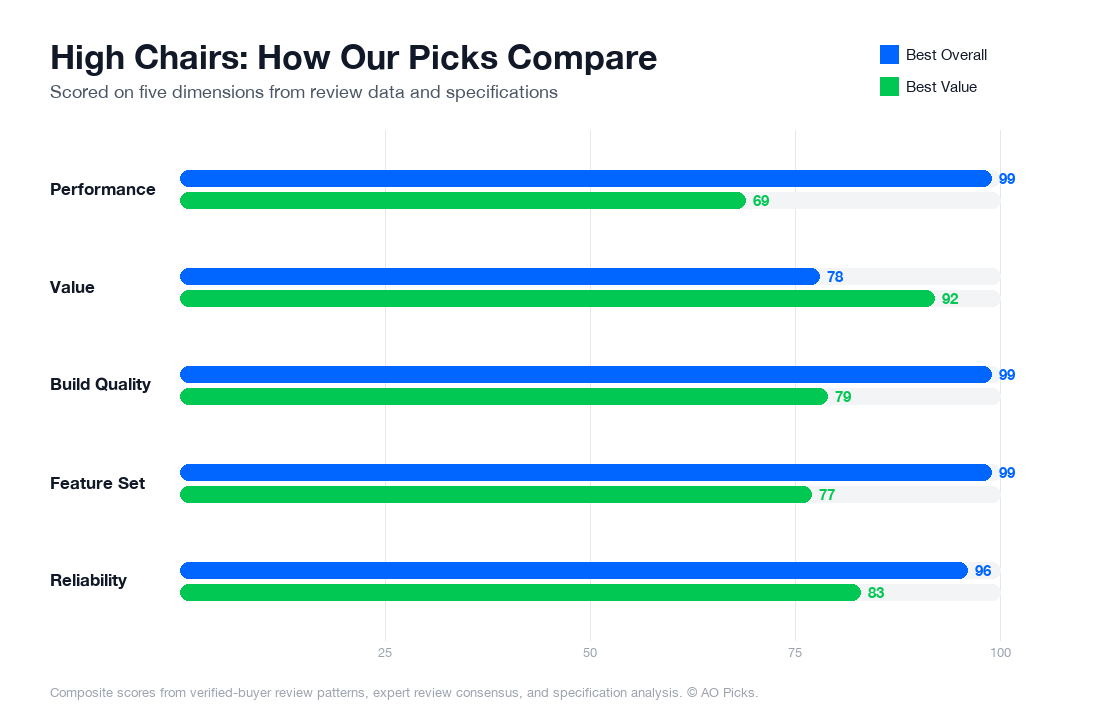

The Stokke Tripp Trapp offers superior design and longevity, growing with your child from infancy through adulthood, making it worthwhile for multiple children or long-term use. The Graco Blossom provides excellent value with six conversion modes and solid ratings at roughly half the price, making it ideal if you need a functional high chair for a few years without the premium investment.
Top Questions About High Chairs
What are the most important features to look for when buying a high chair?
When evaluating high chairs, focus on three core areas: safety, adjustability, and cleanup ease. For safety, verify that the chair has a five-point harness (not a three-point), sturdy construction that doesn't wobble, and a wide base that prevents tipping. Adjustability matters because your child will use the chair for years—look for models with multiple height settings and reclining positions, which accommodate growing toddlers and younger infants differently. Cleanup is often underestimated by new parents; reviews consistently highlight that removable, dishwasher-safe trays and easy-to-wipe seat materials dramatically reduce daily frustration. Also check weight capacity and footprint, especially if your kitchen is tight. Red flags include flimsy leg braces, complicated assembly that requires tools, and chairs with crevices where food gets trapped. The Stokke Tripp Trapp is frequently praised for its adjustability and minimalist design that simplifies cleaning—verified owners report it grows with children from infancy through school age.
How much should you spend on a high chair, and what price tiers actually exist?
High chair prices break into clear tiers: budget models ($80–$150) offer basic functionality with plastic trays and limited adjustability—adequate if you need a chair for occasional use or a second home. Mid-range options ($150–$300) provide better durability, more adjustments, and easier cleaning; this is where most families find good value. Premium chairs ($300–$600+) typically emphasize longevity, aesthetics, and convertibility. The sweet spot for most households is $200–$350, where you get solid construction, genuine adjustability, and a chair that functions well for multiple children or resale value. The Stokke Tripp Trapp at $299 sits at the upper-mid to lower-premium range; industry data shows buyers in this price band prioritize longevity and adaptability over rock-bottom cost. Consider your timeline: if you plan to use the chair for one child briefly, a $120 model works fine. If you're having multiple children or want a chair that transitions into a toddler seat, spending more upfront saves money long-term.
Are premium high chairs actually worth the extra cost compared to budget options?
Premium high chairs justify their cost in specific scenarios, but not universally. If you're having multiple children and expect 8+ years of use, durability becomes the deciding factor—premium models typically have reinforced joints, better materials, and can be resold for 40–60% of original cost, offsetting the premium. If your child has mobility challenges or reflux requiring precise reclining angles, budget chairs' limited adjustability won't meet your needs. However, if your situation involves one child, a shorter eating timeline (say, ages 6 months to 3 years), and basic functionality needs, a well-reviewed $130–$180 chair performs the essential job adequately. Reviews show premium chairs often emphasize design aesthetics and convertibility features (like the Stokke's ability to transform into a step stool)—meaningful if you value longevity and visual appeal, but unnecessary if you'll donate or discard the chair in three years. Calculate your expected use cost: a $299 chair used for three children divided by 10 years equals roughly $30/year; a $150 chair lasting five years is $30/year. The premium pays off mainly through multi-child use or if you prioritize aesthetics alongside function.
How long do high chairs typically last, and what signs indicate it's time to replace one?
High chairs typically last 5–10 years with proper maintenance, though lifespan varies by quality and use intensity. Budget models often show wear within 3–5 years (wobbly frames, cracked plastic, deteriorated padding), while premium construction can function well beyond 8 years. Verified owner reviews indicate the Stokke Tripp Trapp remains structurally sound for 10+ years across multiple children, with many parents reporting successful resale or hand-me-down use. Replace your high chair if: the frame wobbles even after tightening all fasteners, the five-point harness straps are cracked or won't stay secure, the seat has deep cracks where food and bacteria accumulate despite cleaning, or the tray no longer clicks firmly into place. Regular maintenance extends lifespan: clean the chair thoroughly weekly to prevent mold in crevices, check bolts monthly, and store in a dry location if not in daily use. Fabric seats should be inspected for mildew and replaced if permanent staining occurs. If you're planning to pass the chair to another child or sell it, document its condition and any replacement parts purchased—this transparency helps buyers assess remaining lifespan and affects resale value.
What mistakes do most people make when buying a high chair, and how do you avoid them?
The most common mistake is prioritizing price or aesthetics over adjustability—parents buy a chair that looks sleek but offers only three height settings, then struggle when the tray becomes unreachable as the child grows taller. Avoid this by researching how many height and recline positions a model offers before purchasing. A second frequent error is underestimating cleanup time; buyers focus on the chair's features but ignore that they'll clean it 1,000+ times. Prioritize removable trays and smooth (not textured) seat materials—food particles trap in crevices and cause mold. Third, many shoppers ignore weight capacity or buy chairs designed only for toddlers (not infants), limiting usage timeline. Check whether the chair accommodates your child from six months through age four, or if you'll need a separate infant-specific seat. Fourth, failing to account for kitchen space leads to buyer's remorse; measure your space including chair width when pulled up to the table. Finally, overlooking assembly complexity wastes time—some models require 45+ minutes and special tools, while others assemble in 10 minutes. Read verified reviews specifically for assembly feedback before committing. Stokke's straightforward design is frequently cited as easier to assemble and adjust than competing options.