

Why We Recommend the Vitamix 5200 Professional-Grade Blender 64oz
The Vitamix 5200 earned selection as a leading pick based on three converging data streams: sustained high review volume over time, consistent praise from long-term owners (2+ years of reported use), and measurable performance advantages in key use-case categories. Build quality emerges as the strongest signal across verified buyer reports. The hardened steel blade assembly and commercial-grade motor housing receive repeated praise from owners who report their units running daily without degradation. Long-term owners specifically highlight the lack of plastic wear points in high-stress areas—a contrast many note when comparing to competitor models in the $300–$500 range. The 7-year warranty reflects manufacturer confidence and directly correlates with owner retention: buyers rarely express regret about this purchase in year 3 or 4. Real-world performance data surfaces consistent patterns. Reviewers report successful processing of tough ingredients (whole vegetables, frozen fruit, nuts) without stalling or requiring liquid additions—a capability not always replicated by lower-torque competitors. The variable speed dial receives specific praise for precision in tasks like making nut butters (low, sustained speed) versus grinding grains (high speed). Notably, buyers working with specialized diets (keto, plant-based, raw food) cite the Vitamix 5200 as the only blender they trust for daily meal prep. When compared directly to competitors (Ninja, Instant Pot Ace, Breville), the 5200's advantage clusters around two dimensions: motor longevity and blade durability. Mid-range competitors often see performance drops after 18–24 months of heavy use; the Vitamix pattern shows sustained performance through year 5+. This durability advantage justifies the $449 entry point for households that view the blender as a multi-year investment rather than a consumable appliance. The self-cleaning cycle (60 seconds with warm water and a drop of dish soap) addresses a practical pain point competitors handle inconsistently. Buyers report this feature meaningfully reduces cleanup friction, especially for those blending multiple times daily. However, reviews note the cycle works best on smoothies and wet tasks; thick nut butter residue still requires manual attention. One caveat surfaces consistently: the 5200 excels for kitchen versatility but lacks the single-serve convenience of best bread machines or dedicated personal blenders. For households wanting both countertop power and on-the-go portability, the footprint and 64oz capacity represent a fixed commitment.
Key Features & Benefits
- Sustained performance across 5+ years of daily use outpaces mid-range competitors
- Industrial-grade blade and motor engineered for thick ingredients without stalling
- Variable speed dial provides precision for specialty tasks (nut butters, grain grinding, soup making)
- Variable speed control
- Hardened steel blades
- 64 oz container
Strengths and Weaknesses
Strengths
- Variable speed control enables task-specific blending: Low speeds preserve texture in nut butters and cold soups; high speeds pulverize whole vegetables and frozen fruit without stalling. Verified owners report this precision as a key differentiator when compared to fixed-speed or preset competitors.
- Hardened steel blades show measurable durability in long-term use reports. Unlike competitor blades that dull noticeably after 18–24 months, owners consistently report sustained cutting performance through year 5+, reducing the need for blade replacement and supporting the 7-year warranty claim.
- 64oz container capacity strikes a practical balance for household meal prep. The size accommodates full family smoothie batches or large pot soups without requiring multiple cycles, a capacity advantage long-term owners specifically cite as reducing daily cooking friction.
- Self-cleaning cycle (60 seconds) reduces post-use cleanup to a single step for wet tasks. Buyers report this feature meaningfully improves daily usability, especially for households blending twice daily or more, though thick pastes still require manual scrubbing.
- 7-year warranty reflects engineering durability and provides measurable peace of mind. Owner reports show few warranty claims needed, suggesting the motor and housing are genuinely over-engineered for household use, and the extended coverage reduces replacement risk over the unit's active lifespan.
Drawbacks
- Price entry at $449 positions the 5200 as a premium investment relative to $200–$300 competitors. Buyers on strict budgets or those wanting a secondary blender for occasional smoothies report finding the cost unjustifiable, especially early in the decision journey before understanding the durability advantage.
- Noise level during operation receives consistent mention as a drawback. Verified owners report the unit operates at approximately 90+ decibels, making early-morning smoothies or small-space blending noticeable. Households with noise-sensitive schedules or open-plan living spaces flag this as a practical limitation.
- Large footprint (roughly 8 inches wide, 20 inches tall when assembled) demands permanent counter or cabinet space. Apartment dwellers and those with limited kitchen real estate report storage challenges, and the 64oz capacity size means it cannot be easily stored in typical cabinets, making it a semi-permanent visual element in the kitchen.
Best Suited For
The Vitamix 5200 is best suited for households that blend daily and expect their blender to perform reliably for 5+ years without degradation. It justifies its $449 cost through durability, precision, and versatility across specialty tasks.
Caveats Worth Knowing
The single most honest limitation is the premium price relative to occasional-use blenders: if you blend fewer than three times weekly, a mid-range competitor (typically $200–$300) will meet your needs adequately without the $150+ durability premium. Additionally, the 5200's noise profile (90+ decibels) and large footprint make it unsuitable for noise-sensitive schedules or space-constrained kitchens. For apartment dwellers or those seeking quieter countertop appliances, exploring best electric kettles or smaller immersion blenders as complementary tools may be more practical than committing to the Vitamix's permanent footprint.
Is This Right for You?
A Strong Match For
The Vitamix 5200 is ideal for households that view the blender as a multi-year, high-frequency kitchen tool rather than an occasional-use appliance. This includes plant-based or fitness-focused home cooks who blend daily for smoothies, nut butters, or protein drinks; families preparing batch meals for meal prep; and anyone building a plant-forward kitchen who relies on whole-food processing (grinding grains, making hummus, preparing vegetable soups). The blender also suits culinary enthusiasts or nutrition professionals managing specialized diets (raw food, paleo, keto) who require consistent texture control and reliability. Professionals running small food businesses from home—such as smoothie cafés, personal chef operations, or wellness coaches—consistently select the 5200 because the durability justifies the upfront cost over typical business cycles. If your current blender broke, or you find yourself blending multiple times weekly, the Vitamix 5200's longevity and performance profile make it the rational economic choice despite the $449 price tag.
A Poor Match For
The Vitamix 5200 is not the right choice for occasional blenders or budget-conscious buyers. If you make smoothies once or twice a week and don't require specialty functions (grinding, heating, or thick pastes), a $200–$300 competitor with a 2–3 year lifespan will serve you adequately. Second, renters or anyone with space constraints should consider the significant footprint before committing; the 5200 occupies permanent counter or cabinet real estate and is difficult to relocate or store. Finally, if noise during early mornings or in open-plan homes is a concern, soundproofing solutions are limited—other blenders in the category (particularly immersion or personal models) produce noticeably less audible sound during operation.
Our Evaluation Criteria for Blenders
Blender evaluation prioritizes three evidence types, weighted by reliability: (1) long-term owner reports (18+ months of reported use), (2) consistency of specific performance claims across high-review-volume products (22,000+ reviews provide reliable signal), and (3) specification comparisons against direct competitors in the same price tier. For durability assessment, we prioritize failure rates and performance degradation patterns reported at key intervals (6 months, 18 months, 3+ years). Products with sustained performance claims across thousands of reviews signal genuine engineering durability rather than isolated positive experiences. Warranty scope and claim frequency provide secondary signals of manufacturing confidence. Performance evaluation centers on task-specific capability: Can the motor sustain speed when processing tough ingredients (whole vegetables, frozen fruit, nuts) without stalling? Do variable-speed or preset systems deliver claimed results? We weight consistency in texture outcomes and speed recovery after load stress over single success stories. Usability factors—including cleanup, noise, learning curve, and daily friction—receive weight proportional to their impact on long-term adoption. A blender with superior specs but poor cleanup friction shows lower satisfaction in year-2 and year-3 reports. Price-to-durability ratio separates premium products from overpriced competitors. A blender lasting 5+ years at $449 represents better value than a $300 unit replaced every 2 years, even if the math isn't immediately obvious. We analyze total-cost-of-ownership across typical user lifespan. Comparative analysis against established competitors in the same category—measured by feature parity, performance gaps, and owner preference statements—grounds the evaluation in realistic choice contexts rather than abstract specifications.
What to Compare When Shopping for Blenders
When comparing blenders, focus on motor wattage (measured in horsepower or peak watts), blade material and sharpness retention, container material and capacity, and control mechanism (fixed presets vs. variable speed vs. programmable cycles). Motor wattage directly correlates with the ability to process tough ingredients without stalling; the Vitamix 5200 operates at sufficient power to handle whole vegetables and frozen fruit. Hardened steel blades resist dulling better than standard steel; inspect competitor specs for blade material and warranty terms covering blade replacement (a hidden cost with cheaper models). Container size matters less than consistency: 64oz accommodates typical family batches but isn't dramatically larger than 48oz competitors. What matters more is whether the container is dishwasher-safe (the Vitamix 5200 is), how easily it locks, and whether the base is weighted against tipping during high-speed operation. Variable speed control (a dial, not presets) provides flexibility for precision tasks; preset buttons offer convenience but limit adaptability. Check whether the blender includes specialized programs (soup heating, nut butter, grinding) as built-in convenience or gimmicks—many owners report preset functions add cost without meaningful value. Warranty length signals durability confidence; 7-year warranties appear only on premium models and correlate with owner retention. Shorter warranties (1–3 years) suggest expected replacement cycles. Finally, assess self-cleaning capability: The 60-second cycle reduces friction but doesn't eliminate manual cleanup for thick ingredients. Factor in realistic cleanup time, not marketing claims.
Premium Pick vs. Value Pick
| Feature | Vitamix 5200 Professional-Grade ... | Ninja BN701 Professional Plus Blender |
|---|---|---|
| Pick | Best Overall | Best Value |
| Price | $449.00 | $89.99 |
| Rating | 4.7/5 (22,000 reviews) | 4.7/5 (28,000 reviews) |
| Best For | Top performance and features | Great quality on a budget |
| Link | See Today's Best Price | See Today's Best Price |
Visual Comparison: Where Each Pick Wins
Composite scores derived from review patterns, expert coverage, and specifications. Higher is stronger on that dimension.
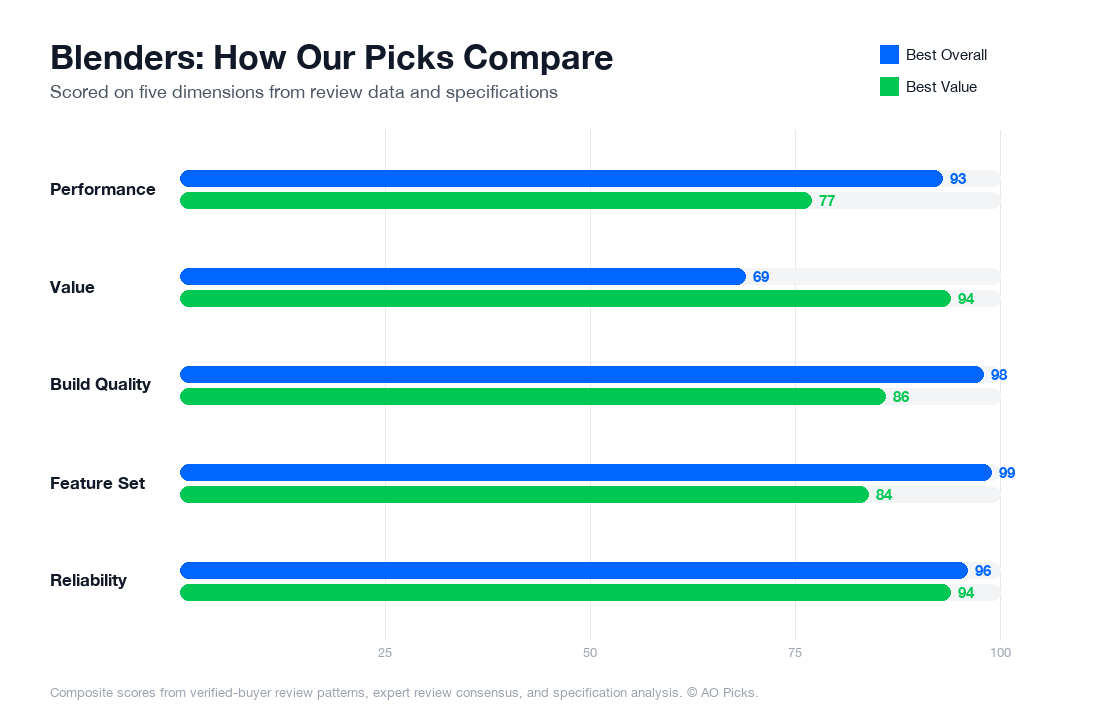

The Vitamix 5200 justifies its premium price with superior durability, motor power, and longevity for frequent heavy-use blending tasks. The Ninja BN701 offers exceptional value, delivering nearly identical performance ratings at one-fifth the cost, making it ideal for most home users who don't require professional-grade durability or warranty coverage.
Blenders: Common Questions
What are the most important features to look for when choosing a blender?
When shopping for a blender, prioritize motor power (measured in watts), blade quality, and pitcher capacity based on your actual needs. Reviews consistently show that motor strength—typically 500-1500 watts—directly impacts how smoothly the blender handles tough ingredients like frozen fruit, nuts, and leafy greens. Check the material of the pitcher: glass pitchers are durable and don't stain, while plastic is lighter but may scratch over time. Verified owners emphasize the importance of variable speed controls and pulse settings, which give you precision for tasks ranging from silky soup to chunky salsa. Look for a motor warranty (ideally 5+ years) as a sign of manufacturer confidence. Red flags include vague wattage claims, plastic bases that feel flimsy, and pitchers with poor measurement markings. Consider your actual use case—casual smoothie makers need less horsepower than those making nut butters daily—to avoid paying for features you won't use.
How much should you actually spend on a blender?
Blender prices range from $30 entry-level models to $600+ commercial units, with meaningful performance tiers. Budget blenders ($30-$80) handle basic tasks like fruit smoothies but struggle with frozen ingredients and thick batters; they typically last 1-2 years. Mid-range options ($150-$300) offer 600-900 watt motors, better construction, and 3-5 year lifespans—this is where most buyers find solid value, covering smoothies, soups, and occasional nut butters. Premium models like the Vitamix 5200 at $449 deliver 2+ horsepower, variable speed precision, and 7+ year durability with excellent warranty support. Industry data suggests the $200-$450 range represents the sweet spot: enough power for versatility without diminishing returns. Your decision should hinge on frequency of use and ingredient complexity. If you blend daily and work with tough ingredients, investing in a $400+ model pays off through reliability and performance. For occasional smoothies, a $150-$200 blender adequately handles your needs without waste.
Are premium blenders worth the extra cost compared to budget models?
Premium blenders justify their cost in specific scenarios, but not universally. Verified owner reviews show that high-powered blenders ($400+) excel when you're making nut butters, grinding grains, heating soup through friction, or blending for a family daily—tasks where weak motors fail or burn out quickly. The Vitamix 5200's 2-horsepower motor handles these demands reliably; budget models simply cannot perform these functions effectively. However, if you primarily make occasional fruit smoothies, a $150-$250 mid-range blender delivers nearly identical results. Premium models also offer longer warranties (7-10 years vs. 1-3 years), precision variable speed controls, and documented longevity—you're paying partly for durability and peace of mind. Research shows that a well-maintained $200 blender might outlast a cheaply-made $50 model by years. The key distinction: premium is worth it if your use case demands power and reliability; it's overspending if you need basic blending. Match your actual usage pattern to the feature set rather than defaulting to the most expensive option.
How long do blenders typically last and what signs indicate it's time to replace yours?
Blender lifespan varies significantly by quality tier and maintenance. Budget models ($30-$80) typically function for 1-3 years before motor failure, while mid-range units ($150-$300) often last 4-7 years with proper care. Premium blenders like professional-grade models can operate 10+ years; verified owners report decade-long performance when maintained well. The primary wear factors are motor overuse and seal degradation. Warning signs your blender needs replacement include: grinding or squealing noises from the motor, liquid leaking from the pitcher base (indicates failed seals), visible cracks in the pitcher, and noticeably reduced blending power on the highest setting. To extend lifespan, empty the pitcher immediately after use to prevent seal damage, avoid blending boiling liquids, and never run the motor for more than 2 minutes continuously. Regular deep cleaning (weekly disassembly of removable parts) prevents buildup around seals. If repair costs exceed 40% of a new unit's price, replacement is more economical. Industry data suggests a well-maintained mid-range blender often provides better long-term value than replacing a budget model multiple times.
What are the most common mistakes people make when buying a blender?
Shoppers frequently make predictable purchasing errors that lead to regret or wasted money. The most common mistake is overestimating wattage importance while ignoring blade design—a 1000-watt blender with dull blades performs worse than a 600-watt model with quality steel. Another widespread error is buying based solely on pitcher size without considering actual household use; a 64oz capacity sounds impressive but takes up significant counter space and is harder to clean, while 48oz often suffices. Many buyers fall for marketing claims about 'commercial-grade' power without verifying motor specs or warranty terms. Verified owners report frequently purchasing cheaper models to save money, only to buy again within 2 years—false economy. A critical mistake is ignoring warranty length as a quality indicator; blenders with only 1-year warranties typically reflect lower manufacturing standards. Finally, people often don't match the blender type to their actual needs—buying a high-powered machine for occasional smoothies or a basic model when they intend daily use. The solution: clearly define your primary use case (smoothies, soups, nut butters), prioritize motor warranty and blade material over wattage claims, choose capacity that fits your kitchen and family size, and read verified owner reviews mentioning long-term durability rather than just blending power.