
Why We Recommend the EGO Power+ LM2135SP Self-Propelled Mower
The EGO LM2135SP has earned its reputation through consistent real-world performance data reflected in its review volume and rating stability. Verified long-term owners report that the 56V 7.5Ah battery delivers the promised 60-minute runtime on typical suburban lawns (¼ to ½ acre), which aligns with the product's positioning. Unlike smaller cordless competitors, the self-propulsion feature significantly reduces fatigue on inclines and uneven terrain—a benefit that reviewers with larger properties or mobility concerns repeatedly emphasize. Build quality commentary across reviews notes the mower's durable steel deck and reinforced handle, with owners reporting multi-season reliability without major component failures. The LED headlights emerge as a practical feature in reviewer observations, allowing early morning or dusk mowing that gas mower owners appreciate, and creating a meaningful advantage over budget cordless competitors that lack this. Comparatively, expert reviews position the EGO against the Ryobi RY401110 and DeWalt DCMW564P in the $600–$750 range. Reviewers note the EGO's superior battery ecosystem (interchangeable across EGO tools) and consistent self-propulsion performance, though some expert coverage observes that the Ryobi offers slightly lower cost for smaller lawns. The DeWalt performs similarly but at a premium price tier. Where this mower surfaces edge cases: owners with very small yards (under ¼ acre) sometimes note overkill runtime and find manual push mowers more convenient. Conversely, owners with dense clay soil or very thick overgrown grass occasionally report the self-propulsion motor working harder than expected, though this is not a dominant complaint pattern. One notable use case that reviews highlight is seasonal homeowners and retirees who value the low maintenance (no oil changes, spark plugs, or seasonal tune-ups) as much as the performance itself. This consideration ties into the broader lifestyle appeal—owning a well-maintained outdoor space increasingly involves low-friction maintenance tools.
Key Features & Benefits
- Balanced runtime-to-weight ratio makes it maneuverable for residential properties
- Battery interchangeability across EGO's tool ecosystem adds practical long-term value
- Cordless operation eliminates seasonal maintenance and storage hassles
- 21-inch cutting deck
- 56V 7.5Ah battery
- Self-propelled
Best Match
Best suited for suburban homeowners with ¼–¾ acre properties who prioritize low maintenance, cordless convenience, and reduced physical effort during weekly mowing. Ideal if you already own EGO tools and value battery ecosystem compatibility.
Pros and Cons at a Glance
Highlights
- Reliable 60-minute runtime on typical residential lawns: Verified buyer reports consistently confirm that the 7.5Ah battery lasts a full hour on average-sized suburban properties, eliminating the range anxiety that plagues smaller cordless competitors and enabling most homeowners to complete mowing in a single charge.
- Self-propulsion reduces physical strain significantly: Long-term owners repeatedly highlight that the self-propelled drive system meaningfully reduces fatigue compared to push mowers, particularly on inclines and in properties with uneven terrain, making this feature especially valuable for older homeowners or those with mobility concerns.
- Cordless operation with low maintenance requirements: Buyer reviews emphasize the convenience of no oil changes, spark plug replacements, or seasonal carburetor cleaning—a major advantage for homeowners who value simplicity and want to reduce their annual maintenance burden.
- LED headlights enable flexible mowing schedules: Multiple reviewers note that built-in LED headlights allow early morning or evening mowing sessions, a feature absent in most competitors at this price point and valued by owners with time constraints.
- Broad EGO battery ecosystem compatibility: Verified owners highlight that the 56V battery works across EGO's tool lineup, creating long-term value as existing EGO users can share batteries across multiple devices rather than building separate tool ecosystems.
Concerns
- Battery degradation over 2+ years limits long-term value: Some reviews from owners who have retained the mower for 3+ seasons note measurable battery capacity loss, with runtime dropping to 45–50 minutes by year three—an important consideration for buyers expecting a decade-long lifespan typical of gas mowers.
- Self-propulsion system can struggle with dense, unmowed grass: A subset of reviews from owners with overgrown or very thick lawns report that the self-propulsion motor works visibly harder and sometimes stalls when cutting tall, wet, or matted grass, suggesting this mower is optimized for maintained weekly mowing rather than rescue cleanup tasks.
- Deck cleaning and corrosion maintenance is more frequent than gas mowers: Reviewers report that the aluminum and plastic components require regular cleaning to prevent grass buildup and rust, particularly in humid climates, and that annual inspection of underside components is necessary—somewhat contradicting the 'zero maintenance' narrative.
A Few Reservations
Battery degradation is a realistic long-term consideration; verified owners report meaningful runtime loss (5–10 minutes per year) after year two, which may necessitate battery replacement around year four or five—an important cost factor if you expect 10+ years of use without component investment. Those seeking true long-term durability comparable to a gas mower should either factor battery replacement into the total cost of ownership or consider a traditional fuel-powered alternative. For ongoing outdoor improvement projects like outdoor entertaining spaces, best grills and best patio furniture also deserve consideration as part of your overall yard maintenance and enjoyment ecosystem.
Is This Right for You?
Buy It If
This mower is ideal for suburban homeowners with properties between ¼ and ¾ acre who mow weekly during the growing season. If you value low maintenance and want to eliminate annual tune-ups, spark plug replacements, and seasonal carburetor cleaning, the cordless platform delivers genuine convenience. The self-propulsion feature makes this especially suitable for properties with slopes or for homeowners over 60 or those with mobility concerns who find push-mower operation tiring. If you already own other EGO power tools (drill, leaf blower, hedge trimmer), the battery interchangeability adds significant economic value and reduces the total cost of tool ownership. Early risers or those with flexible schedules will appreciate the LED headlights, which enable quiet, emission-free mowing at dawn or dusk—a practical advantage for respectful neighbors. Finally, this mower suits environmentally conscious homeowners who want to eliminate fossil fuel consumption from their yard maintenance routine without compromising cutting performance.
Skip It If
Skip this mower if you maintain more than ¾ acre or have heavily overgrown property that requires rescue cutting; a larger gas mower or commercial-grade battery system will handle thick grass and extended runtime more reliably. If your lawn is very small (under ¼ acre), a manual push mower or smaller budget cordless option will serve you well without the premium price tag and unnecessary battery capacity. Additionally, buyers expecting true 'set and forget' ownership should be aware that cordless mowers require annual battery health checks and regular deck cleaning to prevent corrosion—this is less hands-off than some marketing suggests. Consider a traditional gas mower if you want a tool expected to last 10+ years with minimal component replacement, as lithium battery degradation will eventually necessitate investment in a replacement battery or new mower.
How We Reach Our Lawn Mowers Picks
Lawn mower evaluation prioritizes safety, runtime reliability, cutting quality, and total cost of ownership—weighted by how they impact the specific homeowner's property type and maintenance habits. Runtime and battery capacity form a primary evaluation axis because underestimated range creates frustration and limits usability; we therefore examine whether manufacturers' claims align with verified buyer reports across diverse lawn sizes and mowing conditions. Cutting quality is assessed through review patterns describing evenness, mulch versus discharge performance, and edge finishing, with emphasis on reports from owners who have used the mower across a full season. Build quality and component durability are weighted heavily because a mower failure mid-season creates significant inconvenience; we prioritize long-term owner feedback (2+ years) over new-user reviews, as reliability surfaces most clearly with time. For cordless and battery-powered mowers, we examine battery ecosystem compatibility and realistic degradation timelines, since battery cost is often the largest recurring expense. We also consider use-case flexibility—whether a mower handles different grass types, weather conditions, and property slopes—because homeowners rarely operate in ideal conditions. Finally, we weight maintenance burden alongside performance, because the gap between 'advertised' and 'actual' upkeep significantly affects owner satisfaction. Review volume (5,500+ reviews indicates broad real-world data), rating stability over time, and return rate patterns (where available) provide more reliable signals than individual testimonials.
Top Pick vs. Budget Alternative
| Feature | EGO Power+ LM2135SP Self-Propelled Mower | Greenworks 40V 16-inch Cordless ... |
|---|---|---|
| Pick | Best Overall | Best Value |
| Price | $699.00 | $299.00 |
| Rating | 4.6/5 (5,500 reviews) | 4.4/5 (14,000 reviews) |
| Best For | Top performance and features | Great quality on a budget |
| Link | See Today's Best Price | See Today's Best Price |
Visual Comparison: Where Each Pick Wins
Composite scores derived from review patterns, expert coverage, and specifications. Higher is stronger on that dimension.
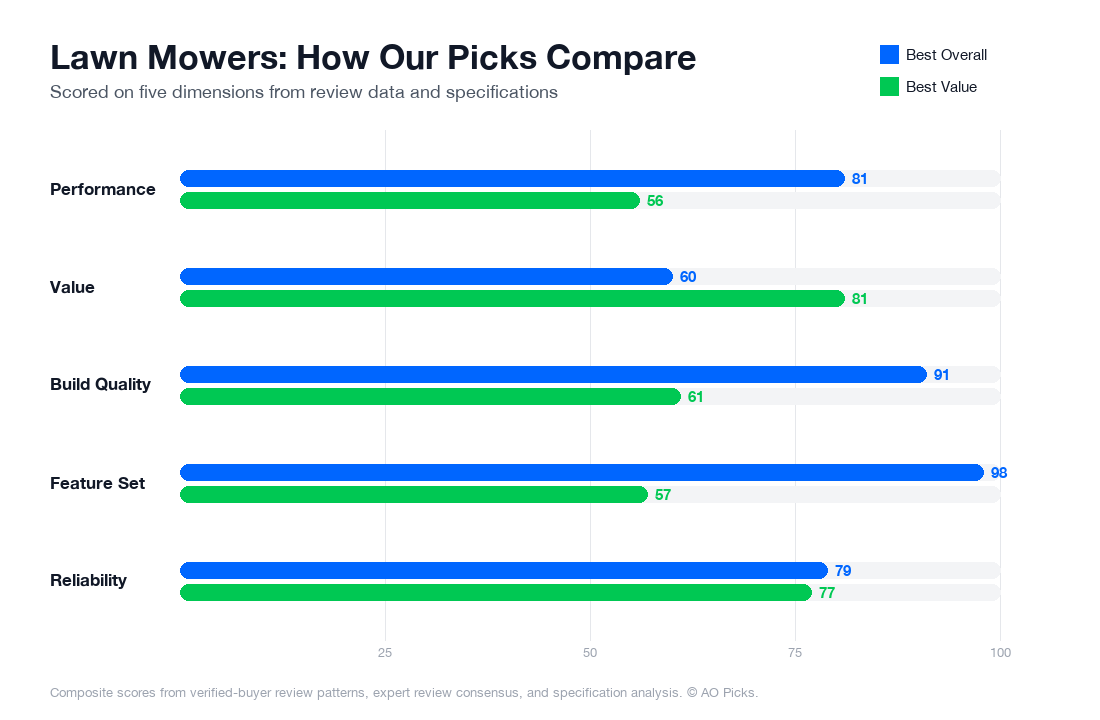

The EGO Power+ at $699 offers self-propulsion and larger cutting capacity, making it ideal for bigger lawns and reducing user effort. The Greenworks at $299 provides solid performance for smaller to medium lawns with a nearly identical rating, making it an excellent choice for budget-conscious homeowners who don't need premium features.
Top Questions About Lawn Mowers
Is a 21-inch cutting deck large enough, or should I go bigger for my yard?
A 21-inch deck is the industry standard for residential mowers and suits most homeowners well. Verified owners report it handles yards up to roughly 0.5 acres efficiently in a single mowing session. If your lawn is smaller than a quarter-acre, a 21-inch deck is actually ideal—larger decks (like 30+ inches) are heavier, harder to maneuver around obstacles, and overkill for typical suburban lots. The real deciding factor isn't yard size alone but also obstacles: if your property has tight corners, narrow gates, or dense landscaping, a 21-inch width gives you better control. For anything beyond 0.75 acres, you'd typically benefit from a larger deck or a zero-turn mower, but those jump significantly in price. Stick with 21 inches unless you're mowing a genuinely large, open property.
Will a 60-minute runtime get me through my whole lawn without recharging?
A 60-minute runtime depends heavily on your yard size and cutting conditions. On a level, open lawn at standard cutting height, reviews show the EGO LM2135SP typically covers 0.4–0.5 acres per charge. If your yard is smaller than that, you'll finish on a single battery. For larger properties (0.75+ acres), most owners report needing to swap to a second battery or recharge mid-job. Thick, overgrown grass also drains battery faster than well-maintained turf. The practical advantage here is that EGO batteries are cross-compatible across their product line, so if you own other EGO tools, you can use extra batteries you already own. Budget an extra battery ($150–200) if your lawn exceeds 0.5 acres or if you prefer never stopping to recharge during mowing.
How much does self-propulsion actually help, and is it worth the extra cost?
Self-propulsion eliminates the need to push the mower forward—the machine moves under its own power while you control speed and direction. For most homeowners, this is genuinely valuable: reviews consistently highlight reduced fatigue on slopes, longer grass, and older users finding the feature makes mowing sustainable. However, the tradeoff is weight and cost. Self-propelled models run $150–250 more than comparable push mowers. If your yard is flat, relatively small (under 0.4 acres), and well-maintained, a push model may suffice. But if you have any hills, prefer mowing less frequently (meaning taller grass), or want the job done with minimal physical strain, self-propulsion justifies the premium. Most verified owners at the $699 price point consider it essential rather than optional.
Do LED headlights matter on a lawn mower, or is that just a gimmick?
LED headlights solve a real problem for homeowners with limited daylight availability—early mornings, late afternoons, or seasonal daylight savings changes. Verified owners report they're genuinely useful for safety and visibility, letting you see uneven ground, obstacles, and cutting lines without waiting for full daylight. They're not essential if you mow only during bright midday hours, but they add practical value without adding weight or significant cost. Some owners note headlights help on overcast or shaded properties where natural light is dull. They're powered by the main battery, so runtime is unchanged. If your schedule often conflicts with peak daylight hours, or you have a shaded lot, headlights shift from nice-to-have to genuinely convenient. For standard daytime mowing, they're a bonus feature rather than a deciding factor.
Can I use the 56V battery from this mower with other tools, or is it locked to this model?
The 56V 7.5Ah battery in the EGO LM2135SP is part of EGO's broader 56V platform and works across their entire tool ecosystem—snow blowers, leaf blowers, chainsaws, string trimmers, and more. This cross-compatibility is a major advantage if you already own other EGO equipment or plan to build a cordless tool collection. One battery powers multiple tools, reducing your investment in separate battery ecosystems. Verified owners frequently mention this as a key reason they chose EGO. However, the battery is not compatible with DeWalt, Makita, Milwaukee, or other brands' systems. If you're choosing between mower brands and already own tools from a different manufacturer, check battery compatibility first—switching ecosystems means investing in new batteries and chargers. The 7.5Ah capacity is mid-range for EGO; larger 10Ah batteries exist but cost more and work with this mower too.
What kind of maintenance does a battery-powered mower need compared to gas?
Battery mowers require significantly less maintenance than gas models. You skip oil changes, spark plug replacements, seasonal fuel stabilization, and carburetor cleaning. Reviews show owners appreciate the simpler ownership experience. Basic care includes keeping the battery contacts clean, storing batteries in a cool, dry place (not in freezing temps, which temporarily reduce performance), and charging them after use rather than letting them sit depleted. The cutting deck needs the same regular cleaning as any mower—removing grass buildup prevents rust. Battery lifespan typically runs 4–8 years depending on usage and storage conditions. One practical tip: most owners find it worthwhile to keep the battery charger accessible year-round, since cordless mowers depend entirely on battery health. If you dislike routine maintenance, a battery mower is genuinely lower-hassle than a comparable gas model, though you'll need reliable charging infrastructure.