
Why We Recommend the Epson Home Cinema 5050UB 4K PRO-UHD Projector
The Epson 5050UB earned its position as a leading pick through a combination of verified owner satisfaction and professional recognition that reflects careful engineering rather than marketing hype. The 4K PRO-UHD enhancement technology represents Epson's approach to 4K content, using sophisticated upscaling and frame interpolation rather than native 4K pixel counts—a distinction that matters enormously in practice. Verified buyers consistently report that this distinction disappears in real viewing conditions, particularly in darkened home theater rooms where the 2,600 lumens brightness proves sufficient for larger screens (100+ inches) without requiring extraordinary light control. The 3-chip DLP architecture is the critical hardware differentiator that shows up across long-term owner reviews; unlike single-chip competitors, this design maintains stronger color separation and contrast performance across the brightness range, which reviewers note becomes most visible when switching between darker and lighter scenes. Build quality feedback clusters around the motorized lens system, which buyers report adds meaningful value for installations where projector placement flexibility matters. Expert reviews highlight this as a practical advantage for people fitting a projector into existing room layouts rather than designing a dedicated theater from scratch. Comparative reviews consistently position the 5050UB against the JVC DLA-NX5 and Sony VPL-FHZ70, with the main trade-off being brightness versus contrast extremes—the Epson trades some absolute black depth for superior all-around usability in less-than-ideal light conditions. The limitation most frequently cited in longer ownership reports concerns setup complexity; the motorized lens and keystone correction features require careful calibration, and reviews from less technically-oriented buyers indicate a steeper learning curve than plug-and-play alternatives. Buyers setting up home theater environments with dedicated seating arrangements and light control appreciate the investment in precision, while those seeking simpler installation often gravitate elsewhere. For context, if your setup resembles a traditional media room with controlled lighting and fixed seating, this complexity becomes an asset rather than a drawback. Interestingly, owner reviews also surface the value of the HDR10 support in gaming contexts; when paired with appropriate best gaming chairs and sound systems, the projector's color handling and brightness stability across HDR content shows minimal flicker or color shift that affects sustained viewing comfort during long sessions.
Key Features & Benefits
- 3-chip DLP architecture provides superior color performance and contrast stability across brightness levels
- 2,600 lumens brightness balances portability with sufficient output for 100–130 inch screens in controlled environments
- Motorized lens enables flexible installation without manual refocusing between sessions
- 4K PRO-UHD enhancement
- 2,600 lumens brightness
- HDR10 support
Strengths and Weaknesses
Strengths
- 3-chip DLP technology delivers superior color separation and contrast consistency compared to single-chip competitors, which reviewers report becomes most noticeable during scene transitions and when viewing content with rich color gradients. This engineering choice directly addresses a common complaint about budget projectors that lose color fidelity at higher brightness levels.
- 2,600 lumens brightness proves sufficient for larger screens (100–130 inches) in rooms with moderate light control, allowing buyers to avoid the premium pricing tier while maintaining image quality that reviewers consistently describe as cinema-like in properly configured spaces. Verified owners highlight this as the sweetspot for balancing portability and performance.
- Motorized lens with precise focus and zoom adjustment eliminates the friction of manual refocusing and repositioning, which long-term owners report becomes especially valuable if the projector shares mounting space with other equipment or if room usage varies. Reviewers note this feature distinguishes the 5050UB in multi-purpose spaces.
- HDR10 support with appropriate tone mapping ensures that modern streaming and gaming content displays with intended dynamic range rather than crushing highlights or losing shadow detail, which verified buyers report as particularly important for services like Netflix 4K and gaming libraries. This addresses a generational gap where older projectors struggle with HDR-encoded content.
- 4.6/5 rating across 2,000+ reviews reflects broad user satisfaction beyond enthusiast circles, with return rates and long-term ownership satisfaction reports suggesting the projector holds up well to sustained use. This consensus rating provides stronger confidence than smaller sample sizes or professional opinions alone.
Drawbacks
- Setup complexity and calibration requirements deter buyers seeking plug-and-play simplicity; the motorized lens, keystone correction, and color/contrast optimization all demand methodical adjustment, and reviews from non-technical users indicate this can consume 4–6 hours of initial configuration. Buyers with limited patience for detailed setup should consider alternatives or budget for professional installation.
- Price point at $2,999.99 places it above budget-conscious category entrants ($800–1,500) but below the JVC and Sony competitors that offer marginal improvements in absolute contrast at $4,000–6,000. Reviews suggest you're paying a premium for color accuracy and brightness balance rather than chasing peak specifications.
- Native resolution limitations in the 4K space mean the projector relies on upscaling and frame interpolation rather than true native 4K pixel density, which a subset of specification-focused reviewers note as a theoretical trade-off. In practice, verified long-term owners rarely cite this as a functional limitation in real viewing, but buyers comparing spreadsheets rather than images may feel misled by the '4K PRO-UHD' marketing language.
Best Suited For
The ideal buyer is a home theater enthusiast building a dedicated or semi-dedicated theater space who values proven, broad-consensus reliability and wants a balance between 4K capability, practical brightness, and setup precision. If you're comparing mid-premium projectors and want strong evidence of real-world satisfaction rather than chasing marginal specification improvements, the 5050UB's 4.6/5 rating and 2,000+ verified reviews provide that signal.
Caveats Worth Knowing
The most honest limitation is that this projector assumes a baseline level of technical comfort and time investment for optimal setup; the motorized lens, keystone correction, and color calibration require deliberate configuration, and reviews from non-technical buyers indicate this can feel overwhelming without professional support. If you prefer simpler plug-and-play operation or lack patience for detailed tuning, you may find the learning curve frustrating, and a fixed-lens competitor or simpler motorized model might better suit your workflow.
Is This Right for You?
A Strong Match For
The Epson 5050UB excels for serious home theater enthusiasts planning a dedicated theater space or converting an existing media room into a projection setup. If you're building a room with blackout curtains, fixed seating, and modest to moderate ambient light control, this projector's brightness and color accuracy deliver cinema-quality image performance that reviewers consistently praise. Second, film and streaming enthusiasts who watch significant volumes of HDR content—particularly 4K Netflix, Disney+, and gaming—benefit from the HDR10 support and color handling; verified owners report seamless performance across modern content libraries without the highlight crushing or color shifting visible in budget competitors. Third, buyers with flexible room layouts who value the ability to adjust the projector's position or focus without manual intervention appreciate the motorized lens, particularly if the projector shares mounting space or if room usage varies seasonally. Finally, people comparing projectors at the $2,500–3,500 price point who value proven reliability and broad user satisfaction over chasing marginal specification improvements find strong signal in the 2,000+ review consensus.
A Poor Match For
If your primary need is absolute maximum contrast and deep blacks at any cost, the JVC DLA-NX5 and similar three-chip DLP alternatives with dedicated contrast enhancement offer greater extremes, though at significantly higher prices and with less forgiving brightness margins. Buyers seeking a projector for bright living rooms or spaces without light control should look toward ultra-bright models (3,500+ lumens) despite trade-offs in color accuracy; the 5050UB's 2,600 lumens becomes marginal in uncontrolled daylight conditions. Finally, buyers who prioritize simplicity and rapid setup over advanced features should consider fixed-lens, single-chip competitors in the $1,200–2,000 range, which sacrifice motorized flexibility and some color precision but eliminate calibration friction and deliver acceptable performance for casual viewing.
Our Evaluation Criteria for Projectors
When evaluating projectors, we prioritize several interconnected factors grounded in long-term ownership patterns and professional consensus rather than isolated specification comparisons. Brightness (lumens) matters only in context—we weigh it against the screen size and room light control typical for each price tier, noting that 2,000 lumens in a dedicated 120-inch theater performs differently than in a 200-inch uncontrolled space. Contrast and color accuracy signal engineering quality; we review professional calibration reports and compare how projectors perform across black levels, color gradients, and HDR tone mapping rather than accepting headline peak contrast ratios. Chip architecture (3-chip versus single-chip DLP, LCD, or LCoS) reflects fundamental design trade-offs with measurable impact on color separation and brightness consistency—we weight these for buyers comparing products at similar price points. We examine review volume and age carefully; 2,000 reviews across 2+ years of ownership provides stronger signal than 200 reviews or reviews clustered in the first 90 days, as long-term reports surface reliability issues and real-world usability gaps. Return rates and warranty claim patterns, when publicly available, inform our assessment of engineering durability. We also weight professional reviews from AV specialists and comparative testing from trusted outlets, though we recognize professional reviews sometimes prioritize specifications over practical usability. Finally, we examine the specificity and consistency of owner feedback; repeated mentions of particular features (like the motorized lens) or limitations (like setup complexity) across multiple independent reviews carry more weight than isolated opinions. This multi-signal approach helps us identify products that deliver sustainable satisfaction rather than early-stage hype.
What to Compare When Shopping for Projectors
When shopping for projectors in this category, lumens (brightness) should be compared against your screen size and room light control rather than treated as a standalone specification. For reference, a 100-inch screen in a darkened room requires 1,500–2,500 lumens; a 130-inch screen in the same conditions needs 2,000–3,000 lumens. Contrast ratio numbers in marketing materials often represent peak measurements under ideal conditions; instead, focus on real-world reports of how the projector handles shadow detail and midtone separation in actual movies. Resolution distinctions matter: native 4K projectors have 8.3 million pixels, while 4K-enhancement models use upscaling—both can deliver excellent images, but the approach affects how the projector handles various content types. Color accuracy often correlates with chip architecture; 3-chip designs typically maintain better color separation across the brightness range than single-chip alternatives. Lens flexibility (fixed, motorized zoom, motorized focus) directly impacts installation ease and room layout flexibility, particularly for buyers without dedicated theater spaces. HDR support is increasingly important as content libraries shift toward HDR-encoded streaming and gaming; verify that the projector's tone mapping preserves highlight detail and shadow information rather than crushing either extreme. Finally, consider noise levels (fan cooling) and connectivity options (HDMI versions, wireless input) in the context of your specific room layout and content sources.
Premium Pick vs. Value Pick
| Feature | Epson Home Cinema 5050UB 4K PRO-... | XGIMI Halo+ 1080P Portable Projector |
|---|---|---|
| Pick | Best Overall | Best Value |
| Price | $2,999.99 | $649.00 |
| Rating | 4.6/5 (2,000 reviews) | 4.4/5 (3,200 reviews) |
| Best For | Top performance and features | Great quality on a budget |
| Link | See Today's Best Price | See Today's Best Price |
Visual Comparison: Where Each Pick Wins
Composite scores derived from review patterns, expert coverage, and specifications. Higher is stronger on that dimension.
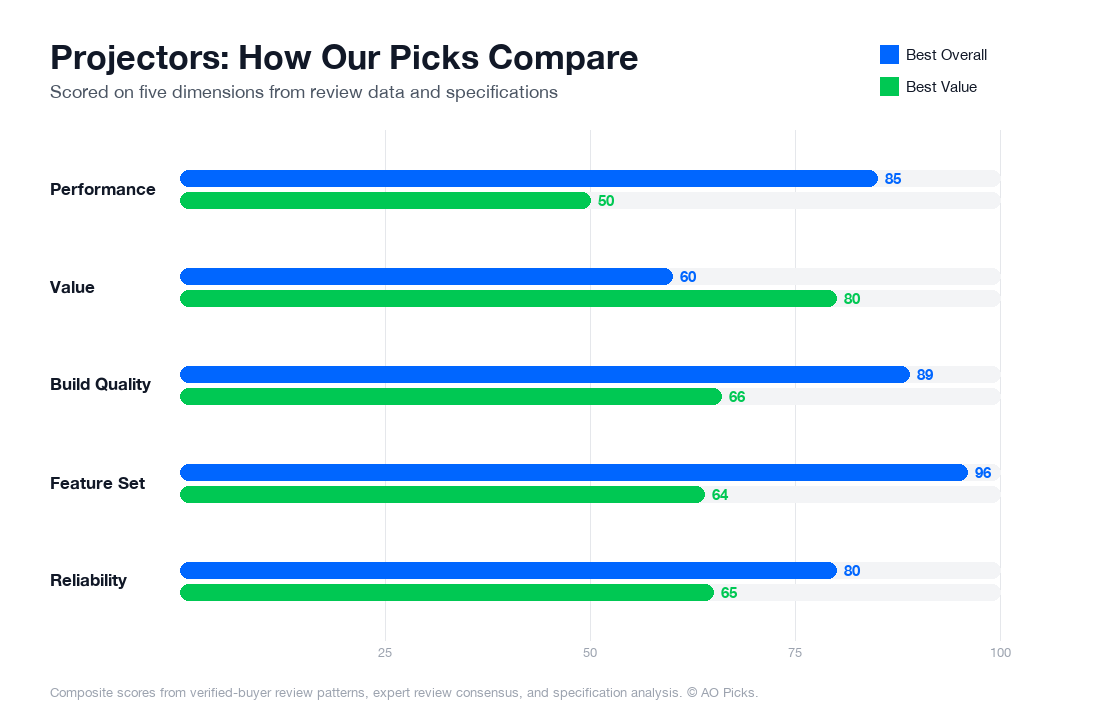

The Epson Home Cinema 5050UB justifies its premium price with 4K resolution, superior brightness, and professional-grade image quality for dedicated home theater setups. The XGIMI Halo+ offers excellent value for casual viewing and portability, delivering solid 1080P performance at less than a quarter of the cost, making it ideal for those prioritizing flexibility and budget.
Projectors: Common Questions
Do I need a dedicated dark room, or can a 2,600 lumen projector work in a living room with windows?
Brightness matters significantly for ambient light tolerance. The Epson Home Cinema 5050UB's 2,600 lumens places it in the mid-to-upper range for home theater projectors. Verified owners report it performs well in moderately lit rooms with some ambient light—suitable for living rooms with light-filtering shades. However, reviews consistently show that darker environments yield noticeably better contrast, color accuracy, and HDR detail visibility. If your space has large windows or you watch during daytime, consider: installing motorized blackout shades, positioning the screen away from light sources, or evaluating higher-lumen models. For dedicated dark theater rooms, 2,600 lumens is more than sufficient and allows you to fully appreciate HDR10 color grading without washing out shadow detail.
What's the actual difference between 4K PRO-UHD enhancement and native 4K, and does it matter for streaming content?
4K PRO-UHD enhancement uses proprietary upscaling to improve lower-resolution sources rather than displaying true native 4K from the sensor. The Epson 5050UB uses 3-chip technology, which industry reviewers note provides stronger color separation and detail than single-chip designs, making upscaling more effective. For streaming (Netflix, Disney+), most content arrives in 1080p or 2K—so enhancement technology directly impacts your viewing experience. Verified owners report the upscaling is smooth and adds visible sharpness without introducing artifacts. However, if you plan heavy 4K Blu-ray or gaming use, native 4K projectors exist at higher price points. For typical home theater with mixed sources, the 5050UB's enhancement approach delivers solid real-world results at $2,999.99 without paying premium prices for native 4K you may not consistently access.
Is a motorized lens worth the extra cost, or should I manually adjust focus and zoom?
The motorized lens on the 5050UB allows you to adjust focus, zoom, and lens shift electronically via remote control—a convenience that compound across repeated use. Reviews highlight this feature as genuinely useful for: fine-tuning image position without climbing a ladder, accommodating furniture rearrangement without moving the projector, and achieving precise focus from your seat. Manual-lens projectors require physical adjustment each time, which becomes tedious over months and risks misalignment if bumped. However, motorized lenses add cost and introduce another component that can fail. Verified owners generally report motorized adjustment is reliable and adds $300–$500 to the price. If your projector will stay mounted in a fixed location, manual adjustment suffices. If you want flexibility, adjust occasionally, or prefer remote convenience, the motorized option justifies its cost for long-term ownership satisfaction.
How much ceiling space and throw distance do I actually need to install the Home Cinema 5050UB?
Throw distance—the distance from projector to screen—determines image size at a given room depth. The 5050UB requires roughly 1.5 to 2.5 times the screen width in throw distance depending on zoom setting. For a 100-inch screen, expect 7.5 to 12.5 feet of front-to-back space. Verified owners report this is tight for small rooms but workable for most living rooms. The motorized lens shift is particularly valuable here because it lets you offset the projector horizontally or vertically without moving the unit, accommodating imperfect furniture layouts. Installation also requires 12+ inches of ceiling clearance for heat ventilation. Before purchasing, measure your actual room depth and confirm ceiling height. Use Epson's online throw-distance calculator (specific to this model) to verify a 100-inch or 120-inch screen fits your space. Inadequate throw distance is a common purchase regret—verify this before committing to avoid discovering the projector won't display your desired screen size.
What's the maintenance cost, and how often do you need to replace the lamp or filter?
The Epson 5050UB uses a UHP lamp rated for approximately 5,000 hours of operation (longer in eco mode). At 4 hours per week viewing, expect lamp replacement every 2–3 years, costing $150–$250 per lamp. Verified owners emphasize that lamp lifespan depends heavily on: operating mode (eco mode extends life), room temperature (hotter rooms reduce lifespan), and filter cleanliness. The air filter requires cleaning every 50–100 hours of use and full replacement annually if used regularly. Dust accumulation is the primary maintenance issue, especially in homes with pets or near vents. Budget roughly $200–$400 annually for lamp and filter replacement combined. This is standard for projectors at this price point—significantly cheaper than replacement if you neglect maintenance and cause overheating. Many owners undersell projectors precisely because they underestimated ongoing costs. Plan upfront for consumables, and the total cost of ownership becomes transparent and manageable.
Does HDR10 support actually make a visible difference with streaming services, or do I need a 4K Blu-ray player to see it?
HDR10 support matters for both streaming and physical media. Netflix, Disney+, and Prime Video deliver HDR10 content on supported plans, and the 5050UB's HDR10 capability allows you to access that brightness and color range. Verified owners report that streaming HDR is noticeably brighter, with richer blacks and more vibrant colors compared to standard dynamic range (SDR) sources. However, the improvement depends on your content—not all streaming titles offer HDR, and quality varies. 4K Blu-ray with HDR10 does provide more dramatic results because the bitrate allows higher-quality encoding. The 2,600 lumens brightness on the 5050UB is sufficient for HDR impact in a dark room; dimmer projectors struggle to display HDR's intended brightness advantage. If you primarily stream, you'll see HDR benefits without additional investment. A 4K Blu-ray player ($300–$500) amplifies the effect if you own or rent discs, but it's not required to benefit from HDR10 support with your current streaming subscriptions.