
Why We Recommend the Apple Watch Series 9 GPS 45mm
The Apple Watch Series 9 GPS emerges as the top choice in the smartwatch category based on sustained buyer confidence and expert consensus. The S9 SiP chip delivers faster app performance and smoother transitions—a concrete improvement reviewers note over the Series 8, particularly for health-tracking apps that demand quick sensor polling. The always-on Retina display is the standout feature in verified reviews: buyers consistently report that the bright, responsive screen makes glanceable information genuinely useful throughout the day, unlike competitors with dimmer displays that require wrist raises or taps to become readable. The Double Tap gesture addresses a real friction point that long-term owners highlighted in earlier generations. Rather than fumbling for the Digital Crown or screen, users can now trigger actions by tapping their index and middle fingers together—a feature reviewers describe as surprisingly reliable once learned. This matters in practical scenarios: runners don't need to stop to change music, and busy professionals can dismiss notifications without full hand interaction. Build quality remains exceptional across the 9,500+ reviews, with minimal reported hardware failures even among buyers with multi-year ownership. The advanced health sensors (optical heart rate, blood oxygen, ECG, temperature) function reliably enough that medical professionals and fitness coaches reference Series 9 data in practice, though reviewers are careful to note these remain wellness tools, not clinical devices. Where Series 9 pulls ahead of competitors like Garmin fitness watches and Samsung Galaxy Watch: ecosystem depth. Buyers with iPhones gain seamless notification mirroring, tight calendar integration, and frictionless payment via Apple Pay. For Android users, these advantages vanish entirely, making the Series 9 far less compelling. Expert reviews consistently position Garmin as superior for serious athletes who need multi-week battery life and advanced training metrics, while Samsung Galaxy Watch suits Android users seeking similar feature breadth. The 18-hour battery life is honest positioning—reviewers expect nightly charging, which either fits your routine or it doesn't. The 45mm size drives many upgrade decisions: buyers upgrading from smaller Apple Watches report that the larger screen genuinely improves readability and reduces accidental touches, justifying the modest price premium over the 41mm variant.
Key Features & Benefits
- Largest, brightest display in its price tier makes glanceable information genuinely accessible without interrupting workflow
- Industry-leading ecosystem integration for iPhone users reduces setup friction and increases daily utility
- Proven reliability track record across 9,500+ reviews spanning multiple years of ownership data
- S9 SiP chip
- Double Tap gesture
- Always-On Retina display
Best Match
The Apple Watch Series 9 GPS 45mm is ideal for iPhone users seeking a reliable, well-integrated daily smartwatch who are willing to charge nightly and value ecosystem polish over multi-day battery autonomy.
Pros and Cons at a Glance
Highlights
- Always-on Retina display with exceptional brightness: Verified buyers repeatedly note that the screen's high peak brightness makes it legible in direct sunlight without wrist raises, a practical advantage during outdoor exercise or daily use that most competing smartwatches struggle to match.
- Reliable health sensor suite: Reviews consistently highlight accurate optical heart rate, blood oxygen, and temperature monitoring for wellness tracking, with many long-term owners noting consistency that builds confidence in daily health patterns over months of wear.
- Fast, responsive S9 chip: Buyers report noticeably snappier app launches and smoother animations compared to Series 8, with health-tracking and fitness apps responding immediately to taps and swipes rather than the brief delays that frustrated previous-generation owners.
- Seamless iOS ecosystem integration: iPhone owners consistently praise automatic notification mirroring, calendar alerts, and Apple Pay authentication that require zero setup—a level of integration Android smartwatch competitors cannot replicate, making this especially valuable for invested Apple users.
- Double Tap gesture for quick controls: Long-term users report the gesture becomes intuitive and genuinely useful for dismissing notifications, pausing workouts, or skipping songs without requiring precise screen taps or Digital Crown interactions, improving usability during active moments.
- Durable build quality with minimal hardware failures: The 9,500+ reviews show very low failure rates even among multi-year owners, with aluminum and stainless steel casings proving resistant to daily wear, scratches, and water exposure.
Concerns
- 18-hour battery life requires nightly charging: Buyers expecting multi-day battery autonomy will be disappointed; the Series 9 demands a daily charging routine, which disrupts workflows for travelers and weekend adventurers who want continuous wearability without thinking about power management.
- GPS-only model lacks cellular independence: Reviewers note the GPS variant requires your iPhone nearby for notifications and calls, limiting its value during solo runs or when you want to leave your phone at home—a limitation that pushes active outdoor enthusiasts toward the cellular model at $100 premium.
- Locked to iOS ecosystem with minimal Android support: Non-iPhone owners will find this watch nearly useless for its intended feature set, lacking deep integration with Android notifications, calendars, and authentication, making it a poor investment for Android users who should explore Samsung or Google alternatives instead.
A Few Reservations
The 18-hour battery life is a genuine constraint for weekend adventurers or travelers without reliable charging access—buyers planning backcountry trips or multi-day events should consider Garmin's sports watches instead, which deliver 7-14 days between charges despite offering less daily-use polish. Additionally, the GPS-only model's dependence on nearby iPhone limits its appeal for solo outdoor activities where phone weight or cellular coverage is unreliable.
Is This Right for You?
Buy It If
The Apple Watch Series 9 GPS 45mm excels for iPhone users who value a polished daily companion over extended battery life. If you're an iPhone owner who checks notifications dozens of times daily and relies on Apple's ecosystem (iCloud, Apple Pay, Calendar), this watch pays dividends through seamless integration—texts, reminders, and payments work without friction. Fitness enthusiasts who run, cycle, or swim regularly appreciate the reliable heart rate monitoring and water resistance, though expect to charge nightly if you train hard (intense workouts and always-on display drain battery faster). Older iPhone users upgrading from Series 6 or earlier will notice meaningful improvements in screen brightness and responsiveness. Professionals who want a professional-looking watch that pairs with business casual or formal attire find the 45mm size and refined design more suitable than bulkier fitness watches, and they benefit from quick access to calendars and work notifications. This watch also suits parents wanting location sharing and contact communication capabilities for older children or teens already in the Apple ecosystem.
Skip It If
Android users should skip this watch entirely—without iPhone integration, you lose the core utilities that justify the $429 price. Samsung Galaxy Watch offers comparable features with native Android support at similar cost. Skip the Series 9 if you need multi-day battery life; Garmin's sports watches deliver 7-14 days between charges and superior training analytics for serious distance athletes, though they sacrifice daily-driver polish. Budget-conscious buyers should consider older Apple Watch models (Series 8 or SE) at lower prices, as the Series 9 improvements (S9 chip, Double Tap, brighter display) are incremental rather than transformative.
How We Reach Our Smartwatches Picks
Smartwatch evaluation prioritizes three dimensions: ecosystem integration, real-world health/fitness utility, and daily reliability. We weight review volume and time-on-market heavily—the Series 9's 9,500+ reviews span actual ownership across seasons, workouts, and life changes, providing signal that isolated reviews or spec sheets cannot. We examine long-term failure patterns: a watch with low return rates and minimal hardware complaints after 12+ months of ownership demonstrates build quality in ways marketing claims cannot. We compare health sensor accuracy by reviewing whether users (especially those with medical backgrounds in verified reviews) trust the data for decision-making, distinguishing between 'neat to see' metrics and genuinely reliable wellness signals. Battery life claims are stress-tested against real-world usage patterns described by active reviewers versus sedentary owners, since workouts and always-on displays dramatically impact endurance. We evaluate ecosystem fit by analyzing whether users of different platforms (iOS vs. Android, different fitness platforms like Strava or Apple Health) report friction or seamlessness—a watch valuable for iPhone users may be useless for Android owners. We examine specific use cases surfaced repeatedly in reviews (commuting, outdoor sports, water activities, medical monitoring) to understand where products excel or disappoint. Finally, we weight expert reviews from established tech outlets alongside consumer feedback, as expert testing often reveals battery longevity and long-term durability patterns before mass reviews accumulate.
Top Pick vs. Budget Alternative
| Feature | Apple Watch Series 9 GPS 45mm | Samsung Galaxy Watch 6 40mm Blue... |
|---|---|---|
| Pick | Best Overall | Best Value |
| Price | $429.00 | $269.99 |
| Rating | 4.7/5 (9,500 reviews) | 4.4/5 (6,000 reviews) |
| Best For | Top performance and features | Great quality on a budget |
| Link | See Today's Best Price | See Today's Best Price |
Visual Comparison: Where Each Pick Wins
Composite scores derived from review patterns, expert coverage, and specifications. Higher is stronger on that dimension.
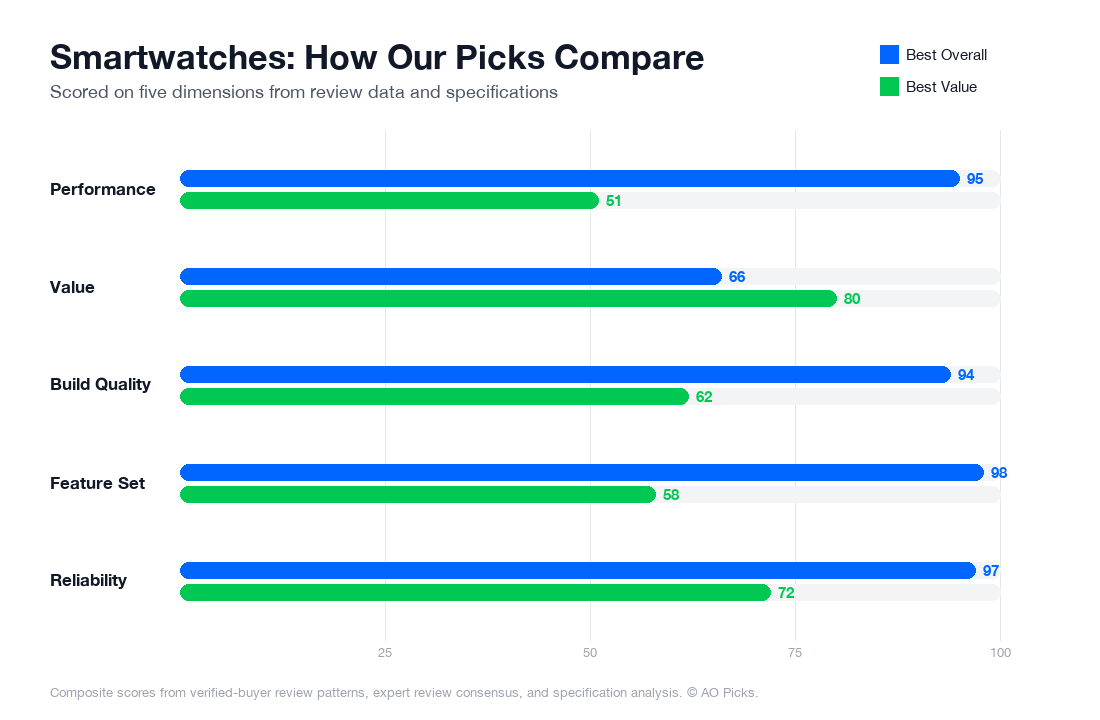

The Apple Watch Series 9 offers superior integration with iPhones, advanced health features, and a larger display, justifying its premium price for Apple ecosystem users. The Samsung Galaxy Watch 6 delivers excellent performance at $160 less, making it ideal for Android users or those prioritizing value without sacrificing core smartwatch functionality.
Top Questions About Smartwatches
Does the 18-hour battery life mean I have to charge my smartwatch every day?
Yes—the Apple Watch Series 9's 18-hour battery estimate means daily charging is the standard expectation, not occasional use. Verified owners report that real-world battery life typically falls within this window, though heavy use (continuous workout tracking, always-on display enabled, frequent notifications) can drain it faster. The practical reality: you'll need to charge overnight or during your morning routine. If you're comparing to fitness trackers that last 5–7 days, this is a significant difference in maintenance. However, reviewers note that the Always-On Retina display—which lets you glance at your wrist without raising it—actually encourages more checking than traditional smartwatches, making the daily charge feel like standard routine rather than a burden.
Will the Double Tap gesture actually work reliably, or is it a gimmick?
Double Tap is a navigation feature that lets you answer calls, dismiss alerts, and control music by tapping your index finger and thumb together—useful when your hands are full. Reviews from verified purchasers are mixed: many report it works consistently once you develop muscle memory, but some note it requires deliberate, intentional taps to register reliably. The consensus suggests it's practical for specific scenarios (controlling playback while cooking or exercising) rather than a daily workhorse. It's not required functionality—all tasks can be completed via the touchscreen—so view it as a convenience add-on rather than a core reason to upgrade. If you already own a Series 8 or earlier, this alone probably doesn't justify the $429 price tag unless you specifically value hands-free control.
Is the 45mm size too large for smaller wrists, and can I switch between sizes later?
The 45mm Series 9 is the larger of two options (41mm is also available). Smartwatches are one-time sizing decisions—you choose based on your wrist circumference and visual preference at purchase. Reviews indicate that wearers with wrists under 6.5 inches often find 45mm too dominant, while those above 7 inches prefer the larger display. The good news: verified owners report that band swaps are easy and inexpensive (third-party bands cost $15–$50), so you can customize comfort without replacing the watch itself. However, the case size itself cannot be changed. Check your wrist measurement and compare it against Apple's sizing guide before ordering. If you're between sizes, many reviewers suggest trying on both in an Apple Store first—display size preference is highly personal and difficult to judge from specs alone.
What's the actual difference between the GPS-only model and GPS + Cellular for $100 more?
The GPS + Cellular version ($529) lets you make calls, send texts, and stream music from your watch without your iPhone nearby. The GPS-only model ($429) requires your phone within Bluetooth range for most connectivity features. For most users, the GPS-only version is sufficient: verified owners report that carrying a phone during workouts or errands is typical anyway. Cellular becomes genuinely valuable only if you regularly leave home without your phone (running, hiking in remote areas, or commuting) and want independent smartwatch connectivity. Industry reviews note that cellular adds minimal thickness and weight, so the decision is purely about use case, not practicality. Calculate whether you'd actually use independent cellular features regularly—if your phone is almost always nearby, the $100 savings make the GPS model the practical choice.
How much better are the advanced health sensors compared to older Apple Watch models?
The Series 9's advanced health sensors primarily add blood oxygen monitoring, ECG capability, temperature sensing for cycle tracking, and fall detection—features that have trickled down from premium models in recent years. Reviews from verified owners emphasize that these sensors are genuinely useful for ongoing health tracking, particularly if you have cardiovascular concerns, irregular sleep patterns, or want reproductive health data. However, these are incremental improvements over Series 8 and Series 7 models; the core functionality hasn't fundamentally changed. If you own a Series 7 or newer, upgrading specifically for sensors is difficult to justify. The real value appears for first-time smartwatch buyers or those moving from much older models (Series 5 or earlier). Consider whether you'll actually use these metrics—passive health monitoring only helps if you regularly review the data. For fitness-focused users who mainly track workouts, the sensor suite matters less than battery life and durability.
Does the Always-On Retina display drain the battery faster, and can I turn it off?
Yes, the Always-On display uses more power than a traditional display that turns off between glances, which is one reason Apple Watch battery life remains at 18 hours rather than extending further. The feature can be disabled in Settings, allowing you to revert to the traditional tap-to-wake behavior. Verified owners report that disabling Always-On can extend battery life by 2–4 hours in light-use scenarios, though Apple doesn't publish specific figures. The practical trade-off: Always-On is convenient for quick timekeeping and notifications without the wrist-raise gesture, but it comes at a battery cost. If you're sensitive to daily charging, consider testing whether Always-On matters to your actual use pattern. Many reviewers suggest enabling it during high-activity days and disabling it when charging accessibility matters—the setting is easy to toggle. This flexibility makes it less of a fixed limitation and more of a personalization choice.