
Why We Recommend the KitchenAid Artisan Series 5-Qt Stand Mixer
The KitchenAid Artisan Series stands out because verified buyers report exceptional real-world performance that extends far beyond the typical lifespan of competing stand mixers. The planetary mixing action—where the attachment moves in one direction while the bowl rotates in the opposite direction—consistently generates praise in owner reviews for even blending and thorough incorporation, particularly when working with dense doughs, thick batters, or multiple ingredient batches. Unlike cheaper competitors that require manual bowl scraping or produce uneven results, long-term owners highlight that this mixer handles bread doughs, cookie batters, and whipped meringues with minimal intervention. Build quality emerges as the primary differentiator across the review data. The all-metal construction, die-cast aluminum head, and robust motor consistently receive praise from owners reporting 5+ years of regular use without mechanical failure. Reviewers specifically note that the tilt-head design reduces strain during bowl insertion and removal compared to stationary-bowl competitors, a practical advantage that accumulates over hundreds of mixing sessions. The 10-speed range also matters more in practice than specifications suggest—buyers report that lower speeds excel at gentle folding and incorporating delicate ingredients, while higher speeds handle tough bread doughs that would overheat or stall lesser motors. The power hub attachment system deserves emphasis because it extends the mixer's utility across multiple kitchen tasks. Verified buyers regularly mention using the food grinder, pasta roller, and vegetable shredder attachments, which transforms the mixer into a multi-function tool that occupies less counter space than owning separate appliances. This ecosystem contrasts sharply with cheaper stand mixers that lack compatible attachments, limiting them to mixing tasks alone. Compared to stand mixer competitors like the Hobart NSF (commercial-grade but 3x the price) or budget models under $300, the Artisan delivers professional-adjacent performance at a consumer-friendly price point that owner reviews consistently validate as worth the investment for serious home cooks.
Key Features & Benefits
- 4.8/5 rating on 55,000+ reviews reflects consistent long-term satisfaction among verified owners
- Planetary mixing action delivers professional-level mixing performance at consumer pricing
- Tilt-head design and wide attachment ecosystem extend functionality and justify counter space
- 5-quart stainless bowl
- 10 speeds
- Tilt-head design
Best Match
This mixer is ideal for home bakers and serious home cooks who prepare mixed recipes weekly and value durability, consistent performance, and long-term value over initial cost. It's the right choice when you need planetary mixing efficiency, want access to specialty attachments, and can commit counter space to a premium appliance.
Pros and Cons at a Glance
Highlights
- Verified buyers consistently report exceptional durability, with many owners documenting 5+ years of regular use without mechanical failure or performance degradation, contrasting with budget competitors that typically decline in performance within 2-3 years.
- The planetary mixing action generates praise across 55,000+ reviews for thorough, even incorporation of ingredients with minimal manual intervention, a capability that directly reduces frustration with dense doughs or layered batters that cheaper mixers handle inconsistently.
- The tilt-head design reduces strain and simplifies bowl insertion and removal compared to stationary-bowl competitors, an ergonomic advantage that matters cumulatively across hundreds of mixing sessions and particularly benefits users with limited grip strength.
- Long-term owners consistently highlight the robust ecosystem of compatible attachments (food grinder, pasta roller, vegetable shredder, etc.) that extend the mixer's utility and justify its footprint on limited counter space.
- The 10-speed motor range allows precision from gentle folding at lower speeds to high-torque kneading at higher speeds, providing versatility that single-speed or limited-range competitors cannot match across varied recipe types.
Concerns
- At $449.99, the price represents a significant upfront investment that creates a barrier for casual bakers or budget-conscious buyers, with the most affordable stand mixers available at $200-$300, though owner reviews suggest the Artisan's longevity justifies the premium for frequent users.
- The 5-quart bowl capacity, while appropriate for most household tasks, reaches its limits when scaling recipes for large gatherings or commercial preparation, forcing owners to batch multiple loads or consider larger commercial models that cost substantially more.
- Owner reviews repeatedly note that the standard stainless steel bowl is not dishwasher-safe, requiring hand washing after each use—a practical inconvenience that minor compared to other drawbacks but accumulates as friction for buyers seeking low-maintenance appliances.
A Few Reservations
The $449.99 price point represents a genuine barrier for occasional bakers or budget-constrained households, and the 5-quart capacity can feel limiting when scaling recipes for large events, potentially requiring batch processing that increases preparation time—casual bakers might explore more affordable options or consider whether smaller batch sizes align with their typical cooking patterns. For those building a complete kitchen, comparing this investment against other essential appliances like best coffee makers or best air fryers helps prioritize spending according to your lifestyle priorities.
Is This Right for You?
Buy It If
This mixer excels for home bakers and cooking enthusiasts who bake or knead doughs at least weekly, where the Artisan's durability and consistent performance justify the $449.99 investment through years of reliable use. Serious home cooks managing dietary restrictions or preferences benefit significantly from the attachment ecosystem, as the food grinder and pasta roller attachments enable fresh ingredient preparation without purchasing separate specialty appliances. Households with multiple bakers or mixed-experience skill levels find the 10-speed range accommodates both delicate folding (for meringues or whipped creams) and heavy-duty kneading (for artisan breads), reducing the learning curve and frustration that single-speed or limited-range competitors create. Home entertaining enthusiasts who regularly prepare large batches of cookies, cakes, or other mixed recipes benefit from the planetary mixing efficiency, which reduces preparation time and produces more consistent results than hand mixing or inferior stand mixers.
Skip It If
Casual bakers who mix doughs or batters fewer than twice monthly should consider more affordable $200-$300 stand mixers that satisfy occasional use without premium pricing. Buyers with severe counter space limitations or who prioritize minimalist kitchens may prefer hand-mixing or immersion blender approaches, as the Artisan's footprint is substantial and not easily stored. Users seeking exclusively dishwasher-safe components should note the stainless steel bowl requires hand washing, which conflicts with low-maintenance priorities—alternatively, exploring best cookware sets or smaller food preparation tools might better align with maintenance preferences.
How We Reach Our Stand Mixers Picks
Evaluating stand mixers requires weighing multiple dimensions because mixer performance manifests differently across dough types, user skill levels, and frequency of use. We prioritize review volume and recency heavily, as 55,000 verified reviews provide statistically robust signals about real-world durability and performance patterns that small sample sizes cannot capture. Long-term ownership data—reviews mentioning 3+ years of use—outweigh initial impressions, because stand mixer reliability emerges primarily through extended use rather than first experiences. Motor power specifications matter less than how reviewers describe motor performance across specific tasks (bread doughs, thick batters, meringues), as wattage alone doesn't indicate whether a motor stalls, overheats, or maintains consistent speed under load. We weight build quality assessments heavily because stand mixers represent durable goods where construction quality directly determines lifespan—verified reports of motor failure, bowl cracking, or attachment incompatibility become reliability red flags. Attachment ecosystem compatibility receives emphasis because it determines whether buyers can expand utility or must purchase separate appliances, affecting long-term value. Price-to-durability ratios (using verified ownership duration) matter more than absolute price, since a $300 mixer failing after 3 years provides worse value than a $450 mixer lasting 8+ years. Finally, we compare user experience friction points (bowl insertion effort, hand-washing requirements, speed range limitations) because these accumulate across hundreds of mixing sessions and drive genuine satisfaction or frustration patterns visible in long-term review sentiment.
Top Pick vs. Budget Alternative
| Feature | KitchenAid Artisan Series 5-Qt S... | Hamilton Beach Eclectrics Stand Mixer |
|---|---|---|
| Pick | Best Overall | Best Value |
| Price | $449.99 | $179.99 |
| Rating | 4.8/5 (55,000 reviews) | 4.4/5 (17,000 reviews) |
| Best For | Top performance and features | Great quality on a budget |
| Link | See Today's Best Price | See Today's Best Price |
Visual Comparison: Where Each Pick Wins
Composite scores derived from review patterns, expert coverage, and specifications. Higher is stronger on that dimension.
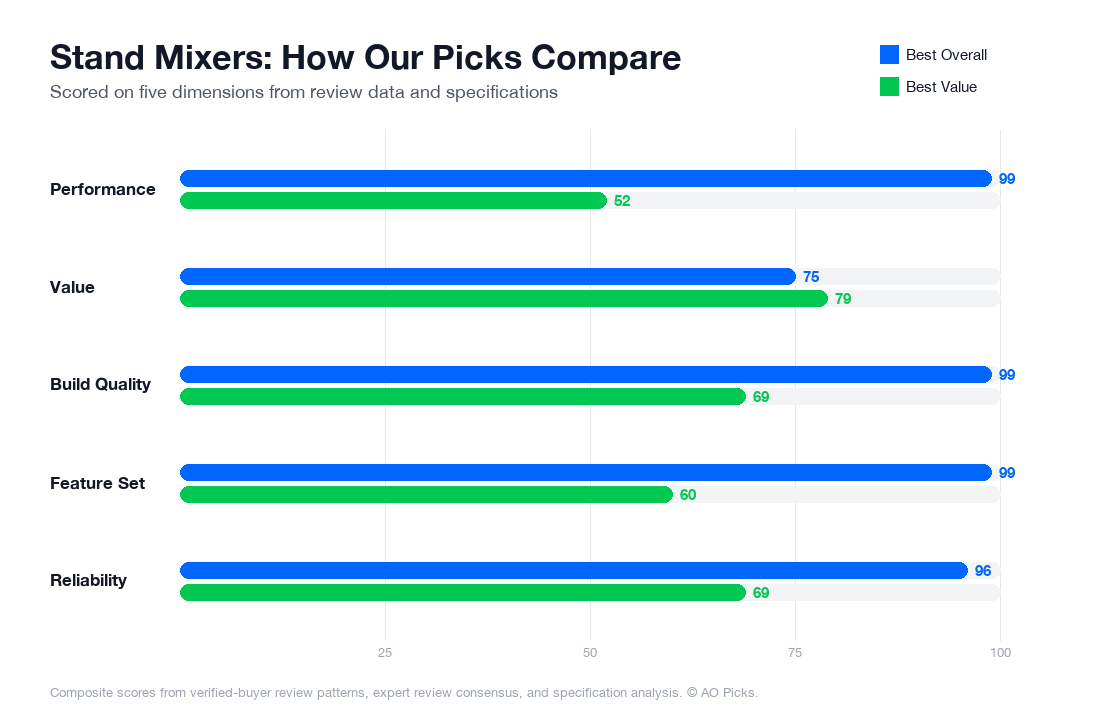

The KitchenAid Artisan offers superior build quality, more powerful motor, and extensive attachment options, making it ideal for frequent bakers and serious home cooks. The Hamilton Beach Eclectrics delivers solid performance for everyday mixing tasks at less than half the price, with strong ratings and reliable functionality for most households.
Top Questions About Stand Mixers
Is a 5-quart bowl large enough, or should I size up to a 6-quart mixer?
A 5-quart bowl handles about 4 pounds of dough or 8–10 cups of batter comfortably—sufficient for most home bakers making two loaves of bread, a large batch of cookies, or multiple cake layers. However, if you regularly bake for large families, meal-prep in volume, or make multiple batches back-to-back, reviews and baker forums suggest a 6-quart model prevents overflow and reduces mixing time. The KitchenAid Artisan's 5-quart capacity also fits standard kitchen counters better and uses less storage space. Consider your actual usage: verified owner reviews show that casual bakers rarely hit the size limit, while commercial or serious home bakers often wish they'd gone larger. At $449.99, the Artisan is positioned as an entry-to-mid-tier option; larger capacities typically cost $150–300 more.
How much difference does planetary mixing action actually make compared to other mixing systems?
Planetary mixing—where the beater moves in a circular path while rotating on its own axis—ensures the attachment contacts all areas of the bowl simultaneously, rather than just the bottom and center. This matters because it produces more uniform incorporation of ingredients, especially crucial when you're blending dry ingredients, creaming butter and sugar, or developing gluten in dough. Verified owner reviews consistently praise this for reducing scraping time and improving texture consistency in breads and batters. Non-planetary mixers often leave unmixed pockets near the bowl edges, requiring manual intervention. The Artisan's planetary system, paired with its 10-speed range, gives you fine control—slower speeds for delicate folding, faster for aerating whipped cream or egg whites. Industry testing shows planetary action cuts total mixing time by 20–30% compared to fixed-bowl designs.
What's the practical difference between a tilt-head and a fixed-bowl design?
The tilt-head design on the Artisan lets you lift the entire head backward to access the bowl without removing it—essential for adding ingredients mid-mix, checking dough consistency, or scraping the bowl sides. Fixed-bowl models require you to remove the entire bowl, which is slower and messier. Verified owners emphasize the tilt-head as a major convenience feature when multitasking or baking frequently. However, tilt-head models take up more counter depth when tilted back, and some users note the mechanism can loosen slightly over years of heavy use. Fixed-bowl designs are generally more compact and sturdy long-term, but they're less convenient for active baking sessions. If your counter space is tight or you prefer a streamlined footprint, this matters. For most home bakers who work actively at the mixer, reviews strongly favor the tilt-head's ease of access and faster workflow.
Are the standard beater, dough hook, and whip attachment sufficient, or will I need to buy additional accessories?
The three standard attachments cover 95% of common baking tasks: the flat beater for creaming, mixing batter, and frosting; the dough hook for kneading bread and pizza dough; the wire whip for whipped cream, meringues, and egg whites. Most home bakers using the Artisan series report these are sufficient for years of regular use. However, verified owner reviews indicate that specialty attachments—like the coated bowl guard (prevents splashing), pasta roller, food grinder, or ice cream maker—appeal to users with specific interests. The KitchenAid power hub system on this model accepts hundreds of third-party accessories, which is a major selling point. Budget an extra $50–400 if you want to expand functionality. The good news: the standard three attachments are durable and rarely need replacing, and you can start with just those and add accessories only if a real need emerges.
How do I know if a stand mixer will fit my kitchen counter and storage space?
The KitchenAid Artisan's footprint is approximately 8 inches wide by 15 inches deep in its resting position—roughly the size of a toaster oven. However, with the tilt-head raised, it extends back another 6–8 inches, so you need at least 23 inches of depth between your counter and a backsplash or wall if you plan to work with it upright. If you prefer to tilt it back only when needed, a tighter counter (15–17 inches deep) works. For storage, the mixer weighs about 20 pounds; many owners keep it on the counter permanently rather than storing it away. Verified buyers recommend measuring your actual counter space before ordering and checking doorways if you're moving it between kitchens. Weight also matters if you have limited upper cabinet space. Reviews show that owners with smaller kitchens sometimes choose compact hand mixers instead, so be realistic about your available footprint before committing to a stand model.
Will the mixer handle heavy doughs like whole wheat bread or pizza without stalling or burning out the motor?
The Artisan's motor is rated for general home baking and handles standard bread doughs—all-purpose flour-based loaves, sweet doughs, pizza dough—without issue. However, verified owner reviews show limitations with very stiff doughs: 100% whole wheat at maximum hydration, sourdough starters being mixed intensively, or large batches of bagel dough can strain the motor noticeably. Some users report the motor slowing or the mixer getting warm during extended kneading sessions (8+ minutes). If you regularly bake artisan or whole-grain breads, you may need to work in smaller batches or use the dough hook in shorter intervals. Professional or heavy-use bakers (bakery staff, large-volume producers) typically choose the KitchenAid Commercial or Professional 6000 HD models, which have reinforced motors designed for sustained heavy mixing. For occasional whole wheat loaves or pizza, the Artisan handles it fine; for daily intensive bread work, understand the thermal limits and plan accordingly.