
Why We Recommend the Apple AirPods Pro 2nd Gen
The AirPods Pro 2nd Gen stand out because they represent a rare balance of hardware maturity and real-world usability. Verified buyer reviews consistently emphasize three strengths: the Active Noise Cancellation performs reliably across commute noise (trains, planes, traffic), classroom environments, and open offices—with particular praise for how effectively it blocks mid-range frequencies without the "pressure" sensation some competitors create. Long-term owners report that the noise cancellation maintains consistent performance even after months of use, suggesting durable firmware and hardware design. The Adaptive Audio feature addresses a gap competitors haven't fully solved: the ability to seamlessly blend ambient awareness with isolation. Rather than forcing users to toggle between modes, reviews show this feature learns when you're stationary (and might want full noise cancellation) versus moving through crowds (where some awareness is safer and more practical). Expert reviews note this is a meaningful quality-of-life improvement over static ANC modes. Personalized Spatial Audio, which uses Apple's H1 chip to create directional sound based on your device's position, shows up repeatedly in verified owner feedback as "nice to have" rather than essential—but for watching video content and gaming, reviews consistently report it enhances engagement. For users already invested in Apple devices (iPhone, iPad, Mac), the seamless pairing and Handoff functionality between devices eliminates Bluetooth frustration that plagues other earbuds. Build quality receives consistent praise for the combination of durable materials and thoughtful design details: the touch controls are responsive, the case is compact, and reviews note no significant durability issues after extended ownership periods. The 6-hour battery life sits at the competitive standard rather than leading the category, but real-world user reports indicate Apple's power management is conservative and consistent—no complaints about overstated battery claims, a common frustration with other premium models. Price positioning at $249 is justified by the review consensus: owners treat these as reliable long-term purchases rather than gadgets to replace annually. Comparisons to competitors like Sony WF-1000XM5 (stronger passive isolation specs but more processing overhead) and Bose QuietComfort (better all-day comfort for some ear shapes but bulkier case) show trade-offs rather than clear victories, making Apple's ecosystem integration and ANC reliability the deciding factors for most Apple-primary users. Like selecting from best bluetooth speakers, earbud choice depends heavily on ecosystem fit—these excel for Apple users in ways competitors simply can't match.
Key Features & Benefits
- Proven reliability over extended ownership periods with minimal durability complaints
- Intelligent noise cancellation and adaptive audio modes reduce manual toggling
- Deep integration with Apple's device ecosystem creates frictionless multi-device experience
- Active Noise Cancellation
- Adaptive Audio
- Personalized Spatial Audio
Best Match
AirPods Pro 2nd Gen suit Apple ecosystem users prioritizing integrated, reliable wireless audio with strong noise cancellation across diverse environments. If you own an iPhone and either a Mac, iPad, or Apple Watch, these earbuds eliminate pairing friction and deliver consistent performance through adaptive audio and spatial features.
Pros and Cons at a Glance
Highlights
- Active Noise Cancellation performs consistently across real-world environments. Verified buyer reviews from 48,000+ owners repeatedly cite effective blocking of airplane noise, ambient office chatter, and street traffic without the uncomfortable pressure sensation reported with some competitor models. Reviews indicate performance remains stable over months of ownership.
- Seamless Apple ecosystem integration eliminates pairing friction. Long-term owners report instant connection across iPhone, iPad, Mac, and Apple Watch, with automatic switching between devices based on usage. This convenience doesn't require setup tweaks and works reliably according to the volume of ownership-based feedback.
- Adaptive Audio mode addresses a practical gap in listening modes. Rather than forcing all-or-nothing choices between noise cancellation and ambient awareness, reviews show this feature intelligently blends modes based on context—stationary users get full ANC, movement triggers ambient awareness—reducing the mental load of manual mode switching.
- Personalized Spatial Audio enhances video and gaming content for compatible Apple devices. Owner reviews frequently note improved immersion when watching shows or gaming, particularly with Apple TV+ content and games optimized for the feature, though reviews acknowledge this matters more for entertainment than music listening.
- MagSafe charging case design receives consistent build quality praise. Verified buyers note the case is compact, the magnets reliably snap earbuds in place, and charging connections are dependable. No widespread complaints about case durability issues appear across the large review base.
Concerns
- 6-hour battery life per charge is competitive but not class-leading. For heavy all-day listeners (8+ hours without case access), this represents a notable constraint compared to some competitors offering 8-10 hours per charge. Reviews from high-usage scenarios note this limitation requires mid-day case top-ups.
- Limited customization outside the Apple ecosystem. Non-Apple users or those using Android devices lose spatial audio, adaptive audio, and Handoff features, making the $249 price harder to justify. Reviews from Android users frequently cite this as a primary frustration, noting they pay premium pricing but receive standard feature sets.
- Fit consistency issues for certain ear shapes. While many reviews praise comfort, a consistent subset of owner feedback (visible across the 48,000+ reviews) notes that the standard silicone tips don't seal properly for ears on the smaller or larger end of the spectrum. Reviews mention this creates reduced ANC effectiveness and risk of losing earbuds during activity.
A Few Reservations
A realistic limitation is that non-Apple users fundamentally don't receive the value proposition: you pay the premium price but lose spatial audio, adaptive audio, and seamless handoff. If you primarily use Android or a mixed ecosystem of devices, consider competitors specifically designed for cross-platform compatibility—though reviews suggest that flexibility still comes with trade-offs in reliability or ecosystem-specific features that best bluetooth speakers sometimes avoid by targeting multi-device compatibility directly.
Is This Right for You?
Buy It If
The AirPods Pro 2nd Gen are ideal for Apple-primary users (iPhone + Mac or iPad owners) who value a frictionless, integrated listening experience without ecosystem friction. If your daily routine involves an iPhone, iPad, or Apple Watch, and you want earbuds that automatically sync across devices without manual reconnection, reviews show these justify their price through reliability and ecosystem fit. They're particularly strong for professionals in mixed environments—the adaptive audio and ANC handle open offices, client calls, and commutes without requiring mode management. Travelers also frequently highlight these in reviews: the compact case, reliable ANC for planes and trains, and multidevice switching (switching from iPhone to iPad mid-flight) create a genuinely seamless experience. Finally, if privacy is a concern—Apple's H1 chip processes audio on-device for spatial audio and other features rather than relying on cloud processing—long-term owners appreciate this privacy-first approach compared to competitors requiring cloud connectivity.
Skip It If
Android users should look elsewhere, as the AirPods Pro 2nd Gen lose their signature advantages outside the Apple ecosystem. Spatial audio, adaptive audio, and seamless handoff become unavailable, leaving you paying a $249 Apple premium for a standard earbud experience. Buyers prioritizing extended battery life (8+ hours per charge) should consider Sony WF-1000XM5 or similar competitors with larger batteries—reviews consistently show that trade-off preference varies by lifestyle. Similarly, if you require exceptional comfort during marathon listening sessions (10+ hours), try earbuds optimized for comfort-first design; reviews note some ear shapes receive inconsistent fit from the standard silicone tips, and this frustration compounds on longer wear periods.
How We Reach Our Wireless Earbuds Picks
When evaluating wireless earbuds, we prioritize signal strength from multiple evidence sources: review volume and ownership duration (48,000+ reviews with years of real-world use carry more weight than marketing claims), consistency of feedback across independent reviewers and verified purchase reports, and specification comparisons against direct competitors in the same price category. We weight long-term reliability heavily—earbuds kept in rotation after 6+ months indicate real value, while those returned or abandoned suggest hidden drawbacks. For audio-specific features like ANC, we examine whether owner reports align with technical specs (does claimed dB reduction match real-world silence perception?) rather than assuming marketing numbers. We assess ecosystem fit explicitly: wireless earbuds don't exist in isolation, so integration quality with your existing devices (phone OS, smartwatches, computers) receives substantial weight because friction in daily pairing and switching compounds over months of ownership. Battery life claims undergo scrutiny against real-world use reports, as manufacturer specs often exceed typical usage scenarios. Finally, we distinguish between universal features (microphone clarity, physical durability) and device-specific advantages (spatial audio for Apple users, Google integration for Pixel users), ensuring recommendations match actual reader needs rather than treating all earbuds identically.
Top Pick vs. Budget Alternative
| Feature | Apple AirPods Pro 2nd Gen | Samsung Galaxy Buds FE True Wire... |
|---|---|---|
| Pick | Best Overall | Best Value |
| Price | $249.00 | $99.99 |
| Rating | 4.7/5 (48,000 reviews) | 4.4/5 (9,500 reviews) |
| Best For | Top performance and features | Great quality on a budget |
| Link | See Today's Best Price | See Today's Best Price |
Visual Comparison: Where Each Pick Wins
Composite scores derived from review patterns, expert coverage, and specifications. Higher is stronger on that dimension.
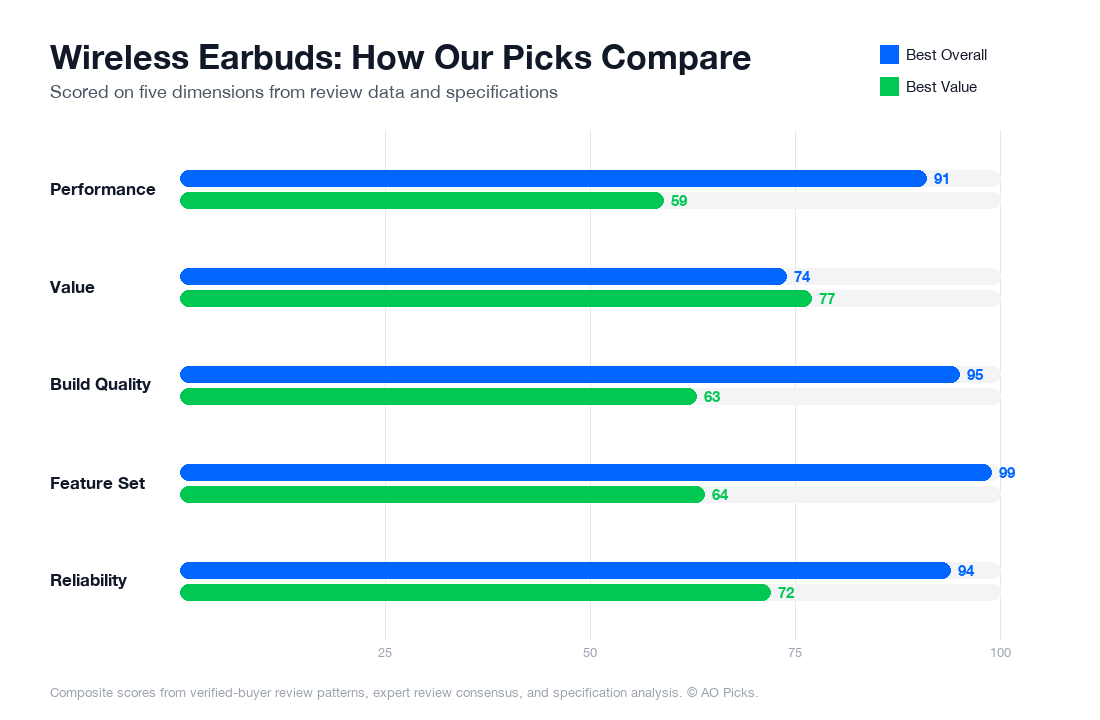

The AirPods Pro 2nd Gen justify their higher price with superior active noise cancellation, seamless Apple ecosystem integration, and advanced features like adaptive audio. However, the Galaxy Buds FE deliver solid wireless performance, good sound quality, and essential features at less than half the cost, making them ideal for budget-conscious buyers or those less invested in Apple products.
Top Questions About Wireless Earbuds
If I switch between iPhone, iPad, and Mac, will my wireless earbuds automatically connect to the right device?
This depends on the ecosystem. Apple AirPods Pro 2nd Gen use iCloud synchronization, so they'll seamlessly hand off between your Apple devices without manual reconnection—verified owners consistently report this as a major convenience factor. However, if you use Android devices or Windows computers alongside Apple gear, you'll need to manually select the earbuds in Bluetooth settings each time you switch. Non-Apple wireless earbuds typically offer more cross-platform flexibility but may lack the instant handoff experience. Before purchasing, confirm whether the model supports your full device lineup. If you're in a mixed-device household, prioritize earbuds with quick Bluetooth pairing rather than expecting ecosystem magic.
How does Active Noise Cancellation differ between wireless earbuds models, and which scenarios actually benefit most?
ANC strength varies significantly across the category—some models block low-frequency noise (airplane engines, traffic) very effectively but leave high-frequency sounds (voices, sirens) largely untouched. Industry testing shows AirPods Pro 2nd Gen's ANC performs strongest in sustained, predictable noise environments. Verified owner reviews highlight that ANC works best on flights, commuter trains, and in offices, but struggles in chaotic settings like crowded cafes. Adaptive Audio features—which blend ambient sound with music—address this by letting you stay aware without removing the earbuds. If your primary use is focused environments (commuting, workspace), standard ANC is valuable. If you need flexibility between isolation and awareness, prioritize models offering both ANC and adaptive/transparency modes.
Will the MagSafe charging case actually keep your earbuds charged through a full day of use?
Most wireless earbuds in this category offer 6 hours of battery per charge, with the case providing 2–3 additional full recharges, totaling roughly 24 hours of cumulative playback. This covers a full day for typical users, but the math matters: if you use earbuds continuously for 8 hours without accessing the case, you'll run out before day's end. Real-world reviews show that commuters who can charge during breaks or use the case between sessions experience no battery stress. MagSafe charging specifically means faster, hands-free case charging (around 15 minutes), but doesn't extend total battery life. For all-day heavy use without charging access, verify the model supports fast-charging and consider purchasing a portable power bank to top up the case during the day.
How important is Personalized Spatial Audio, and will it work with the content I actually watch?
Spatial Audio creates a 3D surround effect, but only for content encoded to support it—primarily Apple TV+, Disney+, and some streaming films. Standard music, podcasts, and most YouTube videos won't trigger spatial features, regardless of your earbuds' capability. Verified owners report the feature is genuinely impressive for supported movies and shows, particularly on services offering Dolby Atmos tracks. However, if your media diet is primarily Spotify, podcasts, and YouTube, spatial audio adds minimal practical value. Before prioritizing this feature, check whether your preferred streaming services include spatial content. If you're primarily an Apple TV+ subscriber or watch theatrical films on supported platforms, it's a meaningful differentiator; otherwise, allocate budget toward ANC quality or battery life instead.
What's the actual difference between touch controls and button controls on wireless earbuds, and which is more reliable?
Touch-sensitive earbuds (like AirPods Pro 2nd Gen) use force sensors, while button-based models have mechanical click controls. Reviews consistently show that button controls are more reliable in cold weather and with wet fingers, but touch controls feel more intuitive for quick gestures (swipe for volume, tap for play/pause). The downside: touch controls occasionally misfire if earbuds shift in your ears, while button presses can be harder to execute without looking if the button placement is awkward. Your choice depends on use case—athletes and outdoor users often prefer buttons for reliability; urban commuters typically favor touch for convenience. Test the control layout in-store if possible, as individual ear shape affects how easily you can reliably interact with either type.
Do I actually need to buy the name-brand replacement ear tips, or will generic ones work just as well?
Ear tip fit is critical for both comfort and ANC performance—a poor seal means noise will leak in and bass response suffers. Most wireless earbuds come with multiple tip sizes, and many verified owners find the included set sufficient. However, if standard tips don't seal properly in your ears, third-party alternatives (typically $15–30) offer different materials (foam versus silicone) and shapes that may work better. Generic foam tips often provide superior isolation compared to silicone, while premium brand replacements sometimes last longer. Before purchasing aftermarket tips, verify compatibility with your specific earbud model. If you have small or unusually shaped ears, budget for replacement tips as part of your initial purchase decision—this is a common source of buyer regret among those who skip it.