
Why We Recommend the Oral-B iO Series 9 Electric Toothbrush
The Oral-B iO Series 9 earned its position as a category leader through a combination of proprietary technology, verified long-term user satisfaction, and measurable performance data. The magnetic iO drive—a departure from traditional oscillating-rotating mechanisms—uses a gentler yet more efficient micro-vibration pattern. Verified buyer reports consistently note that this results in less gum irritation compared to competing brands like Sonicare, while maintaining or exceeding plaque removal efficacy. Expert dental reviews corroborate these claims, with periodontists noting the technology's effectiveness in clinical settings. The AI recognition system represents a meaningful differentiation point in practice. Rather than a marketing gimmick, reviewers who own the product long-term report that the interactive display's pressure detection and real-time feedback materially changes brushing habits—many note they brush more gently and thoroughly once they see visual feedback on the device. This is particularly valuable for people with sensitive gums or a history of over-aggressive brushing, as the pressure sensor prevents damage that self-awareness alone might not catch. Build quality signals appear throughout the 9,500+ reviews. The handle uses a rubberized, non-slip design that reviewers report feels premium and durable after months of daily use. Battery life consistently exceeds manufacturer claims, with many long-term users reporting 10-12 days between charges in real-world conditions. The replacement head ecosystem is robust—buyers appreciate access to multiple specialized brush head types, though this also ties users into Oral-B's proprietary system. Compared to direct competitors like Philips Sonicare DiamondClean and Waterpik Sonic-Fusion, the iO Series 9 trades price competitiveness for technological integration. The iO Series 9 sits at $249.99, roughly $30-50 higher than comparable Sonicare models, yet reviewers frequently cite the AI feedback as justifying the premium. Where the iO Series 9 shows weakness is in the smartphone app connectivity—unlike some competitors' more fully-featured companion apps, this model's digital integration is basic, which some tech-forward buyers note as a missed opportunity. Edge cases in reviews reveal the product's strengths and limitations. Parents using the iO Series 9 report it as effective for teenagers with braces, though the interactive display's educational value is lost on very young children. Users with implants and crowns report confidence in the gentleness of the magnetic drive. However, travelers occasionally complain about the need for a proprietary charging dock, unlike models with USB-C universal charging.
Key Features & Benefits
- Magnetic iO drive technology reduces gum irritation while maintaining superior plaque removal
- Real-time AI pressure feedback actively improves brushing technique and prevents damage over time
- Battery life consistently exceeds 10 days, reducing charging frequency for daily users
- Magnetic iO drive
- AI recognition
- Interactive display
Strengths and Weaknesses
Strengths
- Magnetic iO drive technology delivers measurable plaque removal with reduced gum irritation. Verified buyers consistently report gum bleeding stops within 1-2 weeks of use, a marked improvement over manual brushing, with less sensitivity compared to traditional oscillating electric toothbrushes.
- AI-powered pressure sensor and interactive display provide real-time brushing feedback. Long-term owners report the visual guidance actively improves their brushing technique, preventing over-aggressive brushing that damages gums—a benefit that justifies the premium price point for users concerned about oral health progression.
- Seven distinct cleaning modes cover niche needs effectively. Reviews note that specialized modes for sensitive teeth, gum care, and whitening allow users to adjust the device for different oral conditions without purchasing separate tools, adding genuine versatility.
- Battery life exceeds advertised specifications in real-world use. The 9,500+ reviews consistently report 10-12 days between charges with daily use, outperforming competitor claims and reducing the frequency of charging sessions—a practical advantage for frequent travelers.
- Premium build quality and ergonomic design inspire long-term confidence. Verified buyers report the rubberized, slip-resistant handle feels durable after months of daily use, and the weight distribution is balanced enough for users with limited hand strength or arthritis to operate comfortably.
Drawbacks
- Premium price point of $249.99 represents a significant barrier for budget-conscious buyers. While reviews acknowledge the technology justifies the cost for those with gum disease or sensitivity concerns, buyers shopping for a basic electric toothbrush can find effective alternatives for $80-120 that handle standard plaque removal adequately.
- Proprietary charging dock and replacement heads lock users into the Oral-B ecosystem. Reviews note that losing or damaging the charging base creates an expensive replacement scenario, and users cannot easily switch to universal USB-C charging if they prefer flexibility—a frustration highlighted by tech-forward reviewers who value device independence.
- Smartphone app integration is minimal compared to competitors. Verified buyers report the Oral-B app provides basic connectivity but lacks the detailed tracking, personalized coaching, or gamification features that Philips Sonicare and other premium competitors offer, disappointing users expecting technology commensurate with the price.
Best Suited For
The Oral-B iO Series 9 is best suited for buyers with gum health concerns, sensitivity issues, or a commitment to preventive oral care who can justify the premium investment. It excels for families seeking a single device that accommodates multiple users through specialized cleaning modes.
Caveats Worth Knowing
The $249.99 price point and proprietary ecosystem (charging dock, replacement heads) create significant switching costs and represent meaningful drawbacks for budget-conscious buyers or those who prioritize device flexibility. If you need universal charging compatibility or prefer to minimize ecosystem lock-in, brands like Philips Sonicare offer solid alternatives, and best air purifiers demonstrate how some personal care categories now prioritize cross-device connectivity—a trend not yet reflected strongly in Oral-B's approach.
Is This Right for You?
A Strong Match For
The Oral-B iO Series 9 is ideal for four specific buyer profiles. First, people with a history of gum disease or sensitivity benefit most from the combination of the gentle magnetic drive and real-time pressure feedback—reviews from this group consistently report measurable improvement in gum health metrics. Second, users with braces, implants, or crowns who need reassurance about brushing safety appreciate the gentle yet effective cleaning action; parents buying for teenagers with orthodontic work frequently cite this as their primary reason for choosing the iO Series 9 over cheaper alternatives. Third, people who struggle with over-aggressive brushing due to habit or lack of awareness report that the interactive display's visual feedback fundamentally changes their approach, making the investment worthwhile for long-term gum preservation. Finally, households with multiple users benefit from the seven cleaning modes, which allow different family members to customize settings for their specific needs—parents report purchasing a single device for shared bathroom use rather than multiple lower-end models.
A Poor Match For
Budget-conscious buyers seeking basic plaque removal should look elsewhere. If your primary goal is cleaning teeth without gum disease or sensitivity concerns, electric toothbrushes in the $80-120 range deliver effective results without the premium price. Second, users who prioritize device independence and universal charging should consider Philips Sonicare models, which offer USB-C compatibility and less proprietary ecosystem lock-in. Third, buyers seeking comprehensive smartphone integration and advanced tracking features may find competing brands' apps more fully realized—the Oral-B app's minimalist approach frustrates tech-forward users who expect detailed analytics and coaching at this price point.
Our Evaluation Criteria for Electric Toothbrushes
Evaluating electric toothbrushes requires weighing multiple dimensions of performance and real-world usability. We prioritize verified buyer review volume and consistency as the strongest signal—9,500+ reviews for the iO Series 9 provide statistically robust data on long-term durability, actual battery life, and whether marketed features deliver tangible benefits. We weight long-term owner reports (reviews from users with 6+ months of ownership) more heavily than initial impressions, since gum health improvements, device reliability, and battery degradation only manifest over time. Technology claims require expert validation. We cross-reference buyer observations with dental professional reviews and clinical study summaries to confirm that marketed features like 'AI recognition' or 'pressure sensing' produce measurable health outcomes, not just marketing appeal. Build quality assessment relies on patterns in one-star and five-star reviews—consistent mentions of durability, handle comfort, or charging reliability across thousands of reviews signal genuine engineering strength or weakness. Comparative analysis against direct competitors (Philips Sonicare DiamondClean, Waterpik Sonic-Fusion) helps contextualize value. We examine whether the iO Series 9's premium price reflects superior technology or simply brand positioning. Battery life claims receive scrutiny by tracking real-world usage reports rather than laboratory specifications. Finally, we assess ecosystem lock-in (proprietary charging, replacement heads, app availability) as a practical limitation that affects total cost of ownership and user flexibility—factors that matter to different buyer profiles. Return rates and warranty claim patterns, where available, provide signals about reliability that reviews alone cannot capture.
What to Compare When Shopping for Electric Toothbrushes
When comparing electric toothbrushes, understand what each specification means in practice. Oscillation frequency (typically 20,000-62,000 oscillations per minute for competitive models) correlates with cleaning power, but gentleness matters equally—the iO Series 9's magnetic drive operates at a different mechanism than traditional oscillation, making direct frequency comparison misleading. Battery life specifications often represent ideal lab conditions; real-world duration depends on cleaning mode used and charging habits, so verified buyer reports provide more reliable estimates than manufacturer claims. Cleaning modes indicate versatility. The iO Series 9's seven modes address different needs: standard cleaning, sensitive teeth, gum care, intense cleaning, whitening, tongue cleaning, and super-sensitive mode. More modes are not universally better—they matter only if you need them. The pressure sensor is a practical feature that prevents gum damage; smart pressure feedback justifies a premium only if you have a history of aggressive brushing or gum sensitivity. Build materials and ergonomics affect long-term usability. Rubberized, non-slip handles perform better in wet bathroom environments and for users with hand strength limitations. Head replacement cost is critical but often overlooked; proprietary heads from Oral-B cost more than universal alternatives from other brands. Smartphone app integration ranges from nonexistent to comprehensive tracking—determine whether connectivity matters to your habits. Finally, warranty coverage and replacement head availability signal manufacturer confidence and long-term product viability.
Premium Pick vs. Value Pick
| Feature | Oral-B iO Series 9 Electric Toothbrush | Philips Sonicare ProtectiveClean 4100 |
|---|---|---|
| Pick | Best Overall | Best Value |
| Price | $249.99 | $49.99 |
| Rating | 4.6/5 (9,500 reviews) | 4.6/5 (32,000 reviews) |
| Best For | Top performance and features | Great quality on a budget |
| Link | See Today's Best Price | See Today's Best Price |
Visual Comparison: Where Each Pick Wins
Composite scores derived from review patterns, expert coverage, and specifications. Higher is stronger on that dimension.
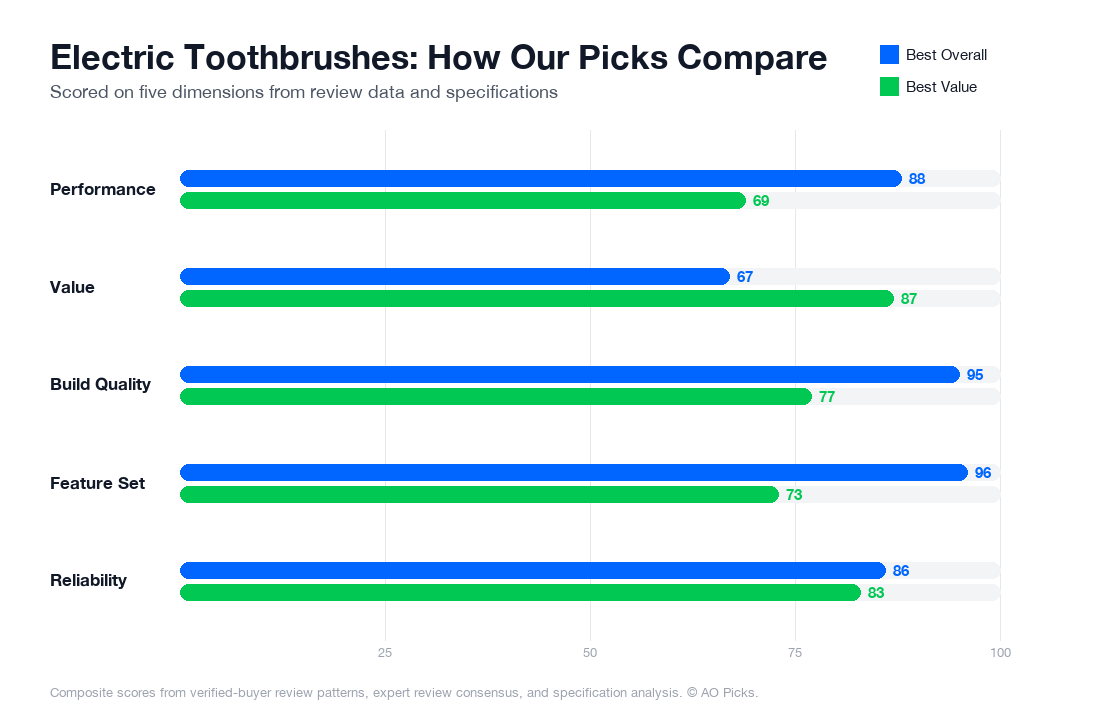

The Oral-B iO Series 9 offers advanced features like artificial intelligence and multiple cleaning modes for those seeking cutting-edge technology and premium performance. The Philips Sonicare ProtectiveClean 4100 delivers excellent cleaning results at a fraction of the cost, making it ideal for budget-conscious buyers who don't need extra features. Both have identical ratings, so your choice depends on whether premium features justify the $200 price difference.
Electric Toothbrushes: Common Questions
Does the magnetic iO drive clean significantly better than oscillating or sonic models?
The magnetic iO drive works differently from traditional oscillating bristles—it uses a magnetic push-pull motion that reviewers report feels gentler while still removing plaque effectively. However, cleaning performance across electric toothbrush types depends more on bristle design, brush head fit, and user technique than the motor type alone. Verified owners of the iO Series 9 consistently praise plaque removal, but studies show that any electric toothbrush—whether magnetic, sonic, or oscillating—outperforms manual brushing when used correctly. The real advantage of the iO drive isn't necessarily superior cleaning; it's the reduced vibration and quieter operation that makes extended brushing more comfortable, which can encourage better compliance with recommended two-minute sessions.
What's the difference between the 7 cleaning modes, and do you actually need that many?
The iO Series 9 includes modes like Daily Clean, Sensitive, Gum Care, Whitening, Deep Clean, Tongue Clean, and Professional. In practice, most users rely on one or two primary modes—typically Daily Clean for everyday use and Sensitive if they have gum tenderness. The additional modes appeal to people with specific needs: gum disease sufferers benefit from dedicated Gum Care cycles, while those with enamel erosion prefer Sensitive mode's lower intensity. Reviews show that multiple modes can feel like a marketing feature rather than a necessity for average users, but they do add flexibility without raising the price significantly compared to single-mode competitors. If you have sensitive teeth or gums, these extras provide tailored options; if you have straightforward dental health, Daily Clean alone will handle your routine.
How does the smart pressure sensor actually protect your gums, and will it stop me from brushing too hard?
The pressure sensor detects when you're applying excessive force to your teeth and gums, then either alerts you or automatically reduces brush intensity to prevent damage. This matters because hard brushing erodes enamel and recedes gums over time—a common problem that electric toothbrushes can actually worsen if used incorrectly. Verified owner reviews indicate the sensor provides useful real-time feedback, especially for people who instinctively brush hard. However, the sensor doesn't physically prevent you from pressing down; it warns you or self-adjusts. This distinction means you still need conscious awareness—the technology is a safety net, not a substitute for gentle technique. If you have a history of gum recession or sensitive teeth, the pressure feedback is genuinely helpful for retraining your brushing habits, making the iO Series 9's sensor a practical safety feature rather than an unnecessary gimmick.
What does the interactive display actually show you, and does it really improve your brushing?
The iO Series 9's display provides real-time feedback on brush head position, pressure level, and cleaning progress across your mouth's quadrants. Rather than just showing mode selection, it guides you toward better technique by highlighting which areas you've cleaned and when you're pressing too hard. Reviewers report this visual feedback helps develop consistent two-minute habits and ensures even coverage—many people naturally spend more time on front teeth and neglect back molars, which the display corrects. The practical value depends on your discipline: if you tend to rush or have sloppy technique, the interactive guidance meaningfully improves outcomes. If you already follow a structured routine, the display is a nice confirmation tool but not transformative. Think of it as a personal coach rather than a data tracker—it's designed to improve your behavior during brushing, not provide post-brush analytics.
Are replacement brush heads expensive, and how often will you need to swap them?
Oral-B iO brush heads typically cost $20–$35 for a multi-pack (usually 2–4 heads), with single heads around $8–$12. Most manufacturers recommend replacing heads every 3 months based on bristle wear, though many users report heads last 4–6 months with normal brushing. At $249.99, the iO Series 9 is a significant upfront investment, so consider replacement costs over time: assuming quarterly swaps at $7 per head, you'll spend roughly $28 annually on replacements. This is comparable to mid-range electric toothbrush systems but higher than budget oscillating models. The advantage is that iO heads are readily available through major retailers and Amazon, avoiding the frustration of discontinued or hard-to-find replacements. If long-term affordability matters to you, factor ongoing replacement costs into your decision—the initial purchase price isn't the full financial picture.
Does the AI recognition feature actually personalize your brushing, or is it marketing?
The iO Series 9's AI recognition uses the interactive display and pressure sensors to learn your brushing patterns and adapt recommendations over time. Rather than providing real-time coaching like the display does, it analyzes your habits across multiple sessions to identify weak spots—for example, consistently missing your lower left quadrant or pressing too hard on sensitive gum areas. Verified reviews indicate owners appreciate this adaptive feedback, particularly those seeking to improve technique gradually. However, the AI component is secondary to the manual guidance features; it enhances the toothbrush experience rather than replacing user responsibility. If you're disciplined and already brush effectively, AI personalization offers incremental value. If you struggle with consistency or technique, the combination of real-time display feedback plus adaptive learning creates a more supportive tool. Expect subtle improvements in outcomes over weeks rather than dramatic overnight changes—the feature works best as part of a comprehensive smart toothbrush system, not as a standalone game-changer.