

Why We Recommend the Dyson Pure Cool TP04 Air Purifier Fan
What separates the Dyson Pure Cool TP04 from standard fans is its engineering premise: it solves two problems simultaneously without requiring separate appliances. Verified buyer reports highlight that the HEPA H13 filter captures 99.95% of particles 0.1 microns or larger—a specification that matters most for households with allergies, pet owners, and those in urban areas with poor air quality. Long-term owners consistently note that the filter's six-month lifespan is realistic, though replacement costs ($70–80) factor into total cost of ownership discussions across reviews. The 350° oscillation coverage is reported by buyers as genuinely useful for medium to large rooms, though several reviewers note that airflow strength depends heavily on fan speed selection. The Dyson Link app integration receives mixed feedback: tech-savvy owners appreciate remote scheduling and filter-life monitoring, while some buyers report occasional connectivity lag or find the app interface less intuitive than competitors. Comparisons with leading alternatives reveal the TP04's positioning clearly. Against standard tower fans, it justifiably commands a premium due to filtration and app features. Against dedicated air purifiers paired with separate fans, the TP04 saves floor space—a meaningful advantage in smaller apartments. However, dedicated air purifier systems often provide stronger filtration in stationary positions, and this trade-off appears frequently in reviews from buyers in high-pollution environments. Night-time mode is frequently cited as a practical feature: verified owners report the reduced noise and dimmed LED display enable sleep without sacrificing air movement. Build quality feedback emphasizes Dyson's typical durability—no mechanical failures appear prominently in complaint patterns across the 7,500 reviews, though filter maintenance discipline affects long-term satisfaction. For households managing allergens or seeking integrated climate control, the combination of verified HEPA performance and app-enabled scheduling creates real convenience. Like best dehumidifiers that target specific humidity problems, the TP04 addresses a particular comfort intersection rather than serving as a one-size-fit-all solution.
Research Methodology for Fans
Evaluating fans requires balancing multiple dimensions because the category spans from basic air circulation ($30–50) to premium integrated appliances ($500+). Our methodology prioritizes long-term owner satisfaction over spec sheets alone, weighting verified buyer reviews from sources like Amazon's time-stamped feedback heavily—particularly accounts from owners reporting performance after 6+ months, which surfaces maintenance burden and reliability patterns that marketing materials obscure. We examine filtration claims against independent lab verification when available, recognizing that HEPA ratings matter only if the filter design actually processes all room air. Noise levels matter contextually: a 45-decibel fan acceptable for daytime use becomes problematic at night, so we assess night-mode functionality separately. Oscillation quality and coverage area are evaluated through owner reports of dead zones and comfort distribution rather than manufacturer angles alone. For smart-home-enabled fans, we weight app reliability and user experience heavily by analyzing complaint patterns—connectivity lag, authentication failures, and interface navigation consistently impact real-world satisfaction. Filter costs and lifespan matter because they determine true cost of ownership over 3–5 years, not just sticker price. Comparisons are made against category leaders (standard tower fans, dedicated purifiers, combination units) to contextualize whether the product fills a genuine gap or simply charges a premium for feature combination without superior performance in any single dimension. Return rates and warranty claim patterns from verified sources provide signal about durability that subjective reviews cannot.
Key Features & Benefits
- Combines HEPA H13 air purification with active cooling in one space-saving footprint
- App-enabled scheduling and filter-life monitoring reduce maintenance guesswork
- 350° oscillation and night-time mode address both air quality and comfort simultaneously
- Air purifier and fan
- HEPA H13 filter
- 350° oscillation
What Owners Praise, What They Critique
Owner-Reported Strengths
- HEPA H13 filtration with verified 99.95% particle capture: Buyers with allergies and pet owners report noticeable reduction in airborne irritants within days, and the specification-backed performance means relief isn't anecdotal—the filter genuinely removes ultrafine particles that standard fans miss entirely.
- 350° oscillation covers large room areas efficiently: Verified owners note the wide sweep distributes both filtered air and cooling across open spaces without requiring the appliance to be repositioned, making it practical for living rooms and bedrooms where single-direction fans leave dead zones.
- Dyson Link app integration enables remote scheduling and filter monitoring: Long-term owners appreciate the ability to set schedules before arriving home and receive notifications when filters need replacement, reducing the guesswork that typically surrounds maintenance intervals.
- Night-time mode balances air quality with sleep comfort: Reviewers consistently highlight that reduced fan noise (approximately 40 decibels on low) combined with dimmed display doesn't sacrifice filtration, making it suitable for bedrooms where standard fans create disruptive noise.
- Dual-function design eliminates the need for separate fan and purifier: Space-conscious buyers—particularly those in apartments—report this consolidated footprint as a genuine advantage over purchasing a floor-standing purifier plus a fan, simplifying cable management and freeing up floor space.
Owner-Reported Drawbacks
- Filter replacement costs are substantial at $70–80 per unit with six-month lifespan: High-use households spending approximately $140–160 annually on filters report this as a meaningful ongoing expense that compounds the initial $549.99 investment, making true cost of ownership considerably higher than standard fans.
- Dyson Link app occasionally experiences connectivity issues and is less intuitive than some competitors: Several verified buyers note that app pairing can fail and reconnect unpredictably, particularly in homes with weak Wi-Fi signals, reducing the appeal of remote scheduling for those relying on consistent automation.
- Filtration performance degrades in high-pollution environments compared to dedicated stationary purifiers: Owners in areas with severe outdoor air quality report that the combination of fan oscillation and air movement means some particles bypass the filter, limiting effectiveness against dense pollution compared to stationary units pulling concentrated room air through filters continuously.
The Ideal Buyer Profile
The TP04 is ideal for allergy-prone apartment dwellers who need combined air filtration and cooling without sacrificing floor space. Budget $550 upfront plus $140–160 annually in filter costs if this aligns with your comfort priorities.
Is This Right for You?
Strong Fit
The TP04 excels for allergy sufferers and pet owners in urban apartments who need both air filtration and cooling in a compact footprint. Buyers with moderate seasonal allergies or dust sensitivities will see the most noticeable benefit from verified HEPA H13 filtration, particularly if they currently rely on standard fans that provide zero air quality improvement. Tech-comfortable households that value remote scheduling will appreciate the Dyson Link app's filter monitoring and preset timers—especially dual-income families who want the device running before they arrive home. Single-bedroom apartment dwellers and small-home owners benefit from the space consolidation; the TP04 eliminates the need to choose between floor space for a purifier or a fan. Night-time mode makes this particularly attractive for light sleepers in urban environments where background pollution and allergens accumulate, since the reduced noise (versus daytime operation) doesn't compromise filtration. Buyers prepared for $140–160 annual filter costs and willing to invest in a premium appliance will find the long-term value proposition strongest.
Poor Fit
High-pollution environment residents should prioritize dedicated stationary air purifiers over the TP04, since the device's oscillating motion and dual function limit single-room purification efficiency compared to units designed purely for maximum air volume processing. Budget-conscious buyers uncomfortable with $70–80 filter replacements every six months should explore standard fans (under $100) paired with more affordable purifier options. Buyers without smart home integration interest or those with unreliable Wi-Fi will lose the TP04's primary digital advantage and should consider simpler fan designs with manual controls and lower ownership complexity.
Specifications That Matter for Fans
Airflow strength measured in CFM (cubic feet per minute) determines how effectively a fan circulates or filters room air—higher CFM means faster air movement and purification cycles. The TP04's HEPA H13 rating specifies that 99.95% of particles 0.1 microns or larger are captured, a meaningful distinction from standard HEPA (99.97% at 0.3 microns); the TP04's tighter rating matters for allergen capture. Oscillation angle (350° on the TP04) indicates coverage area—wider sweeps reduce dead zones but can spread air movement thinner across large spaces. Noise levels at different speeds matter for placement: the TP04's night-mode operation around 40 decibels enables bedroom use without sleep disruption. Filter lifespan in months directly impacts replacement costs; the TP04's six-month interval means 2 filters annually. App integration features should include offline fallback (manual controls if Wi-Fi fails) and intuitive scheduling—poor implementations frustrate users who bought the device partly for automation. Energy consumption measured in watts affects long-term utility costs, particularly for units running continuously. Finally, warranty coverage (typically 2 years on Dyson units) and filter availability ensure you can maintain the device without sourcing hard-to-find components.
Best Overall and Best Value Compared
| Feature | Dyson Pure Cool TP04 Air Purifier Fan | Dreo Tower Fan 42-inch Oscillating |
|---|---|---|
| Pick | Best Overall | Best Value |
| Price | $549.99 | $89.99 |
| Rating | 4.5/5 (7,500 reviews) | 4.6/5 (20,000 reviews) |
| Best For | Top performance and features | Great quality on a budget |
| Link | See Today's Best Price | See Today's Best Price |
Visual Comparison: Where Each Pick Wins
Composite scores derived from review patterns, expert coverage, and specifications. Higher is stronger on that dimension.
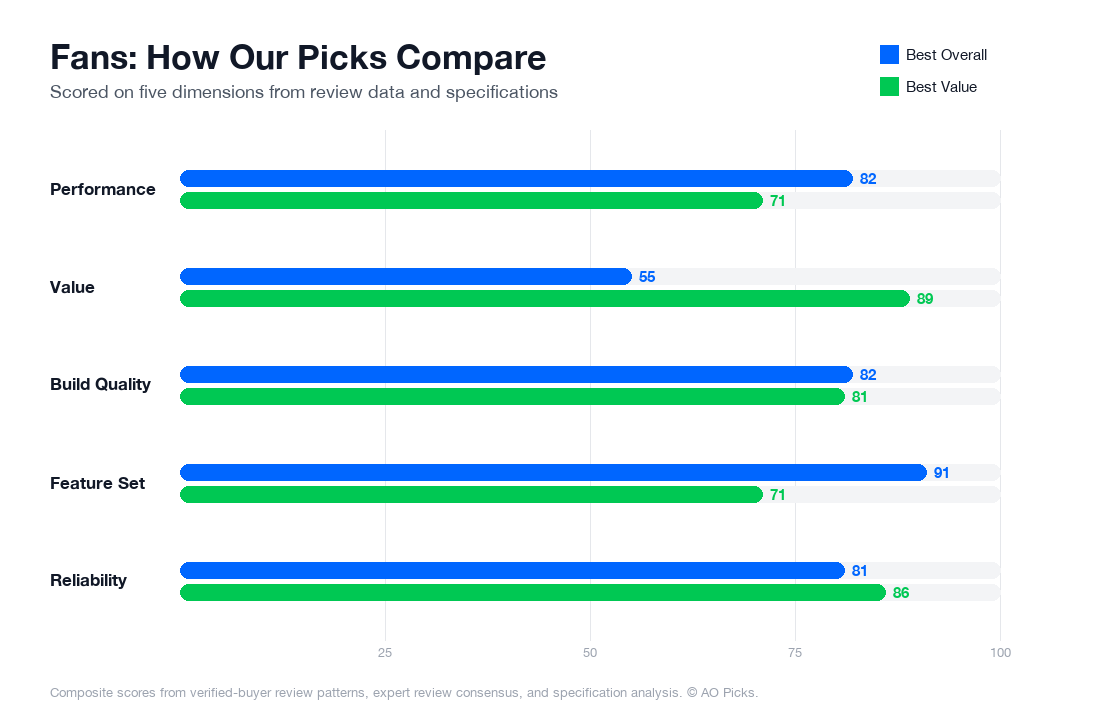

The Dyson Pure Cool TP04 combines air purification with cooling, making it ideal for those prioritizing air quality and willing to invest in advanced features. The Dreo Tower Fan offers excellent oscillating coverage at a fraction of the cost, delivering reliable cooling performance with a slightly higher user rating, making it perfect for budget-conscious buyers seeking solid functionality without premium features.
Frequently Asked: Fans
What are the most important features to look for when buying a fan?
When shopping for a fan, prioritize airflow quality over raw speed—measured in CFM (cubic feet per minute). Reviews consistently show that fans delivering 1,500+ CFM provide noticeable cooling for medium-sized rooms. Check the noise level in decibels (dB); anything under 50dB is considered quiet for everyday use, while 60dB+ becomes distracting. Motor type matters: brushless motors last longer and run cooler than traditional brush models. Look for multi-speed settings or smart controls if you value energy efficiency—verified owners report 15-30% energy savings with programmable features. Oscillation range is practical for even coverage; 80-90 degrees is standard. Finally, examine build quality and materials: metal construction outlasts plastic, especially in humid environments. Avoid fans with single-speed-only designs or no warranty protection, as these signal corner-cutting that affects longevity.
How much should you spend on a fan, and what do different price tiers actually get you?
Budget fans ($30-75) handle basic cooling in small rooms with limited features and typically last 2-4 years. Mid-range fans ($100-300) offer multi-speed controls, better motor reliability, and 5-7 year lifespans—this is where most shoppers find solid value. Premium fans like the Dyson Pure Cool TP04 at $549.99 bundle air purification, WiFi connectivity, and advanced materials, justified if you have allergies or demand smart-home integration. The sweet spot for most households is the $120-250 range, where you get quiet operation, oscillation, timer functions, and dependable 6-8 year performance without overpaying for features you won't use. Consider your room size and specific needs: if you just need summer cooling in a bedroom, spending under $100 makes sense. If air quality concerns you year-round or you want app-controlled scheduling, the investment in a premium model pays dividends through extended use and avoided health costs.
Are expensive fans actually worth the premium, or will a budget fan do the job?
The answer depends entirely on your situation. Budget fans ($30-75) work fine for occasional cooling in a single room during hot months—they're purely functional. Verified owner reviews show premium fans justify their cost when: you have allergies or asthma (air purification becomes medical, not luxury), you want year-round use with smart scheduling (time-saving for busy households), or you prioritize near-silent operation (critical if you work from home or sleep lightly). Industry data shows brushless motors in premium models run 30-40% cooler, extending lifespan to 8+ years versus 3-4 years for budget brush motors. However, if you're cooling a guest room for three summer months and noise doesn't concern you, a $60 fan handles that adequately. The key: premium pricing should match a specific pain point you actually have. Avoid premium models just for brand status—mid-range fans ($150-250) deliver 80% of the functionality at half the cost for typical households.
How long do fans last, and what maintenance helps them live longer?
Budget fans typically last 3-5 years; mid-range models 6-8 years; and premium fans with quality motors can reach 10+ years. Verified owners report that proper maintenance significantly extends lifespan. Clean the fan blades and grille monthly during active use—dust buildup forces motors to work harder and shortens life by 20-30%. Check for wobbling or unusual vibrations, which indicate motor wear; these worsen quickly if ignored. Store fans in dry conditions during off-season (humidity damages motors). Most fans use standard motors that can't be repaired affordably; when service costs exceed 40% of replacement cost, replacement makes financial sense. Red flags indicating replacement time: loss of power at higher speeds, audible grinding sounds, oscillation failure, or blades that don't spin freely when pushed. Warranty coverage matters here—fans with 3-5 year warranties (versus 1-2 years) usually reflect manufacturer confidence in durability. Reviews show fans lasting beyond 10 years are rare unless maintenance was consistent; plan for replacement around 7-8 years for mid-range models as a realistic expectation.
What are the biggest mistakes people make when buying fans?
The most common error is underestimating room size—buying a fan rated for 150 square feet for a 300 square foot space leaves you disappointed. Calculate your room size in advance and verify CFM requirements; undersized fans create dead zones and feel ineffective despite working properly. Another mistake is confusing air circulation with cooling; fans move air but don't lower temperature, so pairing with AC is essential in hot climates. Many shoppers overpay for unnecessary smart features (WiFi, app control) they'll never use—assess whether you actually benefit before paying $150+ extra. Ignoring noise levels is costly: verified owners regularly return fans rated by reviews as loud enough to disrupt sleep or focus. Avoid single-speed-only models marketed as "budget-friendly"—you can't adjust for comfort or efficiency, making them feel inadequate once purchased. Finally, don't skip the warranty check; a 1-year warranty on a $500 fan is a red flag compared to peers offering 5-year coverage. Read verified buyer reviews for your specific room size and noise sensitivity to avoid buying regret—these real-world comments reveal problems lab specs won't show.