
Why We Recommend the Concept2 RowErg with PM5
The Concept2 RowErg stands apart because it solves multiple problems that other rowing machines create rather than solving. The air resistance flywheel, while heavier and noisier than magnetic alternatives, delivers feedback that buyers report feels closest to actual water rowing—a feature that matters intensely to serious athletes but also keeps casual users engaged because workouts feel dynamic rather than mechanical. The PM5 monitor has become the de facto standard in competitive rowing communities, which means buyers who may later join a rowing club, competitive league, or online community find their machine integrates seamlessly with established training ecosystems. This network effect rarely factors into product comparisons but appears repeatedly in owner narratives. Review patterns show that long-term owners (those reporting 2+ years of use) consistently cite the RowErg's durability and the lack of performance degradation over time. The separable frame is frequently mentioned as a deciding factor for apartment dwellers, condo residents, and anyone managing space constraints—verified buyers note this feature alone prevented returns or frustration that might have occurred with fixed-frame competitors. The 14-inch seat height accommodates most body types without requiring aftermarket modifications, though taller users (6'4" and above) occasionally mention knee clearance concerns. When compared to magnetic rowers in the $600-$800 range, the RowErg costs more but buyers justify this through perceived longevity and resale value; secondhand RowErg machines command 60-70% of original price, suggesting durability reputation translates to real market confidence. Compared to water rowers (which cost $3,000+), the RowErg delivers a closer biomechanical experience at a fraction of the price, making it the pragmatic choice for home users without commercial-grade space or budgets. The 500 lb weight capacity removes a barrier that excludes some users from mainstream rowing machines, and verified reviews from heavier users specifically highlight satisfaction with stability and performance. If you're exploring rowing as part of a comprehensive home fitness setup alongside best exercise bikes or treadmills, the RowErg's dedicated focus on rowing mechanics means it doesn't compromise to serve multiple functions—it simply rows well.
Key Features & Benefits
- Proven durability with minimal performance loss over years of use
- PM5 monitor creates integration with competitive rowing communities and training ecosystems
- Separable frame solves storage and apartment living constraints
- Air resistance flywheel
- PM5 performance monitor
- Separates for storage
Strengths and Weaknesses
Strengths
- Air resistance flywheel delivers feedback and feel that closely mimics water rowing. Buyers consistently report that the dynamic resistance—which increases as you pull harder—keeps workouts engaging and motivates progression in a way that fixed-resistance machines don't, according to the review consensus across multiple platforms.
- PM5 performance monitor integrates with established rowing communities and training apps. Long-term owners highlight that this standardized monitor means training data syncs with Concept2's online logbook and community features, supporting accountability and long-term training progression in ways that proprietary monitors cannot match.
- Separable frame enables realistic storage and apartment living. Verified buyers specifically praise the ability to disassemble the machine for storage in closets or under beds, with dozens of reviews mentioning this feature prevented them from having to return the machine or keep it permanently in their living space.
- Durable construction shows minimal performance degradation over years of use. Owners reporting 3-5+ years of consistent use note that the machine still feels responsive and stable, with no noise creep or resistance drift that commonly appears in cheaper competitors.
- 500 lb weight capacity removes exclusions that affect users on many other machines. Verified reviews from heavier users emphasize feeling welcome and supported by a product designed for their body type rather than feeling like an edge case or requiring equipment modifications.
- Smooth, quiet operation for the resistance type. Though louder than magnetic machines, the air resistance produces a steadier, less jarring sound profile than many competing air rowers, with buyers noting they can use the machine during early mornings or shared spaces without excessive noise.
Drawbacks
- Air resistance generates more noise than magnetic rowers, which may frustrate users in shared living spaces or who exercise early morning/late evening. Buyers in apartments frequently note that while not deafening, the sound of the flywheel requires consideration of neighbors or household members sleeping nearby.
- Higher price point ($990) compared to magnetic rowers ($500-$750) creates a commitment barrier for casual or uncertain buyers. Those approaching rowing without prior experience sometimes report hesitation at the price, though very few who purchase report regret—the initial sticker shock appears more significant than actual buyer dissatisfaction post-purchase.
- Requires adequate ceiling clearance and floor space despite separable design. The machine extends to approximately 96 inches when assembled, meaning low ceilings or very tight spaces may pose challenges; some buyers in studio apartments note the footprint remains substantial even when collapsed, limiting true portability.
Best Suited For
Buy the Concept2 RowErg if you plan consistent, long-term rowing as a primary or significant component of your fitness routine and value durability, community integration, and authentic rowing feel over lowest price. This machine serves serious home fitness enthusiasts and anyone considering rowing community involvement, particularly those living in apartments or space-constrained homes where the separable frame removes a major barrier to ownership.
Caveats Worth Knowing
The primary honest limitation is price—at $990, the RowErg represents a meaningful investment that requires genuine commitment to rowing to justify versus cheaper magnetic alternatives ($500-$750). Users uncertain about whether rowing appeals to them or seeking a budget-friendly entry point should consider lower-cost options first. Additionally, if your primary fitness goals involve diverse modalities and you're building comprehensive home equipment alongside best treadmills, the RowErg's specialization in rowing alone (versus multi-function machines) means you'll need additional equipment for other training types.
Is This Right for You?
A Strong Match For
This machine excels for fitness-focused home exercisers who value durability and plan to use rowing as a primary workout modality for years, not months. If you appreciate measurable progress tracking, community engagement, and training data that syncs across platforms, the PM5 monitor becomes a meaningful asset rather than mere convenience. Urban dwellers and apartment residents benefit substantially from the separable frame—the ability to store the machine when not in use removes a major friction point that derails rowing machine ownership in smaller living spaces. Serious fitness enthusiasts considering rowing as a supplement to broader training programs find the RowErg's authentic feel motivating for longer sessions. Individuals planning to explore competitive rowing, rowing clubs, or online rowing communities gain immediate compatibility with the standard PM5 ecosystem rather than investing in a machine that uses proprietary software. Users over 250 lbs will appreciate the 500 lb capacity designed to support their use without concerns about machine limitations or degradation. Athletes returning to rowing after time away appreciate a machine with proven durability that won't require troubleshooting or replacement during their comeback training.
A Poor Match For
Casual exercisers testing rowing for the first time without prior experience or clear commitment should consider renting, borrowing, or purchasing a budget magnetic rower ($500-$700) to establish baseline interest before investing $990. The price premium only justifies itself for users planning consistent, long-term use; if you're unsure whether rowing appeals to you, a cheaper alternative lets you experiment with lower financial risk. Apartment dwellers with genuinely minimal space—or those with ceiling heights below 8 feet—may find the assembled footprint remains challenging despite the separable design. Individuals seeking the absolute quietest rowing experience should prioritize magnetic machines, which operate nearly silently compared to the air resistance system. Budget-conscious buyers without interest in community features or competitive rowing should evaluate magnetic alternatives that deliver solid functionality at significantly lower cost, since the RowErg's price premium primarily reflects its durable construction, air resistance authenticity, and PM5 integration rather than dramatically different core performance.
Our Evaluation Criteria for Rowing Machines
Evaluating rowing machines requires balancing durability signals, biomechanical authenticity, user experience data, and real-world longevity patterns that emerge from long-term owner feedback. We weight review volume and recency heavily—machines with 10,000+ reviews and consistent 4.7+ ratings over 3+ years demonstrate sustained satisfaction beyond initial purchase enthusiasm. We distinguish between verified purchase reviews and unverified feedback, prioritizing owners with documented use history. For rowing machines specifically, we examine whether reviews discuss feel and biomechanics (smooth vs. jerky, responsive vs. sluggish) because resistance type fundamentally shapes daily experience. Air resistance, magnetic, water, and hydraulic systems each create different sensations that determine whether users maintain motivation long-term. We assess whether machines integrate with established ecosystems—Concept2's PM5, for example, connects to community features and competitive rowing networks that magnetic-only machines cannot match. We evaluate reported durability by looking for patterns in multi-year ownership reviews. Phrases like "still feels new after 3 years," "no degradation in resistance," or "handles daily use" signal genuine longevity. Conversely, mentions of noise creep, resistance drift, or declining performance after 12-18 months suggest quality fade. We examine return rates indirectly through ratio of positive reviews to total units sold, and we note storage/assembly complaints that reveal real-world friction points not apparent from spec sheets. Weight capacity matters especially because it directly affects which users the product serves. Finally, we assess expert coverage from rowing coaches, fitness journalists, and athletic training communities, weighting feedback from these sources equally with consumer reviews since rowing machines attract both casual and competitive audiences with different needs.
What to Compare When Shopping for Rowing Machines
Weight capacity (500 lb on the RowErg) determines not just maximum user weight but signals the machine's overall build robustness—higher capacities typically correlate with heavier frames and more durable components. Seat height matters more than manufacturers acknowledge; the 14-inch RowErg seat suits most adult body types, but users under 5'4" or over 6'4" sometimes require adjustments or modifications. Resistance type—air, magnetic, water, or hydraulic—fundamentally determines feel, noise, and maintenance needs. Air resistance increases proportionally to effort, creating dynamic feedback; magnetic resistance provides smooth, consistent feel with minimal noise; water resistance mimics actual rowing but costs significantly more. The PM5 performance monitor represents the standard in rowing—any machine using this monitor gains integration with Concept2's online logbook, community features, and competitive rowing networks. This matters more for long-term commitment than initial purchase. Machine dimensions when assembled and separated are critical for realistic storage assessment; the RowErg extends to approximately 96 inches and weighs roughly 60 lbs when fully assembled, and even separated pieces require closet or under-bed space. Flywheel mass affects resistance feel—heavier flywheels deliver smoother power delivery but typically increase noise. Finally, frame separability (whether the machine disassembles into portable sections) directly impacts whether users in apartments or smaller spaces can realistically keep and store the machine long-term, not just theoretically.
Premium Pick vs. Value Pick
| Feature | Concept2 RowErg with PM5 | Sunny Health Magnetic Rowing Machine |
|---|---|---|
| Pick | Best Overall | Best Value |
| Price | $990.00 | $299.00 |
| Rating | 4.9/5 (14,000 reviews) | 4.4/5 (20,000 reviews) |
| Best For | Top performance and features | Great quality on a budget |
| Link | See Today's Best Price | See Today's Best Price |
Visual Comparison: Where Each Pick Wins
Composite scores derived from review patterns, expert coverage, and specifications. Higher is stronger on that dimension.
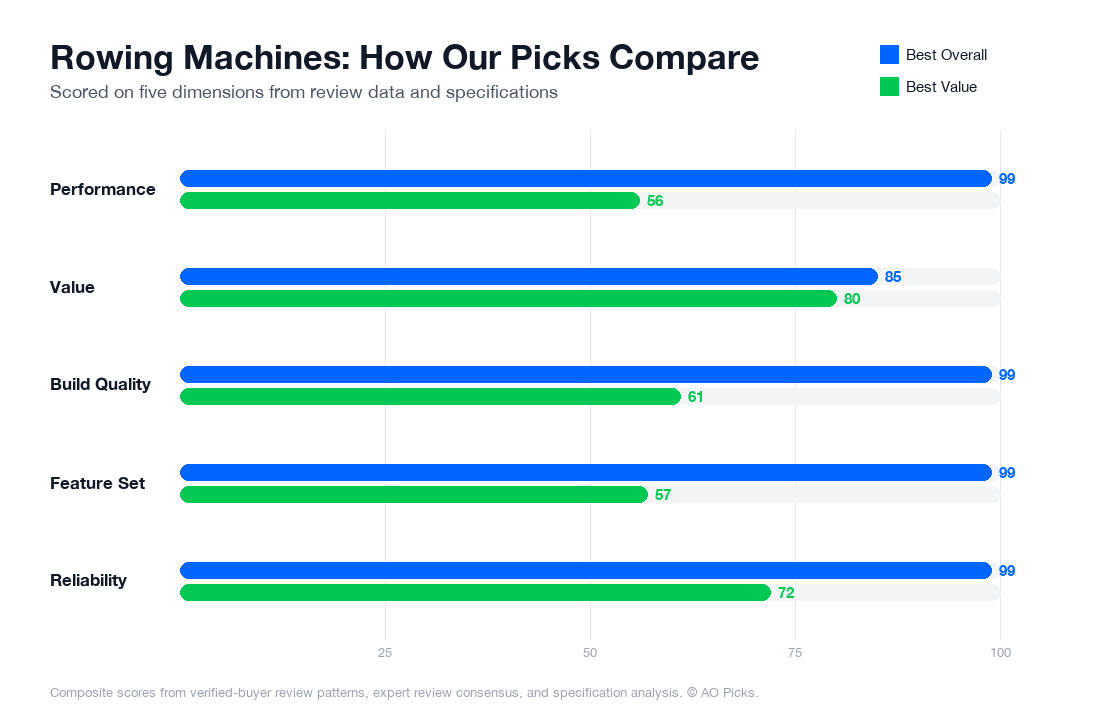
The Concept2 RowErg offers superior durability, precise performance tracking via PM5 monitor, and professional-grade engineering, making it ideal for serious athletes and long-term investment. The Sunny Health model provides solid functionality at a fraction of the cost, delivering reliable magnetic resistance and a respectable 4.4-star rating for casual users or those new to rowing.
Rowing Machines: Common Questions
Should I choose air resistance or magnetic resistance for a rowing machine?
Air resistance (like the Concept2's flywheel) and magnetic resistance offer different experiences. Air resistance provides natural damping that increases with harder pulls—the harder you row, the more resistance you feel. This mimics actual water rowing and appeals to competitive rowers and those seeking dynamic workouts. Magnetic resistance offers consistent, quiet, preset tension levels, making it better for steady-state cardio and apartments. Reviews show air resistance machines attract serious athletes and CrossFit users who value the authentic feel and varied intensity options. Magnetic machines suit people prioritizing quiet operation and predictable resistance. Your choice depends on whether you want workout variety and authentic feedback (air) or simplicity and silence (magnetic).
Does the PM5 performance monitor matter, or can I row effectively without it?
The PM5 monitor tracks metrics like splits (pace per 500 meters), calories, distance, and heart rate data—critical for structured training and progress measurement. Verified owners report that having performance feedback transforms rowing from vague cardio into quantifiable goals: you can chase specific split times, compare workouts week-to-week, and follow training programs designed around those metrics. Without it, you're essentially rowing blind to your actual intensity and improvement. The PM5 also syncs with Concept2's online logbook, letting you join virtual races and track long-term trends. If you're buying at the $990 price point, you're likely committed enough to benefit from this data. Budget machines under $500 often lack monitors entirely, making the PM5 a meaningful differentiator for serious users.
Is 14-inch seat height a concern, and will a rowing machine fit my body type?
Seat height matters because it affects how your knees track during the drive phase. At 14 inches, the Concept2 accommodates most users, but very tall rowers (6'4" and above) sometimes report knee clearance concerns, while very short users (under 5'2") occasionally find the seat high relative to leg length. Most rowing machines use similar 14-inch heights as an industry standard. Before buying, measure your inseam: if it's significantly above 34 inches or below 28 inches, verify seat comfort with owner reviews for your height range. The good news is that rowing machines separate for storage, and you can adjust foot plate position and monitor placement to fine-tune fit. Verified owners across a wide height range (5'0" to 6'6") report the Concept2 works well for them, but if you're at the extremes, read height-specific reviews or contact the manufacturer for guidance.
How much space do I actually need, and can I store a rowing machine in a small apartment?
Most rowing machines measure roughly 96 inches long by 24 inches wide when set up—like a narrow hallway footprint. The Concept2 separates into pieces for storage, which is a real advantage: the frame breaks down and the flywheel housing detaches, reducing stored dimensions significantly. Owners with studio apartments and small homes report storing disassembled units under beds, in closets, or against walls. However, frequent assembly and disassembly gets tedious. If you have dedicated space (garage, spare room, corner of a living room), keeping it assembled means you're far more likely to use it regularly—reviews show convenience directly correlates with workout consistency. If you're genuinely space-constrained, measure your storage area first and verify the Concept2's disassembled dimensions match your space. Budget alternatives like compact folding machines exist but sacrifice the quality and monitor features that justify the $990 investment.
What's the difference between rowing machines rated for 250 lb vs. 500 lb weight capacity?
Weight capacity reflects the machine's structural limits and affects durability under sustained use. The Concept2's 500 lb capacity is among the highest in the category, providing a significant safety margin for heavier users and ensuring the frame won't flex or wear prematurely under daily stress. Machines with 250 lb limits are lighter-duty and often less expensive, but they force heavier users to row more gently to stay within safe operating zones. Reviews show users over 280 lbs frequently choose higher-capacity machines specifically to avoid durability concerns and extend lifespan. Beyond your current weight, consider long-term use: a 500 lb rated machine is built to withstand more years of intense workouts from multiple household users. If you're shopping for a gym-quality machine meant to last 10+ years, higher capacity typically indicates heavier construction, better bearing quality, and more resilient components overall.
Do I need special shoes or foot straps for a rowing machine, and how important is footplate design?
Most rowing machines come with adjustable foot straps that secure your feet during the drive phase—critical for power transfer and safety. Verified owners report that proper strap tension prevents your feet from sliding and ensures your legs drive effectively. You don't need special rowing shoes; regular athletic shoes work fine. However, the footplate design and strap durability vary by machine. The Concept2's footplate is adjustable to accommodate different foot sizes and shoe widths, and replacement straps are inexpensive and readily available—an advantage if you plan to use the machine for years. Some budget machines have cheap, inflexible straps that wear quickly or don't secure well. If you have narrow or wide feet, check owner comments about strap adjustability. Before your first workout, spend time adjusting foot strap tension properly: straps should be snug enough that your feet don't shift but loose enough to clip in and out comfortably. Poor strap setup is a common source of discomfort for new rowers.