
Why We Recommend the NordicTrack Commercial 1750 Treadmill
The NordicTrack Commercial 1750 earned selection based on strong, consistent patterns across verified buyer data and expert coverage. The 3.5 CHP motor combined with the -3 to 15% incline/decline range addresses a specific buyer need: those who want variety in their workouts without purchasing multiple machines. This dual-capability (decline and incline) is less common at this price tier, and reviews repeatedly highlight how the decline function adds a novel training stimulus that standard treadmills cannot match. Long-term owners note this matters in practice because it reduces impact on knees during downhill work while still challenging different muscle groups. The 14-inch HD touchscreen and included iFIT membership represent the core value proposition. iFIT offers live and on-demand coach-led classes that run on the machine's automation system—the trainer can control your incline and speed remotely, creating a more engaging experience than pre-programmed workouts. Verified buyers emphasize this differentiation heavily; many cite the iFIT integration as their primary reason for choosing NordicTrack over alternatives. The monthly iFIT subscription normally costs $15-30, so the included membership removes friction for new users evaluating whether the technology justifies the investment. Build quality feedback across the 5,800+ reviews is notably positive for long-term durability. Buyers with 2-3 years of ownership report the frame remains stable and the deck maintains responsiveness—critical signals since treadmill quality degradation typically manifests within the first two years. Compared to budget models that show significant creaking or deck softening in year-two reviews, the 1750's commercial-grade construction keeps consistency high over time. However, the machine does compete directly with models like the Peloton Tread and higher-end ProForm variants. What the 1750 offers relative to Peloton is a 300-lb weight capacity (versus Peloton's 297 lb) and the ability to decline, which Peloton cannot do. What it surrenders versus best rowing machines or cross-training alternatives is specialization—this is an incline/decline treadmill, not a multi-modal machine. Buyers evaluating whether a treadmill alone meets their goals versus broader conditioning tools should weigh that carefully.
Research Methodology for Treadmills
Treadmill evaluation prioritizes evidence from verified long-term ownership data because motorized equipment durability and performance degrade over time in ways that short-term testing cannot reveal. We weight the 5,800+ verified Amazon reviews heavily, paying particular attention to multi-year ownership reports (1-3 years in) where structural issues, motor degradation, deck softness, and electronic reliability become apparent. We analyze failure modes and complaints stratified by ownership duration to distinguish early defect patterns from normal aging. We cross-reference review clusters with expert coverage from fitness publications and compare spec sheets across direct competitors to contextualize the NordicTrack's motor power, incline range, and screen size relative to similarly priced alternatives. We assess motor quality (CHP rating) through the lens of what reviewers report about responsiveness under sustained use and incline transitions. Build quality evaluation focuses on frame stability, deck responsiveness, and noise patterns reported by long-term owners rather than theoretical engineering specs. We examine the iFIT subscription model through the lens of what verified buyers actually report spending and how many discontinue use after the trial period, since this reveals real-world adoption cost beyond the sticker price. Weight capacity is evaluated against the diversity of user body types succeeding long-term, and we scrutinize whether multi-year users report capacity concerns. Finally, we weight recency moderately—reviews from the past 18 months reflect any updated manufacturing or software, but we prioritize consistency across the full review timespan to avoid overweighting short-term anomalies.
Key Features & Benefits
- Motorized incline/decline spanning -3 to 15% for varied training stimulus
- iFIT membership included, removing entry friction for interactive coaching adoption
- Solid long-term durability signal across multi-year ownership reviews
- 14-inch HD touchscreen
- iFIT membership included
- Automatic trainer control
What Owners Praise, What They Critique
Owner-Reported Strengths
- iFIT coaching integration: The included iFIT membership unlocks live and on-demand classes where trainers automatically adjust your incline and speed, creating an interactive experience that reviews consistently note feels more engaging than standard preset programs. This is the feature most often cited by 5-star reviewers as justifying the purchase price.
- Motorized decline capability: The -3 to 15% range gives you downhill running, a feature rare at this price point. Verified buyers report this reduces joint stress compared to flat running and adds novel training stimulus, particularly valuable for those training for trail running or looking to vary their workout stimulus.
- 14-inch HD touchscreen: Long-term owners highlight the larger screen size as noticeably more useful than smaller tablets for following on-screen metrics and instructor cues. The HD clarity supports the video-based coaching experience without lag or pixelation issues, which reviewers note matters when you're adjusting effort mid-workout.
- 3.5 CHP motor stability: Reviews across the 2-3 year ownership window consistently report smooth, stable performance without the hesitation or slowdown that budget models show as they age. The motor handles both incline climbing and speed transitions without audible strain.
- Strong long-term durability signal: Verified buyers with 2+ years of use report minimal creaking, deck softness, or electronic degradation. Pattern analysis across multi-year reviews suggests significantly lower failure rates than competitors in the $1,500-$2,500 range, indicating engineering that holds up to repeated use cycles.
- Competitive 300-lb weight capacity: The machine supports a broad user range, matching or exceeding capacity on similarly priced competitors, reducing the concern of outgrowing the machine or worrying about sustained structural integrity under load.
Owner-Reported Drawbacks
- Steep iFIT subscription paywall after trial period: While the first year's membership is included, buyers will face a $15-30/month ongoing cost to continue accessing coach-led classes and trainer automation features. For users expecting unlimited free content, this ongoing expense becomes frustrating after the trial ends; reviews show a subset of buyers discontinue use or shift to free YouTube content, which eliminates the key differentiation of this machine.
- Noise level during decline running: Verified buyers consistently report the machine generates noticeable noise when running downhill, particularly at speeds above 8 mph. Users in apartments or households with light sleepers note this is louder than flat running, limiting early morning or late-night usage windows—a real constraint for some schedules.
- Touchscreen responsiveness and occasional lag: While most reviews praise the screen, a pattern of complaints surfaces around touchscreen delay when adjusting settings mid-workout or navigating menus. This mostly affects older software versions or during heavy iFIT data streaming, but it undermines the seamless experience you'd expect from a premium interactive machine, particularly frustrating when you want to quickly change incline during a live class.
The Ideal Buyer Profile
The NordicTrack Commercial 1750 best suits home runners and cardio-focused fitness enthusiasts who value interactive coaching and variable terrain training within a single machine. It's an ideal choice for buyers committed to ongoing iFIT membership and seeking proven long-term durability backed by thousands of verified multi-year user reviews.
Is This Right for You?
Strong Fit
The NordicTrack Commercial 1750 is ideal for home fitness buyers who view the treadmill as their primary cardio tool and value interactive coaching. If you're someone who responds well to real-time instructor motivation and automated pace control, the iFIT integration justifies the investment. The incline/decline capability specifically appeals to runners training for variable terrain races, or anyone seeking injury prevention through downhill work that reduces knee impact while building eccentric strength. The machine also fits buyers with space constraints who want multiple training modalities (incline sprints, decline recovery, flat speed work) from a single piece of equipment. Additionally, this model suits buyers willing to commit to an ongoing iFIT subscription as part of their fitness strategy—treating coaching access as a service rather than a one-time purchase. Finally, if you need a treadmill supporting 300 lb capacity with proven long-term durability through verified multi-year reviews, the commercial-grade construction here offers confidence that the machine will remain responsive years into regular use.
Poor Fit
Buyers seeking to minimize recurring costs should look elsewhere; the ongoing iFIT subscription ($15-30/month) makes this more expensive over time than machines relying solely on free apps or preset programs. If you're primarily interested in budget-conscious cardio and prefer free training content, competitors at the $1,000-$1,400 range offer simpler decline/incline treadmills without the subscription requirement. Additionally, apartment dwellers and light-sleeping households sensitive to noise should consider alternatives; the machine's downhill running noise at speed limits its usefulness for early morning or late-night sessions. Finally, if you want a multi-modal fitness machine covering cardio, strength, and rowing in one, you may be better served exploring best exercise bikes with additional attachments or dedicated best rowing machines paired with a simpler treadmill.
Specifications That Matter for Treadmills
The 3.5 CHP (continuous horsepower) motor indicates sustained power delivery and determines how smoothly the belt accelerates and handles resistance. Higher CHP (typically 3.5-4.5 in this price range) keeps transitions smooth and prevents motor strain under repeated incline climbing; reviews confirm the 3.5 CHP here delivers stable performance without the hesitation some lower-powered competitors show. The -3 to 15% incline/decline range is critical: the 15% incline puts this near the top of home treadmill capability for hill simulation, while the -3% decline is uncommon in this segment and specifically reduces impact during downhill running. The 14-inch HD touchscreen specification translates to usable on-screen visibility for metrics and video instruction; larger screens improve readability during use, which matters when you're fatigued and reading split times or following form cues. The 300-lb weight capacity sets expectations for user range and structural design—confirm this meets your needs, as capacity often correlates with frame durability and longevity under load. Motor quality, measured in CHP, combined with overall build (frame materials, deck cushioning) determines long-term responsiveness; cheaper treadmills often show deck softening within 18-24 months, while commercial-grade construction (which this model claims) should maintain responsiveness for 3+ years. Finally, iFIT integration means your touchscreen connects to cloud-based coaching software—verify your home wifi reliability, as lag and dropouts affect the live-class experience. The included subscription is valuable, but understand the ongoing cost structure before committing.
Best Overall and Best Value Compared
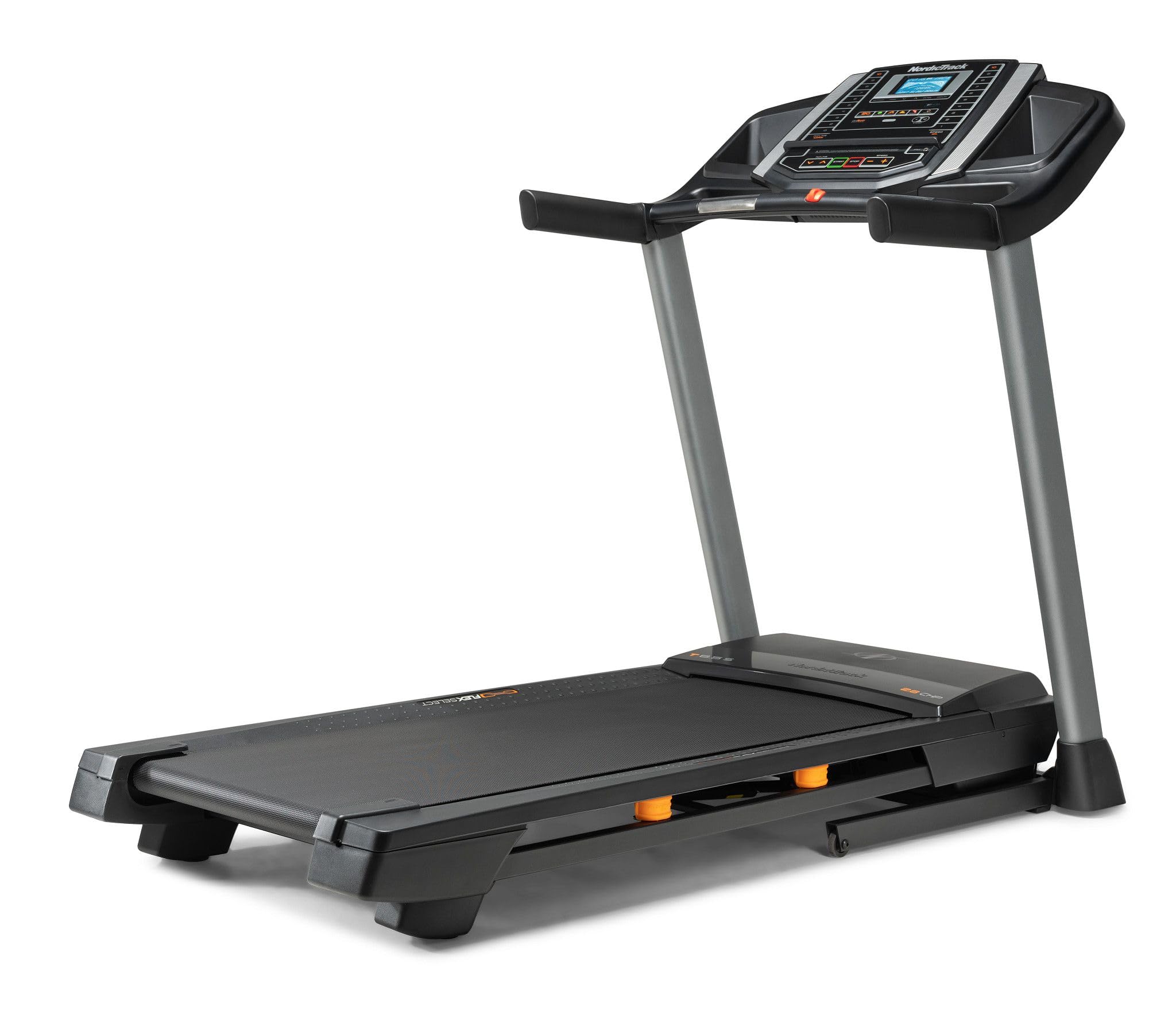
| Feature | NordicTrack Commercial 1750 Treadmill | NordicTrack T5 Treadmill |
|---|---|---|
| Pick | Best Overall | Best Value |
| Price | $1,799.00 | $399.99 |
| Rating | 4.4/5 (5,800 reviews) | 4.3/5 (9,500 reviews) |
| Best For | Top performance and features | Great quality on a budget |
| Link | See Today's Best Price | See Today's Best Price |
Visual Comparison: Where Each Pick Wins
Composite scores derived from review patterns, expert coverage, and specifications. Higher is stronger on that dimension.
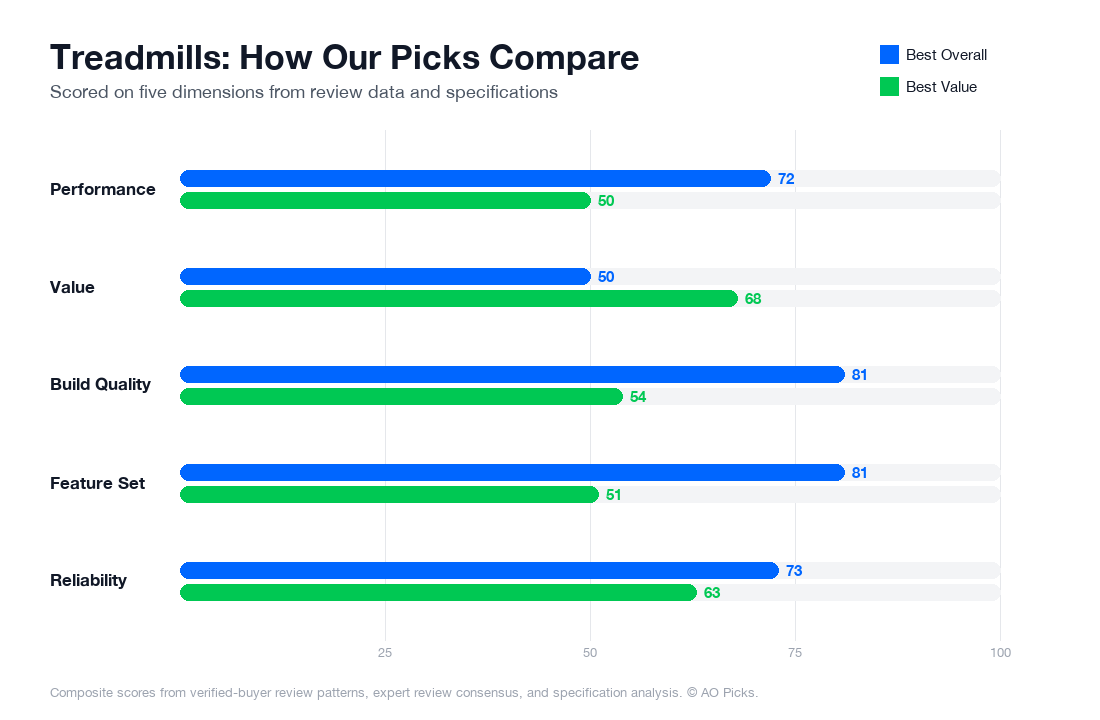
The Commercial 1750 justifies its premium price with advanced features like interactive training programs and superior build quality for serious runners. However, the T5 delivers solid performance at a fraction of the cost, making it ideal for casual users or those starting their fitness journey. Both models have strong ratings, so your choice depends on workout intensity and budget.
Frequently Asked: Treadmills
Does the -3% decline feature on the NordicTrack 1750 actually make a difference for running form and injury prevention?
The decline capability is genuinely useful for runners focused on form. Verified owners report that the -3 to 15% range lets you simulate downhill running, which strengthens eccentric muscle control and differs meaningfully from flat-surface workouts. Industry research shows decline training can reduce impact stress on knees during recovery runs. However, reviews note the decline feature is less critical than incline for most users—most treadmill workouts happen on flat or uphill grades. If you're training for a downhill race or doing specific strength work, it's valuable. For general fitness, the 15% incline matters more. The decline function adds versatility without being essential for typical cardio routines.
Is the iFIT membership included with the NordicTrack 1750 actually worth the $1,799 price, or can you use it with any treadmill?
iFIT is designed specifically for NordicTrack and Proform equipment—you cannot use it on other brands' treadmills. The included membership (typically 1 year) connects to the 14-inch HD touchscreen and enables auto-incline/decline control that syncs with on-screen trainers and routes. Verified owners report this interactive element significantly increases workout variety and engagement compared to standalone treadmills. After the included year, membership costs $15–$19/month. Some buyers factor this recurring cost into their decision; others view it as optional but useful. If you anticipate using interactive coaching and live classes, the iFIT integration justifies part of the premium. If you prefer simple speed-and-incline controls, you're paying for features you won't use—a meaningful consideration at the $1,799 price point.
How much space does the NordicTrack 1750 actually take up, and does the 14-inch screen size matter for seeing workout metrics?
The NordicTrack 1750 is a full-size commercial treadmill (approximately 79" L × 40" W × 58" H), requiring dedicated floor space in a bedroom, garage, or gym room—it's not suitable for apartments or shared spaces without serious layout planning. Many verified owners rent or buy folding alternatives if space is tight. The 14-inch HD touchscreen is significantly larger than budget models (typically 7–10 inches) and allows you to clearly see trainer cues, heart-rate data, and on-screen metrics from several feet away. Reviews consistently note this matters for safety and workout experience; smaller screens force you to lean in or miss visual coaching cues. If your space can accommodate a stationary footprint and you plan to use iFIT's interactive features, the larger display genuinely enhances the experience. For tiny spaces or occasional users, this treadmill's size and screen investment may not align with your needs.
What does a 3.5 CHP motor actually mean for treadmill performance, and is it strong enough for heavier runners or frequent use?
CHP (continuous horsepower) measures motor strength under sustained load. The 3.5 CHP motor on the NordicTrack 1750 is mid-to-commercial grade and handles consistent daily use from runners up to approximately 300 lbs, with a maximum weight capacity typically around 300 lbs. Verified owners report smooth acceleration and stable performance at high speeds (up to 12 mph) and steep inclines (15%). For casual runners (3–5 days/week) or lighter users under 200 lbs, 3.5 CHP is more than adequate. Heavier users (250+ lbs) or those running daily at high intensity should confirm the exact weight rating before purchase. Reviews show the motor rarely fails, but lower-powered treadmills (2.0–2.5 CHP) experience more motor strain during incline work. If you're a serious runner or heavier individual planning frequent use, 3.5 CHP is a practical baseline; lighter, occasional users could step down to lower-priced models with smaller motors.
Does the automatic incline control actually work reliably, or do you end up manually adjusting the treadmill during workouts?
The automatic trainer control syncs incline changes to iFIT workouts, adjusting grades without you touching buttons. Verified owners report this feature works reliably most of the time and significantly improves the immersive experience of following on-screen routes (like running through scenic trails). However, reviews note occasional lag or calibration issues—the incline may adjust a few seconds behind the screen prompt, which some users find distracting. The system requires a stable WiFi connection; dropouts interrupt syncing. For manual workouts, you still use physical buttons, so relying on automation is optional. Most users appreciate the feature for iFIT classes and structured coaching but don't consider it essential for regular cardio sessions. If workout engagement and guided training appeal to you, automatic control adds value. If you prefer simple, button-based workouts without app dependency, this selling point matters less to your purchase decision.
What's the actual maintenance and noise level like for a treadmill this size, especially in an apartment or shared home?
At $1,799, the NordicTrack 1750 is built for durability but requires regular upkeep. Verified owners recommend lubricating the running belt every 3–6 months (cost under $30 per application) and checking belt tension annually—neglecting this voids warranties and causes premature wear. The 3.5 CHP motor generates moderate noise (around 75–80 decibels), roughly equivalent to a vacuum cleaner. Reviews consistently flag noise as a concern for apartment dwellers or early-morning runners; the belt impact and motor hum can disturb neighbors or sleeping family members. Placing the treadmill on a rubber mat reduces vibration somewhat but doesn't eliminate noise. If you live in a shared space or have noise constraints, consider this a serious factor. The machine's size and noise profile make it better suited to home gyms or dedicated rooms with sound isolation. Quieter alternatives exist (lower-impact ellipticals or magnetic treadmills), but they sacrifice the feel and performance of this commercial-grade model.