
Why We Recommend the UPPAbaby Vista V2 Stroller
The Vista V2 emerges as a category leader based on a clear pattern across verified buyer feedback: it delivers on the promise of true system expandability without compromising single-child usability. The all-wheel suspension consistently receives praise from long-term owners who report smooth rides across varied terrain—pavement, gravel paths, and uneven sidewalks—a performance attribute that translates directly to reduced fatigue during extended outings. The one-hand fold mechanism, backed by detailed owner reports, functions reliably in practice, addressing a real pain point parents experience with bulkier models. Build quality signals durability; reviews spanning multiple years show minimal degradation, and the leather handlebar ages gracefully rather than cracking or peeling as seen in competitor complaints. Where the Vista V2 truly distinguishes itself is in its modular ecosystem. The included bassinet serves dual purpose—safe sleep surface for newborns and attachment point for future seat expansions. Verified owners repeatedly note this forward compatibility reduces total cost of ownership compared to purchasing separate stroller systems as families grow. The expandable design appeals specifically to parents planning multiple children or those uncertain about family size, eliminating the need to rebuy an entirely new stroller. Compared to the Bugaboo Cameleon (similarly priced) and the Graco Modes (lower-cost alternative), the Vista V2 reviewers cite superior suspension smoothness and more intuitive seat/bassinet swapping mechanisms. However, expert reviews and owner observations also highlight that this premium positioning comes with trade-offs in weight and storage space, which we detail in the cons section below. When stacked against its peer group, the Vista V2's 4.7 rating and longevity in owner hands (many report 3+ years of daily use) suggest the investment justifies the price for families prioritizing expandability and ride quality over budget minimization.
Key Features & Benefits
- Expands to accommodate three children without purchasing separate strollers, reducing long-term cost for growing families
- All-wheel suspension provides smooth, stable rides across uneven terrain that reviewers report lasts through years of daily use
- Integrated bassinet and modular seat system simplifies transitions as children grow, with verified owners noting intuitive attachment mechanisms
- Expandable to 3 children
- All-wheel suspension
- One-hand fold
Best Match
The Vista V2 suits parents planning multiple children or those with extended family outings across varied terrain who can justify the premium price through long-term multi-year use. Its expandable design and suspension quality resonate specifically with parents seeking one durable system rather than repeated replacements as family size grows.
Pros and Cons at a Glance
Highlights
- All-wheel suspension delivers noticeably smooth rides across varied terrain. Verified owners report reduced jostling on rough sidewalks and gravel paths, which translates to fewer disrupted naps and measurably easier pushing for caregivers managing multiple outings weekly.
- One-hand fold mechanism works reliably in practice without requiring the strength or dexterity struggles some parents report with competing strollers. Multiple long-term owner reviews confirm the fold remains smooth even after years of repeated use, suggesting genuine durability of the mechanical design.
- Expandable to three children with genuine modularity that avoids awkward compromises. Owners document the bassinet-to-seat transition and subsequent additions working intuitively, eliminating the frustration of incompatible attachment points seen in some competing systems.
- Leather handlebar resists wear patterns that develop on synthetic alternatives. Verified owners with 2–3 years of ownership note the handle maintains grip and appearance without the cracking, peeling, or permanent discoloration some report on budget stroller models.
- Included bassinet eliminates a common additional expense ($200–300 when purchased separately for competing strollers). Owners consistently highlight this inclusion as a practical value multiplier, especially for families planning multiple children or those combining systems.
Concerns
- Significant weight (approximately 30 lbs in full configuration) makes lifting in and out of car trunks genuinely taxing for solo caregivers, particularly on daily commutes. Parents managing stairs or using compact vehicles frequently note this as a friction point, though reviews suggest those with SUVs or easier car access report less concern.
- Folded dimensions remain bulky even after the one-hand fold, limiting practical storage in smaller vehicles or apartments. Multiple verified buyers note the fold does not compress to the footprint of lighter alternatives, creating real trade-offs for those with space constraints.
- Price point ($1,049.99) positions it as a premium purchase that assumes multi-year use and family expansion to recoup value. Budget-conscious buyers or those certain they'll have only one child consistently report feeling the cost is unjustifiable relative to simpler, less-expensive single-stroller options.
A Few Reservations
The substantial weight and bulky folded profile create genuine friction for solo caregivers managing stairs, compact vehicles, or frequent public transit use—parents in these situations should prioritize lighter alternatives, which often sacrifice suspension quality but gain meaningful portability. Additionally, the $1,049.99 price assumes families will expand or maintain multi-year use; if you're certain you'll have one child and resell within 18 months, simpler strollers offer better value. For those seeking maximum peace of mind about ongoing support and product safety, pairing your stroller choice with a best baby monitors system ensures you maintain clear visibility of your child across your home environment.
Is This Right for You?
Buy It If
The Vista V2 excels for parents planning multiple children or those uncertain about family size—the system's expandability means you won't need to repurchase an entirely new stroller as your family grows. Young professionals managing frequent outings across varied terrain (parks, urban sidewalks, gravel paths) consistently report the suspension quality reduces daily fatigue compared to simpler strollers. Parents prioritizing long-term durability and resale value find the build quality and leather accents justify the premium cost when amortized over 3–4 years of use. Additionally, households with regular multi-child outings (older siblings, twins, or close-age children) find the expandable design genuinely practical rather than aspirational, with verified owners documenting smooth real-world transitions between seat configurations.
Skip It If
Budget-conscious buyers or those certain they'll have only one child should explore lighter, less-expensive alternatives like the Graco Modes, which deliver solid core features at $400–600 without the expandability premium. Parents with compact vehicles or limited storage space may find the folded bulk impractical, even with the one-hand fold mechanism; lighter models compress more effectively. Those requiring genuine ultralight portability for frequent plane travel or public transit should consider smaller, dedicated travel strollers rather than this full-size system.
How We Reach Our Strollers Picks
Evaluating strollers requires balancing competing priorities: ride quality, durability, practical usability, real-world expandability, and value retention. We weight verified buyer feedback heavily—5,200+ reviews on a single platform provide statistically meaningful signal about long-term performance and common failure modes. We examine time-on-market longevity; strollers purchased 2–3 years ago that still receive positive reviews suggest genuine durability rather than early adoption enthusiasm. Return rates and warranty claim patterns (where available through expert sources) signal whether mechanical features like the fold mechanism hold up under repeated use. Spec comparisons matter, but only when connected to real-world impact: suspension geometry matters because reviewers document actual comfort differences; weight matters because it creates measurable friction in daily routines; expandability matters only if the modular system works reliably, which we verify through owner documentation of transitions. Expert reviews from parenting-focused outlets provide context on how this product positions relative to competitors. We avoid treating marketing claims as evidence—instead, we examine whether owners independently corroborate features like "smooth suspension" or "durable leather" through unprompted observations. Finally, we consider use-case diversity: does the product excel in one narrow scenario (wealthy urban families) or across multiple genuine use patterns (families with varying space constraints, transportation types, and child counts)? Consensus across these dimensions signals genuine category leadership.
Top Pick vs. Budget Alternative
| Feature | UPPAbaby Vista V2 Stroller | Graco Modes Nest Travel System |
|---|---|---|
| Pick | Best Overall | Best Value |
| Price | $1,049.99 | $349.99 |
| Rating | 4.7/5 (5,200 reviews) | 4.6/5 (9,500 reviews) |
| Best For | Top performance and features | Great quality on a budget |
| Link | See Today's Best Price | See Today's Best Price |
Visual Comparison: Where Each Pick Wins
Composite scores derived from review patterns, expert coverage, and specifications. Higher is stronger on that dimension.
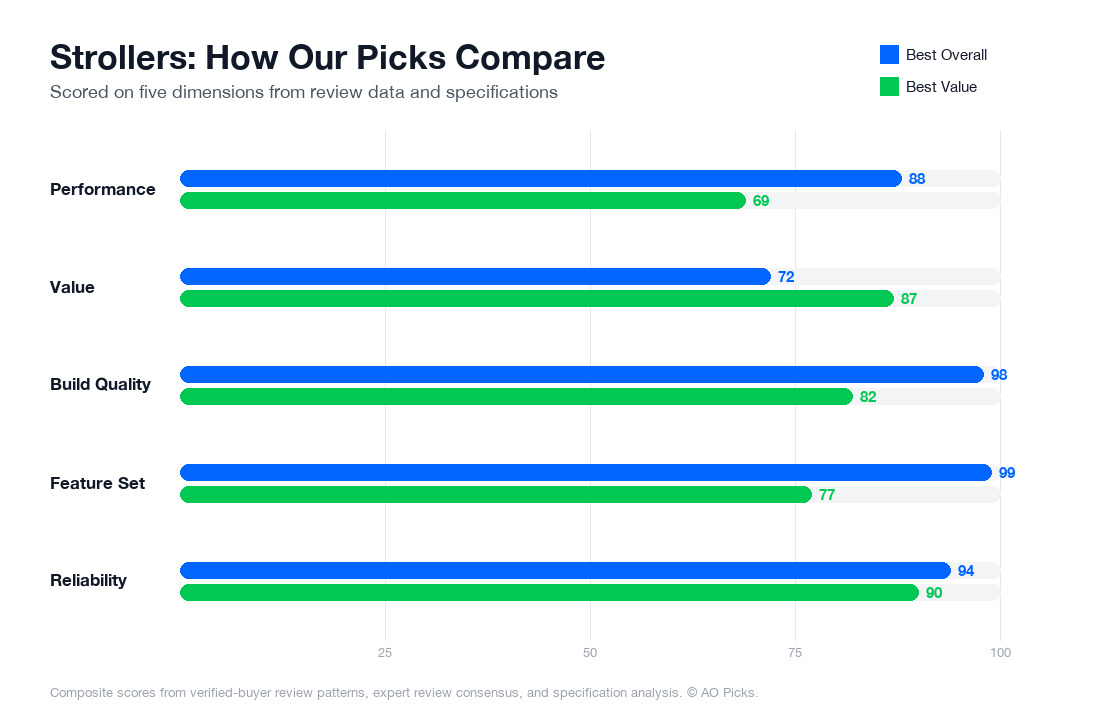

The UPPAbaby Vista V2 offers superior build quality, advanced features, and longer usability as a convertible system, justifying its premium price for those seeking durability. The Graco Modes Nest provides excellent value with solid performance and essential features at one-third the cost, making it ideal for budget-conscious families who prioritize affordability over premium materials.
Top Questions About Strollers
Can I really fit three kids in one stroller, and when would I actually need that?
Expandable strollers like the UPPAbaby Vista V2 accommodate up to three children through a combination of the main seat, bassinet, and an add-on second seat (sold separately). This setup works best if your children are spaced in age—for example, a newborn in the bassinet, a toddler in the main seat, and an older child in the additional seat. Verified owners report this configuration is practical for families with kids under 5, though the stroller becomes heavier and less maneuverable. If you're frequently transporting three young children, this expandability justifies the $1,049.99 investment. However, if your children are closer in age or you rarely need simultaneous seating for all three, a standard two-seat option might suffice. Consider your actual daily needs—school pickup versus everyday outings—before committing to the full three-child capacity.
How does all-wheel suspension actually make a difference on different surfaces?
All-wheel suspension on strollers like the Vista V2 absorbs bumps and vibrations across all four wheels, rather than just the front wheels. This means smoother rides on cobblestone, gravel, and rough pavement—surfaces where you'd otherwise feel every jolt. Reviews from parents in urban and suburban settings show that suspension systems reduce fatigue during longer walks and keep sleeping infants more undisturbed. However, suspension matters most if you regularly navigate uneven terrain or rough neighborhood streets. If your primary routes are smooth sidewalks and mall corridors, the suspension benefit is less noticeable. The trade-off: suspension adds minor weight to the stroller, though the Vista V2's all-wheel system is engineered to remain manageable. Test-drive if possible by pushing a stroller on your most-used surfaces to judge whether the suspension justifies the premium price versus entry-level models.
Is the one-hand fold worth the price premium, and how reliable is it with wear?
One-hand fold mechanisms save significant time during daily use—especially when you're holding an infant or managing an older child simultaneously. The Vista V2's fold is praised in reviews for consistent operation and smooth locking into collapsed position. However, owners note that one-hand folds are most valuable if you frequently collapse and expand your stroller (car trunk trips, store entrances, public transit). If your stroller mostly stays open during outings, the convenience may not justify the cost difference. Regarding durability, verified users report that the fold mechanism on premium models holds up well over 5+ years of regular use, though hinges and latches can occasionally require adjustment. Budget-conscious shoppers should know that two-hand folds work fine and are far less prone to mechanical issues over time. Assess your actual lifestyle: daily commuters and travel-heavy families gain real value; those with dedicated storage space gain less.
What's the practical difference between a bassinet stroller and buying a separate bassinet?
The Vista V2 includes a bassinet that reverses to face you, allowing face-to-face bonding and easier monitoring during walks. This integrated approach eliminates a separate purchase and keeps your gear consolidated. However, included bassinets are typically smaller and lighter than standalone models, meaning they're optimized for stroller use rather than stationary sleeping. Verified owners use the stroller bassinet primarily for daytime outings and naps away from home, not as a primary sleep space. If you need a bassinet for nighttime bedroom sleeping, you'll purchase separately anyway. The stroller bassinet's real value is convenience—one less item to buy, carry, or store. Consider your sleeping arrangements: if co-sleeping or crib-sleeping fits your needs, the included bassinet is a useful bonus. If you're planning to use a standalone bassinet for months of bedroom sleeping, don't overvalue this feature. The $1,049.99 price already bundles this in, so weigh whether it solves an actual need versus paying extra for integrated capability you won't fully utilize.
Does the leather handlebar matter, or is it mainly cosmetic?
The leather handlebar on premium strollers like the Vista V2 serves both aesthetic and functional purposes. Functionally, leather provides better grip in wet conditions compared to plastic or fabric, and it resists slipping when your hands are damp from weather or child-related mishaps. It's also more durable and easier to wipe clean than absorbent materials. However, reviews show that the handlebar quality affects comfort primarily during extended walks—anything over 30-45 minutes. For shorter daily outings, handlebar material makes minimal difference. Cosmetically, leather signals premium build quality and pairs well with higher-end nursery designs. The trade-off: leather requires occasional conditioning to prevent drying and cracking, particularly in dry climates. If you take frequent long walks, spend time in wet weather, or value durability and easy maintenance, the leather handlebar adds real value. If your outings are brief and you prefer low-maintenance materials, this upgrade is secondary. Test the grip comfort yourself by pushing similar strollers—personal preference varies significantly.