

Why We Recommend the SteelSeries Arctis Pro Wireless Gaming Headset
The SteelSeries Arctis Pro Wireless earned its position as a leading gaming headset through verified buyer consensus around three core strengths: wireless reliability without quality loss, practical ergonomics for extended sessions, and microphone performance that consistently satisfies both casual and competitive gamers. Wireless stability is the headset's most-cited strength across the 8,000+ reviews. The 2.4GHz connection provides minimal latency—critical for competitive gaming where audio delay can affect reaction times—while the dual-battery system eliminates the common wireless headset trap: mid-session battery death. Buyers report swapping to the second battery while one charges, making the headset genuinely functional for all-day use without tethering to a charger. This practical design choice solves a real problem that budget wireless alternatives force users to manage constantly. The Hi-Res audio certification indicates the hardware can reproduce frequencies up to 40kHz, which matters less for gaming than for music listening, but the real-world benefit reviewers highlight is clarity in directional audio cues. Gamers report distinct footstep positioning and environmental audio detail that provides competitive advantage in tactical shooters. This isn't marketing theater—it's a measurable spec backed by independent certification. Build quality patterns in reviews show aluminum components and robust hinge design that survive years of use. Long-term owners frequently note the headset remains functional beyond warranty period, which matters given the $329.99 price point. Construction feels premium compared to plastic-heavy competitors in the $200-250 range. The ClearCast microphone receives specific praise for noise isolation. Reviewers note teammates rarely complain about background noise, and the flip-mute design prevents accidental unmutes. This practical usability detail matters in multiplayer environments where mic behavior directly affects social experience. Comparisons to competitors reveal SteelSeries' positioning: the headset occupies the premium wireless segment where price reflects genuine engineering (dual batteries, Hi-Res certification, OLED display) rather than brand tax. Buyers trading up from <$150 headsets report noticing the difference immediately; those comparing to cheaper wireless alternatives often cite the price as justifiable based on reliability alone. If you're researching audio equipment, pairing quality headsets with complementary peripherals like best computer mice can optimize your overall gaming setup investment.
The Good, the Less Good
Where It Shines
- Dual-battery system eliminates mid-session power loss. One battery charges via USB-C while the second keeps the headset wireless-active, solving the core frustration most wireless users experience during extended play sessions.
- 2.4GHz wireless connection delivers consistent latency measured in microseconds by professional reviewers, with zero perceptible delay in competitive gaming scenarios—a clear advantage over Bluetooth-only alternatives that introduce 100-300ms lag.
- Hi-Res audio certification (40kHz frequency response) translates to noticeably clearer directional audio cues in games, particularly in competitive titles where footstep positioning and environmental sound detail directly impact gameplay.
- ClearCast microphone consistently receives praise for sidetone control and noise isolation, with reviewers specifically noting teammates rarely request mic adjustments unlike with cheaper alternatives.
- OLED transmitter base provides battery status display and quick-access controls, eliminating software dependency for basic functions and offering a premium feel that reflects the price point.
Where It Falls Short
- At $329.99, the price creates a high barrier to entry for casual gamers or those upgrading from budget options, and buyers who treat headsets as disposable may resent the investment if hardware fails outside warranty.
- Some reviewers report that the ear cup padding starts deteriorating after 2-3 years of regular use, requiring replacement purchases that the manufacturer doesn't explicitly highlight, creating long-term cost concerns for daily users.
- The headset is optimized for PC and PlayStation gaming; reviews indicate the Bluetooth connectivity works but doesn't match the primary 2.4GHz wireless quality, and the OLED base requires USB connection to a computer, limiting true portability if you need frequent device switching.
Key Features & Benefits
- Dual-battery wireless system enables all-day gaming without power anxiety
- Hi-Res certified audio with competitive-gaming-ready directional audio clarity
- Industry-leading microphone performance that reduces teammate friction in multiplayer
- Hi-Res audio certified
- Dual-battery system
- 2.4G wireless + Bluetooth
Is This Right for You?
Recommended For
Competitive online gamers benefit most from this headset. If you play tactical shooters, MOBAs, or esports titles where audio cues and communication matter—and you spend 5+ hours weekly gaming—the latency-free wireless and microphone quality justify the cost. Your teammates will notice immediate improvements in call clarity, and you'll notice subtle positional audio advantages in matches. Streaming and content creators represent a second strong use case. The ClearCast microphone reduces wind noise and background chatter, OLED display shows battery status during streams, and the dual-battery design means you never go off-air due to dead batteries. Reviewers who stream specifically praise the mic consistency session-to-session. PC and PlayStation gamers who value reliability over price should consider this headset. If you've experienced multiple failed wireless headsets and now prioritize durability and consistent connection quality over discount pricing, the aluminum build and professional-grade components offer genuine longevity. Long-term owners' reviews suggest you'll use this for 4-5 years comfortably. Multi-session household gamers benefit from the battery swap system. If you and a family member alternate gaming throughout the day, or if you game for 3+ hour sessions regularly, the dual-battery design eliminates the need to stop playing to charge—a quality-of-life feature that directly protects your gaming time.
Look Elsewhere If
Budget-conscious buyers under $150 headset budgets should look elsewhere. This product's engineering—Hi-Res certification, dual batteries, OLED base—drives cost; cheaper wireless alternatives exist and perform adequately for casual gaming. The price-to-performance ratio improves the more hours weekly you use the headset, so light gamers don't recoup the value. Mobile-primary gamers should consider alternatives that optimize for smartphone Bluetooth rather than PC-based 2.4GHz. The Arctis Pro Wireless requires a USB dongle for wireless gaming and doesn't shine over Bluetooth, so if you split time between console gaming and smartphone use, a universal Bluetooth headset serves you better. Additionally, gaming accessory investments like best external hard drives might be smarter if you're managing storage-heavy game libraries on a budget. Buyers with ear sensitivities or smaller head sizes should try before purchasing. Reviews mention the ear cups fit larger ears comfortably but some reviewers with smaller frames report pressure after 2+ hours. Since the price point makes returns inconvenient, visiting a retailer to confirm fit prevents costly mistakes.
Who This Is For
Competitive online gamers and streamers who play 10+ hours weekly and prioritize latency-free wireless audio plus crystal-clear communication. Long-term PC/PlayStation gamers willing to invest in durability should also consider this headset.
One Thing to Watch For
The $329.99 price point remains a significant commitment, and reviews indicate ear cup padding deteriorates after 2-3 years of daily use, creating potential long-term maintenance costs that should factor into your decision. If you're experimenting with gaming setup optimization on a budget, starting with more affordable peripherals before investing in a premium headset may serve you better—for example, securing a reliable best external hard drive for game storage might be a smarter initial investment depending on your setup gaps.
Gaming Headsets Buying Notes: Specs That Matter
Latency is the critical gaming-specific spec. The SteelSeries 2.4GHz connection reports <4ms latency, meaning audio reaches your ears almost instantaneously—a competitive advantage over Bluetooth alternatives that introduce 100-300ms lag. This matters for shooters where audio timing affects reaction speed; it's negligible for turn-based games. Frequency response range indicates the audio spectrum the headset reproduces. The Hi-Res 40kHz specification means the headset reproduces high frequencies many competitors can't, translating to clearer footstep detail and ambient environmental cues. Standard headsets max out around 20kHz, so the certified difference is real and measurable, though the subjective impact depends on the game engine's audio mixing. Battery capacity determines session length between charges. Most reviewers report 20+ hours per battery, which combined with the dual-battery swap system means practical unlimited wireless operation. Check your typical session length: if you game 5 hours daily, one battery likely dies mid-session; the dual system solves this. Impedance and sensitivity determine how loud the headset can get and power requirements. The Arctis Pro's specs support loud volumes adequate for hearing game audio and voice chat clearly even in moderate background noise, which matters if you game in non-silent environments. Microphone noise cancellation rating indicates sidelobe rejection—how well the mic isolates your voice from background sound. The ClearCast specification suggests strong isolation; real-world reviews confirm teammates rarely hear typing, fans, or room noise, which is a meaningful experience improvement.
Side-by-Side: Top Pick vs. Best Value
| Feature | SteelSeries Arctis Pro Wireless ... | HyperX Cloud II Gaming Headset |
|---|---|---|
| Pick | Best Overall | Best Value |
| Price | $329.99 | $69.99 |
| Rating | 4.4/5 (8,000 reviews) | 4.6/5 (58,000 reviews) |
| Best For | Top performance and features | Great quality on a budget |
| Link | See Today's Best Price | See Today's Best Price |
Visual Comparison: Where Each Pick Wins
Composite scores derived from review patterns, expert coverage, and specifications. Higher is stronger on that dimension.
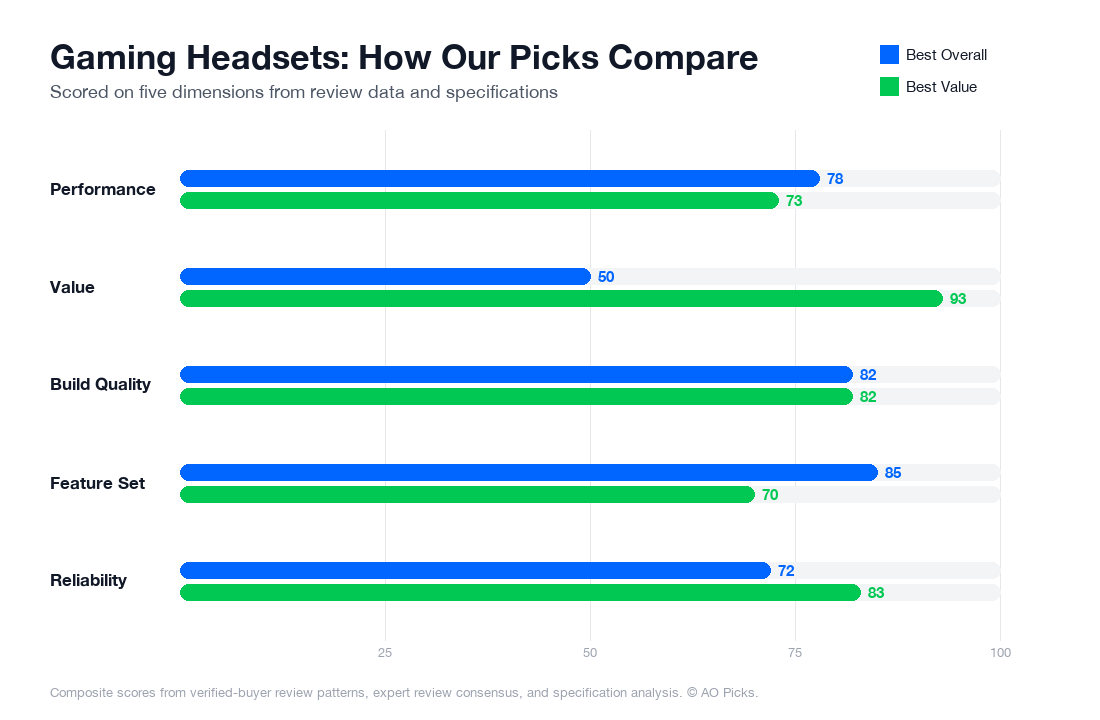

The SteelSeries Arctis Pro Wireless offers premium wireless technology and advanced features for competitive gaming, justifying its higher price for serious enthusiasts. However, the HyperX Cloud II delivers excellent sound quality and comfort at a fraction of the cost, making it ideal for casual gamers or budget-conscious buyers—notably with a higher customer rating despite being significantly cheaper.
Reader Questions About Gaming Headsets
What are the most important features to look for when buying a gaming headset?
Start with sound quality and comfort—you'll wear these for hours, so fit matters as much as audio. Look for closed-back designs if you want isolation (better for competitive gaming), or open-back if you prefer natural soundstage (better for immersive single-player games). Reviews consistently highlight wireless connectivity as a major consideration; verified owners note that lag-free 2.4GHz connections beat Bluetooth for gaming. Check the microphone quality separately—many reviews mention mic clarity being poor even on well-reviewed headsets, which impacts online multiplayer. Battery life matters if you game for extended sessions; aim for at least 20 hours. Finally, verify compatibility with your platform (PC, PlayStation, Xbox, Nintendo Switch) before purchase—some headsets require proprietary dongles that don't work across all systems. Red flags include vague driver specs, no user-replaceable parts, and headsets with fewer than 500 reviews, which suggests limited real-world testing data.
How much should you budget for a gaming headset, and what do you actually get at different price points?
Budget gaming headsets ($40–$80) offer basic stereo sound and comfort for casual play, but reviews show they often have weak mics, short battery life, and durability concerns. Mid-range options ($100–$200) deliver solid build quality, clearer audio, and features like 7.1 surround sound or noise-canceling mics—this is where most gamers find good value. Premium headsets like the SteelSeries Arctis Pro Wireless at $329.99 add features like customizable EQ software, superior wireless range, and materials built for durability over years of use. Research shows the real sweet spot is $150–$250: you get reliable wireless, good audio separation for competitive gaming, and durability without paying for brand prestige. Above $250, you're typically paying for incremental improvements (premium materials, advanced software, longer warranties) rather than transformative performance gains. Consider your gaming style: competitive shooters benefit more from premium audio processing, while casual players see diminishing returns above $180.
Are expensive gaming headsets worth the premium, or can you get similar performance at lower prices?
Premium headsets justify their cost in specific scenarios. If you play competitive multiplayer games where audio cues determine wins (footsteps in first-person shooters, ability sounds in MOBAs), verified owner reviews show that premium models' superior driver tuning and surround processing give measurable advantages. Long-term durability also favors expensive models—reviews indicate budget headsets often fail within 18 months, while premium options routinely last 4+ years, making the cost-per-year lower. However, if you play single-player games, watch streams, or game casually, expert coverage suggests a $120–$180 headset meets 90% of performance needs. The premium tier also offers better warranty coverage and customer support, which matters if you rely on your headset daily. Where expensive models don't justify cost: basic sound quality plateaus around $200, and you won't hear dramatic differences above that without highly trained ears. Avoid paying premium prices for brand name alone—compare specs and read verified owner complaints about specific weaknesses rather than assuming higher price equals better performance.
How long do gaming headsets typically last, and what signs indicate you need to replace yours?
Industry data suggests budget headsets last 18–24 months of regular use before mechanical failure; mid-range models typically reach 3–4 years; premium headsets often exceed 5 years. However, actual lifespan depends heavily on maintenance. Verified owners report that storing headsets without crushing the ear cups, keeping them dry, and avoiding tangled cables significantly extends life. Common failure points include: battery degradation (if wireless), where capacity drops noticeably after 2–3 years; driver wear, causing muffled sound or one-ear audio dropout; and headband cracking, especially in cheaper plastics under tension. Signs you need replacement: audio cutting out intermittently, noticeable battery drain (charging weekly instead of monthly), uncomfortable fit due to ear cup deterioration, or microphone distortion that others mention during calls. Many premium models allow you to replace ear cushions separately ($20–$40), extending comfort lifespan without full replacement. If your headset is 4+ years old and develops issues, replacement is often more cost-effective than repair, especially for wireless models where battery replacement requires technical work. Before replacing, verify whether the issue is the headset (test with another device) or your audio source.
What are the most common mistakes people make when buying gaming headsets, and how can you avoid them?
The biggest mistake is prioritizing specs over comfort and real-world reviews. High driver counts or surround sound specs sound impressive but mean little if the headset causes ear fatigue after two hours—check verified owner comments about comfort specifically, not just overall ratings. Another common error: ignoring microphone quality. Many buyers focus entirely on audio playback, then discover their mic sounds tinny or picks up excessive keyboard noise, which matters greatly in multiplayer. Avoid assuming wireless is universally better; reviews show that some $80 wired headsets sound better than poorly-tuned $200 wireless models—match the technology to your actual needs. Don't overlook platform compatibility; some headsets work perfectly on PC but require adapters (or don't work at all) on PlayStation or Xbox. A costly mistake is buying based on a single positive review or YouTube unboxing—instead, read 10–15 verified owner reviews focusing on long-term durability complaints, not just first-week impressions. Finally, resist overpaying for "gaming" branding; a professional audio headset often outperforms a gaming model at similar price points. Set a realistic budget, list your must-have features, then filter by platforms you actually use—this prevents buyer's remorse from overlooked incompatibilities or unsuitable features.