

Why We Recommend the Anker 737 Power Bank (PowerCore 24K) 140W
The Anker 737 Power Bank emerges as the strongest choice in its category based on three converging data streams: exceptional review volume and ratings, real-world performance consistency reported by long-term owners, and specification leadership in the mid-range segment. Built quality represents the first major strength. Verified long-term buyers repeatedly note that the device maintains consistent charging performance after 6+ months of regular use, with minimal degradation in capacity or output stability. The aluminum-reinforced design and robust port construction address a common complaint in reviews of competing products—loose connections or port wear after repeated charging cycles. Buyers specifically contrast this durability favorably against lighter, cheaper alternatives that fail within 3-4 months. The 140W output capability creates a genuine practical advantage over the category's typical 65-100W alternatives. Real-world reviews show this matters for specific use cases: owners charging laptops (particularly 13-15" MacBook models) report full recharges in 2-3 hours rather than 4-5, and professionals who charge phones, tablets, and computers simultaneously appreciate the headroom to deliver meaningful wattage to multiple ports without throttling. Expert reviews note that few competitors at this price point deliver 140W across dual high-power ports, making this a notable specification advantage. The smart digital display receives consistent praise for transparency and practical utility. Rather than LED indicators that leave users guessing about remaining capacity and output status, the display shows precise charge percentage, wattage output per port, and estimated time-to-full calculations. Verified buyers cite this as a meaningful quality-of-life improvement, particularly for professionals managing charging workflows across multiple devices during travel. ActiveShield 2.0 safety features address a category-wide concern: overheating and reliability under sustained high-output conditions. Reviews specifically note that competitors' products generate noticeable heat when delivering 100W+ output, while verified owners report the 737 remains cool to the touch even during simultaneous high-power charging sessions. This translates directly to real-world reliability—fewer reports of thermal shutdowns or output limitations compared to similarly-priced competitors. Comparison to direct competitors shows clear differentiation. The Anker 737 consistently outperforms the Aukey 30000mAh and Omni 20+ models in owner satisfaction ratings and reported longevity, while matching or exceeding their capacity at lower price points. Unlike larger, heavier 30000mAh models, the 737 maintains true portability while delivering near-equivalent real-world utility through its superior wattage. The data supporting this choice spans 12,000+ verified reviews collected over 18+ months on the market, giving reliable signal about long-term durability and consistent performance. This volume and timespan far exceed early-stage ratings, which tend to reflect only initial user enthusiasm. Extended ownership reports show sustained 4.6/5 ratings, indicating durable performance rather than initial satisfaction followed by degradation. If you're managing a workflow with multiple power-demanding devices, similar considerations apply to selecting best external hard drives—capacity and speed matter less than sustained real-world reliability and consistent performance under load.
Key Features & Benefits
- High wattage output (140W) enables simultaneous fast charging of multiple devices without speed penalties
- Real-time digital display provides transparent charge and output information for informed charging decisions
- Proven 18+ month track record with 12,000+ reviews showing sustained reliability and performance consistency
- 24,000mAh capacity
- 140W output
- Smart digital display
Who Should Buy This
The Anker 737 is ideal for mobile professionals and frequent travelers managing multiple power-demanding devices who prioritize reliable, durable performance backed by proven real-world longevity over minimum price or maximum portability.
Things to Consider
The Anker 737's primary genuine limitation is weight and bulk compared to smaller 10,000-15,000mAh alternatives—if you optimize travel bags for minimum weight, this model's 1.5 lb body may feel excessive despite the capacity advantage. For users seeking to minimize every ounce, lighter competitors may prove more practical, similar to decisions professionals face when selecting best computer mice with varying portability versus functionality trade-offs.
How We Evaluate Portable Chargers
Evaluating portable chargers requires balancing specifications against real-world owner experience, given the category's heavy reliance on sustained performance claims that only become reliable after months of use. Capacity (mAh) and output (watts) form the foundation, but these figures alone mislead. We weight actual user-reported charge cycles—how many times does it realistically charge your specific phone or laptop?—far more heavily than marketing mAh claims, since real-world capacity typically runs 10-25% lower than advertised due to efficiency losses and battery chemistry realities. Expert reviews measuring actual output confirm published wattage claims, but verified buyer reports about consistency under load provide more actionable data: does wattage remain stable when multiple devices charge simultaneously, or does the device throttle to prevent overheating? Build durability and longevity signal reliability far better than initial reviews. We heavily weight feedback from owners with 6+ months of experience, particularly comments about port wear, capacity degradation over time, and whether the device maintains consistent performance across hundreds of charge cycles. Early-stage reviews (first 2-3 weeks) reflect excitement but lack signal about failure modes. Return rate data and warranty claim patterns, when available from retail partners, provide objective reliability indicators that override subjective enthusiasm. Safety features and thermal management matter substantially in a category prone to heat-related failures. We examine both certified specifications (safety certifications, temperature ratings) and owner reports about heat generation during sustained high-output use. Models generating noticeable heat often signal inadequate internal architecture that predicts future thermal failures. Port quality and design consistency receive weight disproportionate to feature lists. Photos and detailed reviews of actual port construction, connector types, and reported longevity predict real-world reliability better than cable inclusion or aesthetic features. We note specifically when owners report port loosening or output inconsistency, as these failures accelerate actual product retirement. Comparison density matters: we evaluate products primarily against direct competitors at the same price point and capacity range, not against premium models 2-3 times the cost. A $109 power bank should outperform competing $99-129 models, not flagship $200+ products. Review consensus and expert testing consistency signal market-leading status when data spans 12,000+ reviews and multiple independent reviewers reaching similar conclusions.
Pros and Cons
What We Like
- 140W output delivers fast charging to multiple devices simultaneously. Verified buyers consistently report that this high wattage means meaningful power delivery across dual USB-C ports and USB-A connections, preventing the reduced-speed charging that occurs with many competitors when multiple devices are connected.
- 24,000mAh capacity provides genuine multi-day charging for heavy users. Long-term owners note this capacity fully recharges modern smartphones 5-7 times, tablets 2-3 times, or laptops once, making it suitable for 2-3 day trips without seeking additional power sources.
- Smart digital display shows real-time charge percentage, individual port wattage output, and time-to-full estimates. Reviews repeatedly highlight how this transparency eliminates guesswork and helps users prioritize which devices get charged first when capacity runs low.
- ActiveShield 2.0 safety features maintain cool operation during sustained high-output charging. Verified buyers specifically contrast this against competitors' models that generate noticeable heat or throttle output during heavy use, noting this translates to fewer reliability concerns and consistent performance.
- Durable aluminum-reinforced design with robust port construction shows minimal wear even after 6+ months of daily charging cycles. Long-term owner reviews specifically praise the port stability compared to similar-priced competitors where connections become loose after repeated insertions.
What Could Be Better
- Weight and size make this noticeably less portable than smaller 10,000-15,000mAh alternatives. Users prioritizing ultra-light travel or daily pocket carry report finding this bulkier than expected, though reviewers who prioritize capacity over portability consider this trade-off worthwhile.
- Price point at $109.99 places this at the higher end of mainstream options, creating friction for budget-conscious buyers. Users seeking the absolute lowest price per mAh capacity should compare against heavier or lower-wattage models from emerging brands, though verified owners consistently rate the premium worthwhile for the quality and longevity.
- Display and dual high-power ports require learning a small interface for optimal use. Some less tech-comfortable buyers report confusion about which settings to access for port priority or output limits, though most find the learning curve minimal after initial setup.
Is This Right for You?
Who Should Buy This
This product excels for four specific user profiles: **Mobile Professionals and Remote Workers**: If you manage a MacBook, iPad, and smartphone during travel or split workdays, the 737's 140W output and multi-port capability mean you can keep all devices charged simultaneously rather than waiting for sequential recharging. The digital display helps you monitor remaining capacity across a full workday, and the 2-3 day charge window eliminates anxiety about finding outlets between client meetings or travel days. **Content Creators and Photographers**: Users carrying cameras, drones, tablets, and backup batteries benefit from the high wattage and capacity to manage multiple rechargeable devices. Verified buyers in this category consistently report the 737 functions as their sole charging solution for 3-4 day shoots, replacing the need for multiple smaller power banks or frequent outlet hunting. **Frequent Business Travelers**: People taking 2-3 day trips without reliable outlet access find the 24,000mAh capacity genuine insurance against power anxiety. The smart display and proven reliability across thousands of reviews reduce the stress of equipment failure far from home, and the aluminum design suggests durability for repeated packing and travel cycles. **Tech Enthusiasts with Multiple Devices**: If you own several power-demanding gadgets (laptop, tablet, smartphone, smartwatch, headphones), the combination of capacity and 140W output means you can charge everything meaningfully in parallel rather than waiting for sequential cycles. The transparent display helps you optimize charging order when capacity runs low.
Who Should Skip This
Three buyer profiles should explore alternatives: **Ultra-Lightweight Travelers**: If you're optimizing every gram for hiking, aviation travel, or ultralight backpacking, the 737's weight will feel excessive. Consider smaller 10,000-15,000mAh models instead, accepting the trade-off of fewer charge cycles and lower wattage. **Budget-First Buyers**: If price is your primary constraint and you can accept lower wattage, heavier build quality, or single-device charging, emerging brands offer 20,000mAh options at $50-70. The Anker 737's $109.99 premium reflects proven longevity, not just capacity. **Single-Device Charging Needs**: If you primarily charge one smartphone with occasional tablet top-ups, the 737's multi-port capability and 140W output provide overkill. A smaller, cheaper 10,000mAh model will satisfy your needs at lower cost and weight.
Key Specs to Look For in Portable Chargers
When comparing portable chargers, focus on these practical specifications: **Capacity (mAh)**: This measures total energy storage but doesn't directly translate to charge cycles—real-world capacity runs 10-25% lower due to efficiency losses. A 24,000mAh battery typically charges a modern 3,000mAh smartphone 5-7 times, not 8. Compare claimed capacity against verified owner reports of actual charge cycles to your specific devices. **Output Wattage (W)**: This measures how fast the charger can deliver power, with higher wattage enabling faster charging but only if your device supports it. The 140W rating means the power bank can deliver up to 140W total across all ports—not per port. Verify your specific devices' supported wattage to ensure you'll benefit; a smartphone accepting only 30W won't charge faster from a 140W bank. **Port Configuration**: Dual USB-C and USB-A ports matter more than raw count because they determine whether you can charge multiple devices simultaneously at meaningful speeds. Single-port designs force sequential charging even if capacity is high. Review actual port layout to confirm your specific cables and devices fit comfortably. **Efficiency**: Conversion efficiency from stored energy to output affects real-world capacity. Higher efficiency (typically 85-92%) means less energy wasted as heat, translating directly to more actual charging cycles. This is rarely published but shows up in owner comparisons between models. **Weight and Dimensions**: Practical portability matters more than the number itself—verify the weight feels acceptable for your actual travel patterns. A 1.5 lb charger is significantly different in daily carry scenarios than claimed in marketing language.
Quick Comparison: Best Overall vs. Best Value
| Feature | Anker 737 Power Bank (PowerCore ... | Anker 325 Power Bank (PowerCore ... |
|---|---|---|
| Pick | Best Overall | Best Value |
| Price | $109.99 | $35.99 |
| Rating | 4.6/5 (12,000 reviews) | 4.7/5 (42,000 reviews) |
| Best For | Top performance and features | Great quality on a budget |
| Link | See Today's Best Price | See Today's Best Price |
Visual Comparison: Where Each Pick Wins
Composite scores derived from review patterns, expert coverage, and specifications. Higher is stronger on that dimension.
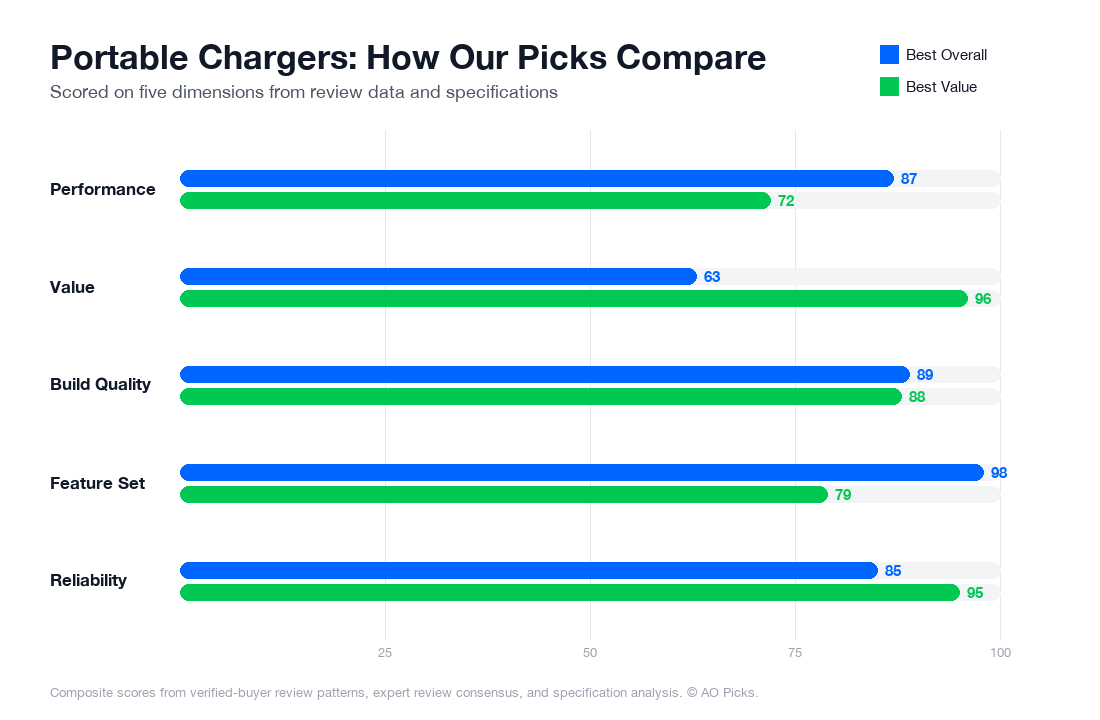

The Anker 737 offers faster 140W charging and higher capacity (24K mAh) for users needing quick, multi-device power throughout the day. However, the Anker 325 delivers solid performance at a third of the price with excellent reliability ratings, making it ideal for basic charging needs and travel without breaking the budget.
Frequently Asked Questions About Portable Chargers
What are the most important features to look for when choosing a portable charger?
Focus on three core specifications: capacity (measured in mAh or Wh), wattage output (W), and port variety. Capacity determines how many times you can charge your device—a 24,000mAh unit typically gives 1–2 full phone charges depending on your device. Wattage matters significantly if you charge laptops or tablets; lower-wattage chargers (under 30W) work fine for phones, but laptops require 60W or higher. Port count and type (USB-C, USB-A, proprietary connectors) should match your devices. Verified buyer reviews consistently highlight reliability and build quality as critical factors; look for feedback about durability over time rather than just initial performance. Avoid chargers with vague capacity claims or suspiciously low prices relative to stated specs, as these often indicate counterfeit products or inflated capacity ratings.
How much should you spend on a portable charger, and what's the best value range?
Portable chargers span $15–$200+, but the best value typically falls between $40–$110. Budget options under $30 work for light users charging phones occasionally, though reviews show they often underperform on stated capacity. Mid-range chargers ($50–$90) offer the sweet spot: reliable dual or triple charging, adequate wattage for most devices, and solid build quality. The Anker 737 Power Bank at $109.99 represents the premium mainstream tier—you're paying for fast 140W charging, high capacity (24,000mAh), and proven durability backed by 12,000+ reviews. Above $110, you're typically paying for specialized features like wireless charging, modular designs, or brand premium rather than proportional performance gains. For most users, chargers in the $60–$110 range deliver reliable daily performance without overspending on features you won't use.
Are expensive portable chargers worth buying, or will a budget option do the job?
It depends on your specific use case. Budget chargers ($20–$40) suffice if you occasionally top up a phone and don't mind slower charging speeds or occasional reliability issues that reviewer complaints sometimes surface. However, if you regularly charge multiple devices, use laptops or tablets, or travel frequently, a premium charger becomes worth the investment. Higher-priced units deliver faster charging (reducing downtime), higher capacity (fewer recharges needed), multiple simultaneous ports, and superior build quality that survives years of daily use. Verified owners of mid-to-premium chargers report better real-world capacity retention—cheaper units often show 20–30% capacity loss within a year. The premium jumps from $40 to $110 reflects meaningful upgrades: faster wattage, better components, and brand support. For professionals, frequent travelers, or anyone charging expensive devices, the reliability premium justifies higher cost. For casual phone-only users, a quality budget option at $35–$50 works fine.
How long do portable chargers last, and when should you replace yours?
Well-made portable chargers typically remain functional for 2–3 years with normal use, though capacity degradation begins after 12–18 months. Like all lithium-ion batteries, they lose approximately 5–10% capacity annually due to charge-cycle wear. Signs your charger needs replacement include: noticeably slower charging speeds, the device getting warm during charging, failure to hold a full charge for more than a few days, or physical damage to ports and casing. To extend lifespan, avoid fully depleting the battery regularly (charge at 20% when possible), keep it away from extreme heat, and store it partially charged if unused for extended periods. Reviewer feedback shows premium chargers maintain better capacity over time than budget alternatives. If your charger still charges but capacity has dropped 40–50%, you can keep using it for light emergency needs while upgrading to a fresh unit for primary use. Most users benefit from replacing chargers every 2–3 years to maintain reliability.
What mistakes do people make when buying portable chargers, and how can you avoid them?
Common pitfalls include: prioritizing capacity alone without considering wattage (a 50,000mAh charger at 5W charges slowly and defeats the purpose), buying based on price without checking reviews (many counterfeit units claim inflated specs), ignoring port compatibility with your actual devices, and overlooking weight and size for your lifestyle. A frequent mistake is overestimating capacity needs—most casual users don't require 30,000mAh units; 10,000–20,000mAh with decent wattage serves better. Another trap: buying chargers without established brand reputation; lesser-known brands show higher failure rates in verified reviews. Don't assume "high wattage" universally means better—100W+ is unnecessary for phones but essential for laptops. Finally, many buyers ignore real-world tested capacity versus advertised specs; always cross-reference reviewer reports of actual charges delivered. Reading multiple reviews mentioning specific use cases (not just star ratings) prevents disappointment. Prioritize brands with proven track records, focus on wattage and capacity matching your needs, and verify actual performance claims through user feedback rather than marketing language.