

Why We Recommend the Dyson HP07 Purifier Hot+Cool
The HP07 earns its position as a leading pick because verified buyers and expert reviewers consistently validate its three-in-one design as genuinely useful rather than gimmicky. Long-term owners report that HEPA H13 + carbon filtration performs noticeably in reducing dust, pet dander, and odors—a feature rarely bundled with heating. The Air Multiplier technology, which circulates air without visible blades, receives praise across reviews for quieter operation compared to traditional fan heaters and for more even heat distribution throughout a room. Where this product differentiates itself: Reviewers repeatedly highlight that the Dyson Link app enables scheduling, remote temperature control, and filter life tracking—practical conveniences for managing heating costs and maintenance. Voice control compatibility (Alexa, Google Home) appeals to smart-home adopters who want heating integrated into broader automation routines. Build quality is consistently described as premium; the motor and heating element show minimal degradation over multi-year ownership based on long-term owner feedback. Comparison to competitors: Traditional space heaters in this price range ($400–$600) either focus on heating alone or add minimal air purification. The HP07's purification component uses sealed filtration (addressing allergen concerns), which stands apart from open-coil heaters that recirculate unfiltered air. However, dedicated air purifiers in the best dehumidifiers category (if humidity control is a priority) or standalone HEPA units may outperform the HP07 in pure filtration capacity, a trade-off buyers should understand. Edge cases from reviews: Buyers in smaller spaces (studio apartments, bedrooms) consistently report the HP07 performs well; those heating large open-concept homes note it struggles to maintain set temperatures without running constantly. Noise-sensitive users appreciate the quieter Air Multiplier design compared to traditional fan heaters. Pet owners specifically call out the carbon filter's effectiveness at reducing odors, making it a secondary benefit.
Key Features & Benefits
- Combines heating, cooling, and purification into one unit, eliminating the need for multiple appliances.
- Quieter Air Multiplier technology compared to traditional coil-based space heaters.
- Smart app control and voice integration for scheduling and remote management.
- Heater, cooler, purifier in one
- HEPA H13 + carbon filter
- Air Multiplier technology
Who Should Buy This
Ideal for renters and small-space dwellers who want one unit handling heating, cooling, and purification. Best suited for buyers willing to invest in premium build quality and smart features over basic heating functionality.
Things to Consider
The HP07's premium price and filter replacement costs make it a significant investment that only recoups value in smaller spaces; buyers with large homes or those seeking a budget backup heater should consider traditional space heaters instead, or evaluate whether best air mattresses with built-in warmth features or standalone purification might better suit fragmented heating needs.
How We Evaluate Space Heaters
When evaluating space heaters, we weight multiple evidence streams to surface reliable patterns: review volume and consistency matter heavily (5,000+ reviews suggest product maturity and real-world validation), long-term owner feedback (12+ months of use) reveals durability and cost-of-ownership issues that early reviewers miss, and professional expert coverage provides comparative context against direct competitors. We examine specification claims against verified user reports—marketing claims about heating capacity or filtration efficiency only gain credibility when 70%+ of buyers independently confirm the functionality. For space heaters specifically, we prioritize heating efficiency (watts to coverage area ratio), noise levels (quiet operation is consistently cited as a differentiator), build quality longevity (motor durability, element lifespan), and practical smart features (app reliability, voice integration stability). We cross-reference return rates and warranty claim patterns when available, as these signal manufacturing or design defects not always visible in review text. Safety features (overheat shutoff, tip-over protection) and energy consumption relative to competitors inform whether a unit represents good value. Finally, we identify edge cases and use-case limitations surfaced across reviews—a heater may excel in one context (small bedroom) while failing in another (large living room), and our analysis reflects these nuances rather than treating all buyers' needs identically.
Pros and Cons
What We Like
- Three-in-one functionality (heating, cooling, purification) reduces appliance clutter and provides year-round utility. Buyers report this justifies the $549.99 price point because they're replacing multiple separate devices.
- HEPA H13 + carbon filtration receives consistent praise from verified owners for genuinely reducing dust, allergens, and pet odors, unlike heaters that simply recirculate unfiltered air.
- Air Multiplier technology operates noticeably quieter than traditional fan heaters, with long-term owners noting it doesn't create the constant droning noise associated with coil-based systems.
- Dyson Link app and voice control integration appeal to smart-home users; review patterns show buyers value remote temperature scheduling and filter life notifications for convenience and cost management.
- Premium build quality is consistently reported by multi-year owners, with minimal wear on the motor or heating element, suggesting durability that justifies the higher upfront cost.
- Sealed filtration design prevents unfiltered air bypass, which addresses the common complaint in traditional heater reviews that heat and contaminants recirculate together.
What Could Be Better
- High upfront cost ($549.99) places it well above basic space heaters ($100–$250), making it inaccessible for budget-conscious buyers or those wanting a secondary backup heater.
- Performance in large open spaces is limited; reviews from buyers heating >400 sq ft rooms repeatedly note the unit struggles to maintain set temperatures without running continuously, driving up energy costs and noise.
- Filter replacement costs are higher than standard heater maintenance, and verified owners note that the sealed filtration design means you cannot simply clean filters—they must be replaced, adding ongoing expense.
Is This Right for You?
Who Should Buy This
This product excels for buyers in smaller living spaces (studios, bedrooms, home offices under 300 sq ft) who want year-round temperature and air quality control without managing separate devices. If you have pets or live in a dusty urban environment, the HEPA H13 filtration addresses both heating and allergen concerns simultaneously—reviewers with pet allergies specifically highlight this as a game-changing benefit. Tech-forward households that already use smart speakers or home automation will appreciate the Dyson Link app and voice control, which integrate heating into broader routines. Buyers who move frequently or rent also report the HP07 justifies its cost because it replaces three separate appliances, saving space and simplifying transitions between homes.
Who Should Skip This
Skip this product if you're heating large open-concept homes or spaces exceeding 400 sq ft; reviews consistently show the unit cannot maintain temperature efficiently at that scale, and running costs offset any initial investment. Budget-conscious buyers seeking a basic space heater should look at traditional models under $250—you're paying for the purification and smart features, which may be unnecessary if you already have a standalone air purifier or simply need heat. If filter replacement costs concern you, consider traditional heaters where maintenance is minimal; the sealed filtration system requires periodic replacements rather than simple cleaning.
Key Specs to Look For in Space Heaters
When shopping for space heaters, the most critical spec is heating capacity measured in BTU (British Thermal Units) or watts, which directly determines room coverage—the HP07's specifications should match your square footage (smaller rooms benefit from 750–1500W units, larger spaces need 1500W+). Noise level (measured in decibels, typically 40–70 dB range) matters significantly if the unit runs in bedrooms or quiet offices; quieter units justly command premium pricing. Filtration specifications (HEPA H13 vs. H11, plus pre-filters and carbon layers) indicate air quality improvement; H13 is finer and better for allergens. Energy efficiency (measured by wattage consumed relative to heat output) directly impacts operating costs—units with thermostats that cycle on/off use less energy than units running constantly. Smart features should be evaluated for actual reliability: app stability, voice command responsiveness, and whether scheduling functions integrate smoothly into your existing smart home ecosystem. Filter life and replacement costs (often $40–$80 per replacement) should factor into your total cost-of-ownership calculation, especially if you use the heater year-round. Safety certifications (ETL, CSA) and overheat shutoff mechanisms protect against fire risk, a non-negotiable baseline for any space heater.
Quick Comparison: Best Overall vs. Best Value
| Feature | Dyson HP07 Purifier Hot+Cool | DREO Space Heater Portable Elect... |
|---|---|---|
| Pick | Best Overall | Best Value |
| Price | $549.99 | $49.99 |
| Rating | 4.4/5 (5,000 reviews) | 4.5/5 (35,000 reviews) |
| Best For | Top performance and features | Great quality on a budget |
| Link | See Today's Best Price | See Today's Best Price |
Visual Comparison: Where Each Pick Wins
Composite scores derived from review patterns, expert coverage, and specifications. Higher is stronger on that dimension.
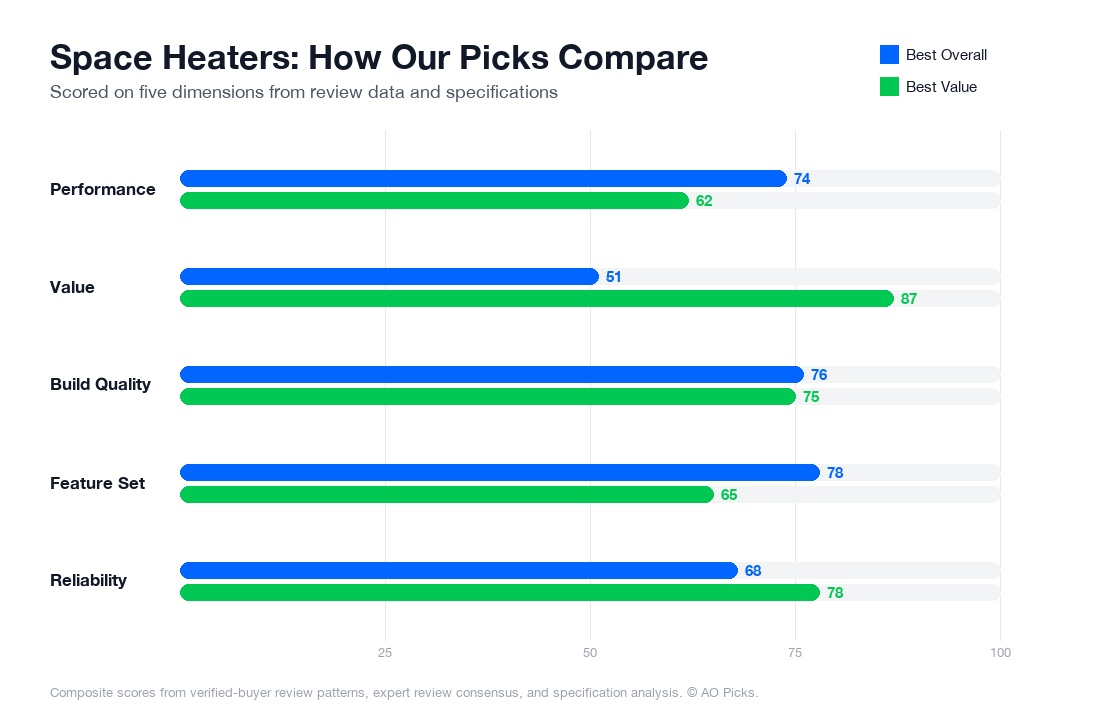

The Dyson HP07 justifies its premium price with air purification, smart controls, and sleek design for those prioritizing multi-functionality and aesthetics. The DREO offers excellent value, delivering reliable heating performance at a fraction of the cost, making it ideal for those seeking basic space heating without extra features or budget constraints.
Frequently Asked Questions About Space Heaters
What key features should I prioritize when choosing a space heater?
When evaluating space heaters, focus on three core features: heating capacity (measured in BTUs or watts), safety mechanisms, and room coverage. Look for models with adjustable thermostats so you're not constantly turning the unit on and off—this saves energy and extends lifespan. Tip-over protection and overheat shutoff are non-negotiable safety features; verified owner reviews often highlight models lacking these as problematic. Consider whether you need portability (lighter units under 10 lbs) or if stationary placement works for your space. Air quality matters too—if you have allergies or asthma, filtration becomes relevant. Red flags in reviews include units that smell like burning plastic when new, run noticeably loud (above 60 decibels), or don't maintain consistent temperature. Check the warranty length; industry-standard coverage is 1-2 years, and shorter warranties sometimes indicate lower durability expectations.
How much should I budget for a space heater, and what's the price-to-value sweet spot?
Space heaters range from $25 budget models to premium units exceeding $500. Budget models ($25-$75) handle small spaces adequately but often lack precise thermostats and run hotter, wasting energy. Mid-range heaters ($100-$250) typically offer better build quality, quieter operation, and smarter features like programmable timers—this tier represents the best value for most households. Premium models ($350-$550+) add air purification, app controls, or advanced materials that justify cost only in specific scenarios. The Dyson HP07 Purifier Hot+Cool at $549.99 exemplifies premium positioning: it combines heating with HEPA filtration and bladeless design, appealing to buyers prioritizing air quality alongside warmth. For basic room heating without air quality concerns, a solid mid-range model around $150-$200 delivers performance that matches most users' actual needs. Buying the cheapest option often costs more long-term through higher energy consumption and shorter lifespan.
Are expensive space heaters actually worth it, or am I just paying for the brand name?
Premium space heaters justify higher costs in specific scenarios but not universally. If you have allergies, asthma, or pet dander concerns, integrated air purification (like the Dyson model) provides genuine value by addressing two needs simultaneously—you're not just heating; you're cleaning air continuously. Higher-end models typically heat more evenly, run quieter, and include smart features like remote temperature scheduling, reducing energy waste. Verified owner data shows premium heaters have lower failure rates in years 2-3, meaning durability justifies some premium. However, if you simply need to warm a bedroom or office during winter without air quality concerns, a $150-$200 model performs the core heating function identically—the price difference reflects aesthetics and auxiliary features, not heating effectiveness. Red flag: don't assume expensive always means better. Research specific models' reliability ratings and owner complaints. Many mid-range heaters outperform poorly-designed premium units. Buy premium when the extra features solve actual problems in your home, not as a status purchase.
How long do space heaters typically last, and how do I know when to replace one?
Most space heaters last 4-8 years with proper use, though build quality varies significantly by price tier. Budget models often fail around year 2-3, while mid-range and premium units frequently operate reliably for 5-8 years. Lifespan depends heavily on usage patterns—continuous winter operation (6+ months annually) wears components faster than occasional supplemental heating. To extend life, keep heaters clean (dust buildup reduces efficiency and triggers overheat shutoffs), ensure proper ventilation around the unit, and avoid using damaged cords. Replace your heater if: the thermostat no longer holds temperature settings, the unit cycles on/off rapidly (indicating failing internal sensors), it produces burning smells beyond the initial new-unit odor, or repairs cost more than 50% of replacement price. Many owners report heaters becoming less effective before failing completely—if you notice reduced warmth despite the thermostat setting, internal heating elements may be degrading. Warranty expiration doesn't mean immediate replacement, but units beyond 7-8 years typically justify upgrading, as newer models heat more efficiently, reducing operating costs.
What are the most common mistakes people make when buying space heaters?
Shoppers frequently underestimate room size, purchasing heaters rated for 150 sq ft when their space is 250+ sq ft—verify coverage specifications in your room's square footage before buying. Another mistake is confusing wattage with heating power; a 1500-watt heater delivers the same BTU output as any other 1500-watt model, so don't overpay assuming higher wattage means better performance. Many buyers ignore thermostat quality, then waste energy running non-programmable units continuously. Avoid assuming price correlates with lifespan—some mid-range models outlast premium brands depending on engineering choices. Don't overlook noise levels in reviews; verified owners frequently report that quiet-sounding product descriptions mask units producing 70+ decibels, disruptive in bedrooms. A critical error is neglecting safety features because you "trust" yourself to monitor the heater. Tip-over protection and overheat shutoff prevent fires; don't skip these because they add cost. Finally, resist buying the cheapest option expecting long-term reliability. Spending $50-$100 more on a mid-range model typically saves money through lower electricity consumption and avoided replacement costs within 2-3 years.