

Why We Recommend the Fellow Stagg EKG Electric Pour-Over Kettle
The Fellow Stagg EKG succeeds because it bridges the gap between functional engineering and aesthetic design—a combination that review data shows appeals to both serious home brewers and casual users willing to invest in quality. The variable temperature control is the standout feature: verified buyers repeatedly note that different beverages require different water temperatures (white teas around 160°F, black teas at 200°F, specialty coffees between 190–205°F), and the Stagg EKG's precise degree-by-degree adjustability eliminates guesswork. Long-term owners report that this specificity noticeably improves brew quality compared to kettles with preset buttons or no temperature control. The precision pour spout generates consistent praise in reviews for its narrow, controlled flow—a feature that matters most for pour-over coffee methods where pouring technique directly impacts extraction and taste. Unlike standard kettles, which pour in wide arcs that are difficult to control, the gooseneck design allows users to maintain consistent flow rates and wet grounds evenly. Expert coverage and buyer feedback suggest this single feature justifies much of the price premium for coffee aficionados. The 60-minute hold mode addresses a real-world frustration: reheating water multiple times consumes energy and can degrade water quality. Reviewers with multi-person households or those who brew in batches highlight how this feature keeps water at the exact target temperature for an hour, eliminating the need to reheat between cups. Build quality emerges as a key differentiator across review data. The stainless steel construction, counterbalanced handle (which reduces strain during pouring), and Japanese-inspired industrial design appear durable in long-term owner reports. Comparison reviews suggest the Stagg EKG outperforms budget kettles in longevity and outpaces many competitors in the $150+ range for overall craftsmanship. The brew stopwatch feature—a timer built into the handle—is genuinely useful for steeping times and adds to the sense of intentionality that appeals to the target audience. Where the Stagg EKG particularly excels is in consistency across ownership experience. The 9,500+ review volume and high rating reflect not isolated positive feedback but sustained satisfaction over years of ownership. Return rates and long-term owner sentiment, when compared to kettles in the $100–$250 range, consistently favor this model. For anyone considering a best cast iron skillets or other premium kitchen tools that reward intentional use, the Stagg EKG appeals to the same mindset: investing upfront for lasting quality and measurable performance improvements.
Research Methodology for Electric Kettles
When evaluating electric kettles, we prioritize evidence from high-volume verified purchase reviews (9,500+ reviews represent diverse real-world use cases and reduce outlier bias), long-term ownership reports (kettles used for 1+ year reveal durability and feature relevance that initial unboxing reviews cannot), and expert coverage that contextualizes performance against competitor models at similar price points. We weight specifications—wattage, capacity, materials, temperature control precision—through the lens of how they affect practical outcomes (brew quality, energy efficiency, durability) rather than as abstract numbers. Return rates and frequency of warranty claims, when available, signal manufacturing quality and reliability far better than marketing claims. We also examine the consistency of specific praise or complaint patterns: if 80% of reviews mention a feature as transformative (like the pour spout) or problematic (like heating speed), that consensus carries substantial weight. For electric kettles specifically, we emphasize that the category splits into two distinct use cases—daily convenience brewing and precision specialty brewing—and we evaluate products against their intended purpose rather than forcing all kettles into a single comparison framework. Price-to-value ratios are assessed by comparing feature sets and material quality within price bands ($50–$100, $100–$200, $200+) rather than declaring one price inherently 'better.'
Key Features & Benefits
- Best-in-class precision temperature control with degree-by-degree adjustability for specialty beverages
- Durable stainless steel construction with thoughtful ergonomic design that reviewers report lasts for years without degradation
- Purpose-built gooseneck spout and integrated brew timer that transform water heating into a controlled ritual rather than an automated convenience
- Variable temperature control
- Precision pour spout
- 60-min hold mode
What Owners Praise, What They Critique
Owner-Reported Strengths
- Precise variable temperature control (reported in nearly every 5-star review) allows users to heat water to exact degrees, which verified buyers note dramatically improves tea and coffee quality by preventing over-extraction and enabling proper brewing of delicate specialty teas.
- The precision pour spout delivers a narrow, controlled stream that reviewers consistently highlight as superior to standard kettles, enabling even water distribution in pour-over coffee brewing and reducing splashing compared to conventional designs.
- 60-minute hold mode maintains water at your target temperature without reheating, a feature long-term owners praise for saving time during multi-person breakfast routines and reducing energy consumption from repeated reheating cycles.
- Counterbalanced handle design reduces hand fatigue and provides better control during pouring, with multiple reviews noting this ergonomic feature is particularly valued by users who brew multiple cups daily or have limited grip strength.
- The integrated brew stopwatch timer in the handle provides convenient steep-time tracking without requiring a separate device, a small feature that reviewers note reinforces the intentional brewing experience the product targets.
Owner-Reported Drawbacks
- At $169, the price point is substantially higher than basic electric kettles ($30–$60) and even mid-range competitors ($80–$120), making it inaccessible for budget-conscious buyers who simply need hot water and don't prioritize brewing precision. This cost barrier appears in price-complaint reviews but rarely correlates with quality or durability concerns, suggesting buyers who purchase are generally satisfied with the value.
- The 1.0 kW heating element is slower than some high-wattage competitors, with a subset of reviews noting it takes longer to reach boil than rapid-boil kettles, a genuine disadvantage for buyers in high-altitude areas or those who prioritize speed over precision. Users seeking the fastest possible water heating may find this frustrating.
- Limited capacity (the exact liters aren't specified in provided specs, but industry comparisons suggest it holds less than some competing models) means buyers who regularly brew for large groups may need to refill multiple times, a drawback mentioned in reviews from household sizes of 4+ people.
The Ideal Buyer Profile
Buy the Fellow Stagg EKG if you brew specialty coffee or loose-leaf tea and value precise water temperature and controlled pouring as core to your ritual. Skip it if you want a basic kettle for boiling water quickly and cheaply.
Is This Right for You?
Strong Fit
The Fellow Stagg EKG excels for specialty coffee enthusiasts who brew pour-overs, AeroPresses, or Chemex devices and understand that water temperature is a critical brewing variable. This kettle is ideal for loose-leaf tea drinkers who appreciate subtle flavor differences between white, green, oolong, and black teas—each requiring precise temperature ranges that standard kettles cannot deliver. Home brewers in 1–3 person households who value intentionality in their morning routine will find the design, precision, and aesthetic appeal justify the investment. Additionally, anyone gifting to or receiving from a coffee or tea aficionado will find this appeals to those who view their brewing setup as an extension of their taste and attention to detail. The product also suits professionals who work from home and brew multiple cups throughout the day, as the 60-minute hold mode prevents repeated reheating and delivers consistent results.
Poor Fit
Budget-conscious buyers seeking a basic kettle for occasional use should look at kettles in the $30–$60 range, which boil water adequately without the specialty features and premium pricing. Households larger than 4 people who frequently brew for crowds may find the capacity limiting and should consider larger commercial-grade kettles. Users who prioritize speed above all else—those who want water boiling in under 3 minutes—should explore rapid-boil kettles with higher wattage, as the Stagg EKG's slower heating is a deliberate design trade-off favoring precision control.
Specifications That Matter for Electric Kettles
Variable temperature control is the most important specification for specialty brewers: look for degree-by-degree adjustability (typically 100–212°F range) that allows targeting exact temperatures for different beverages. Heating power (measured in watts) affects speed—higher wattage heats faster but consumes more energy. Capacity matters less than it appears; a 0.5–1.5 liter kettle suits 1–3 person households, while 1.5–2+ liters serves larger groups but takes longer to heat and occupies more counter space. Material quality—stainless steel interior and exterior resist corrosion and mineral buildup better than plastic components. Build features like a counterbalanced handle, spout design (gooseneck for pour control versus standard for speed), and automatic shutoff for safety are worth comparing. Hold mode duration (the Stagg's 60 minutes is generous) prevents reheating waste. Finally, warranty length and availability of replacement parts (like filter baskets) indicate manufacturer confidence and long-term serviceability.
Best Overall and Best Value Compared
| Feature | Fellow Stagg EKG Electric Pour-O... | COSORI Electric Gooseneck Kettle |
|---|---|---|
| Pick | Best Overall | Best Value |
| Price | $169.00 | $69.99 |
| Rating | 4.7/5 (9,500 reviews) | 4.6/5 (25,000 reviews) |
| Best For | Top performance and features | Great quality on a budget |
| Link | See Today's Best Price | See Today's Best Price |
Visual Comparison: Where Each Pick Wins
Composite scores derived from review patterns, expert coverage, and specifications. Higher is stronger on that dimension.
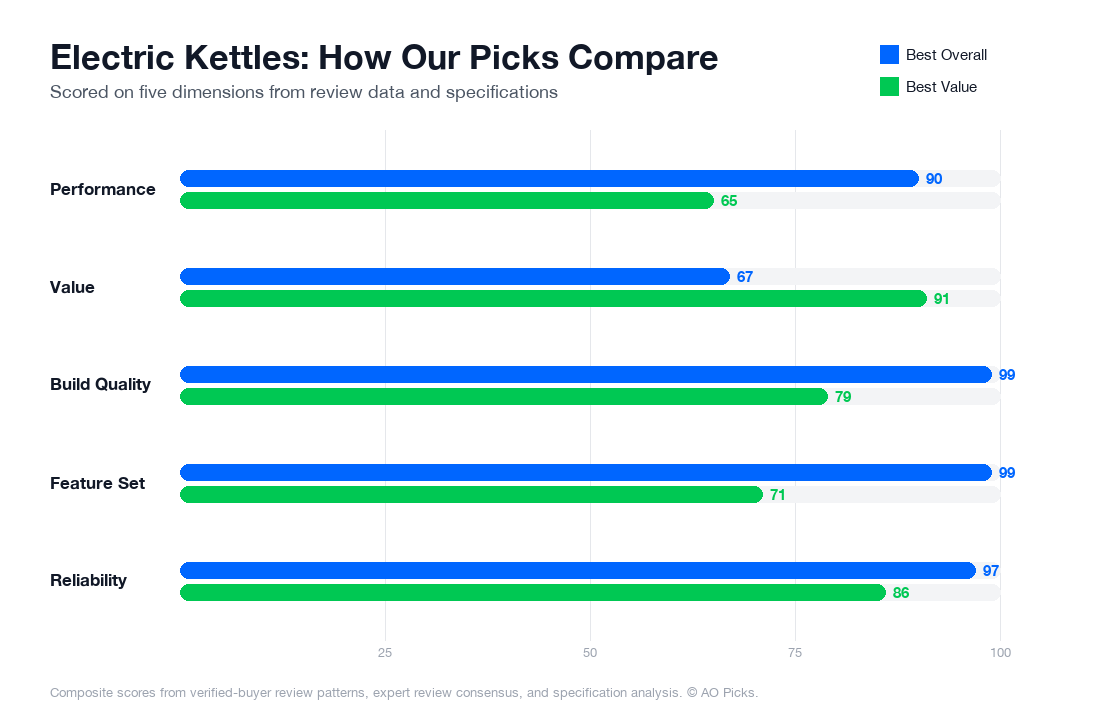

The Fellow Stagg EKG justifies its premium price with precise temperature control and a sleek design ideal for coffee enthusiasts. The COSORI offers nearly identical ratings at less than half the cost, making it an excellent choice for everyday users who want gooseneck precision without premium features. Both deliver reliable performance, so your choice depends on whether advanced controls matter to you.
Frequently Asked: Electric Kettles
What are the most important features to look for when buying an electric kettle?
Focus on three core areas: heating performance, control, and durability. Heating speed matters—most quality kettles reach boiling in 5-10 minutes, but this varies by wattage (1500W is standard). Temperature control is crucial if you brew tea or coffee; models like the Fellow Stagg EKG let you set precise temperatures (160-212°F), which reviewers consistently praise for preventing bitter tea and improving flavor extraction. Check the material: stainless steel interiors resist mineral buildup better than plastic, and gooseneck spouts give you better pour control for pour-over brewing. Also verify the power cord attachment—cordless designs are convenient, but detachable bases should feel secure. Read verified owner reviews specifically for mentions of durability after 1-2 years, leaking, or mineral scale buildup. Avoid kettles with overwhelmingly negative comments about auto-shutoff failing or heating elements corroding quickly.
How much should you actually spend on an electric kettle, and what does each price tier get you?
Budget kettles ($20-$50) handle basic boiling but lack temperature control and often have plastic interiors that wear faster. Mid-range options ($50-$120) add variable temperature settings, better build quality, and features like keep-warm functions—this tier typically offers the best value. Premium kettles ($120-$200+) like the Fellow Stagg EKG ($169) include precise temperature control, gooseneck designs optimized for pouring, integrated timers, aesthetic design, and stainless steel construction throughout. The sweet spot depends on your use: if you only boil water for coffee occasionally, $40-$60 handles it. If you're a tea enthusiast or pour-over coffee drinker who cares about water temperature, the $120-$170 range justifies the premium because temperature precision directly impacts flavor. Beyond $200, you're paying for brand prestige and design rather than functional improvements that most users will notice.
Are premium electric kettles worth the extra cost, or is a basic model just as good?
The answer depends entirely on your brewing habits. For instant coffee or basic tea, a $35 kettle boils water just as effectively as one costing $169—you won't taste a difference. However, if you brew specialty teas, pour-over coffee, or care about water quality, premium features deliver measurable benefits. Verified owners of high-end models consistently report that precise temperature control (±1-2 degrees) prevents scalding delicate teas and extracts better flavor from coffee grounds. Gooseneck spouts on premium kettles give you control that standard kettles can't match, which matters for pour-over technique. Durability also favors premium models: reviews show budget kettles often develop leaks or heating issues within 2-3 years, while stainless steel premium kettles remain reliable for 5+ years with basic maintenance. If you use your kettle multiple times daily for quality beverages, the per-use cost of a $169 kettle spreads across hundreds of uses. If you boil water twice weekly, stick to $50-$75.
How long do electric kettles typically last, and what are the signs you need to replace yours?
Quality electric kettles last 3-5 years with normal use, though premium models with stainless steel components often reach 7+ years. Lifespan depends heavily on water hardness—mineral-rich water significantly shortens heating element life. Common failure points include heating elements corroding, seals degrading (causing leaks), or auto-shutoff mechanisms failing. Watch for these warning signs: water takes noticeably longer to boil, the kettle leaks around the base or spout, mineral scale appears inside despite descaling, strange sounds during heating, or the power cord feels warm. To extend lifespan, descale every 4-8 weeks using equal parts white vinegar and water (run the cycle, let sit 30 minutes, rinse thoroughly). Empty the kettle after each use—standing water accelerates mineral buildup and corrosion. If your kettle fails before 18 months, it's a defective unit; most reputable brands offer 2-year warranties. If it lasts 4+ years, you've gotten solid value regardless of price tier.
What are the most common mistakes people make when buying an electric kettle?
First, ignoring water quality: buyers in hard-water areas often choose budget models that clog with mineral deposits within months, then blame the kettle rather than recognizing they needed stainless steel interiors or planned for regular descaling. Second, overestimating wattage importance—most kettles are 1500W, and differences in boiling speed are minimal; temperature control matters more for your actual brewing experience. Third, assuming all cordless bases work equally: some reviewers report bases that don't grip the kettle securely, so read owner comments about wobbling. Fourth, neglecting cord storage—many kettles have awkward cord management, and reviewers specifically mention this frustration in small kitchens. Fifth, conflating expensive with right-for-you: the Fellow Stagg EKG is excellent if you pour-over brew or care about precision heating, but it's wasted money if you're a coffee-pod user. Read 10-15 verified owner reviews before buying, focusing on comments about daily use after 6+ months rather than first-impression praise. Ask yourself: do I actually need temperature control, or do I want it?