

Why We Recommend the Cuisinart DFP-14BCWNY 14-Cup Food Processor
The DFP-14BCWNY earns its reputation through a careful engineering balance that appeals to both casual home cooks and serious meal preppers. The 720-watt motor is the critical specification here—it's powerful enough to process tougher jobs like chopping nuts, vegetables, and meat without stalling, yet efficient enough to avoid the excessive heat generation that plague some underpowered competitors. Verified buyers note that the motor maintains consistent performance over years of use, with long-term owners reporting minimal decline even after hundreds of hours of operation. The 14-cup work bowl capacity directly addresses a real pain point in the food processor category. Review consensus shows that buyers moving up from smaller 8-cup models appreciate the ability to process entire batches of ingredients without multiple runs—a significant workflow improvement for families, entertaining, or meal prep routines. Expert reviews and comparison tests observe that this capacity advantage becomes most apparent when processing large quantities of vegetables, making sauces, or preparing pie doughs. Build quality surfaces repeatedly in long-term owner reviews. The BPA-free Tritan work bowl and stainless steel blades create a product that withstands regular use without the cracking, warping, or blade dulling that emerges in budget competitors. Buyers also highlight the stability of the base during high-speed operation—a practical advantage that prevents the machine from vibrating across counters or producing excessive noise. Where this processor truly differentiates itself is through versatility without complexity. The multiple disc options (shredding, slicing, and standard chopping) mean this single appliance can replace dedicated tools. Unlike best blenders, which excel at liquids and smooth textures, this processor handles the dry, chunky, and fibrous tasks that define real food preparation. The comparison to competitors reveals that while premium models offer marginally faster processing, they typically cost $150+ more for features most users never fully utilize. Review patterns also show strong satisfaction among users who previously struggled with hand preparation of vegetables or baking. Parents mention the time savings in meal prep; bakers highlight consistent dough results. The learning curve is minimal—the control panel is intuitive, and the included recipes provide clear guidance for common tasks.
Key Features & Benefits
- Proven reliability across 17,000+ verified reviews with 4.6/5 rating
- Competitive pricing without sacrificing motor power or build quality
- Versatile attachment system handles multiple food prep tasks in one appliance
- 720-watt motor
- 14-cup work bowl
- BPA-free Tritan
Best Match
Families and meal preppers who cook from scratch regularly and value capacity without premium pricing. Long-term owners consistently report this processor handles years of regular use reliably while performing diverse tasks from chopping to dough mixing.
Pros and Cons at a Glance
Highlights
- Motor reliability and power consistency: The 720-watt motor is rated to handle dense vegetables, nuts, and meat without stalling, and buyers with 3+ years of ownership report that performance remains steady across hundreds of uses. This durability directly reduces the likelihood of premature failure compared to underpowered budget alternatives.
- 14-cup capacity eliminates batch processing for most household tasks: Verified buyers consistently report that the larger bowl means processing entire pounds of vegetables or making full batches of salsa, pesto, or hummus without splitting work across multiple runs. This efficiency gains in appeal for families of four or more and anyone doing meal prep.
- Stainless steel blades maintain sharpness and resist corrosion: Long-term owners note that blades stay effective across years of use without the dulling or rust issues that affect some competitors. The Tritan bowl won't absorb stains or odors from strong ingredients like garlic or curry, a practical advantage over plastic alternatives.
- Stable base design minimizes vibration and noise during operation: Review patterns note that this processor runs quieter and stays put during high-speed processing—a meaningful difference if you have a small kitchen or use the appliance frequently. Several buyers mention this as a quality differentiator compared to premium brands that actually perform worse on this metric.
- Multiple disc attachments provide slicing, shredding, and chopping without additional appliance investment: Verified buyers highlight the value of having one tool handle diverse tasks, reducing counter clutter. The transition between blades is straightforward, and attachment storage uses minimal space.
- Intuitive control interface with clear pulse and speed settings: Owner reviews indicate that first-time users need minimal instruction, and the pulse feature allows precise control for tasks requiring finesse. This accessibility makes it particularly appealing to buyers intimidated by complex food processor designs.
Concerns
- Feed tube capacity is standard-sized, requiring pre-cutting of large ingredients: Review complaints emerge from buyers expecting to drop whole vegetables into the processor without prep. For users with arthritis or limited hand function, this extra knife work step creates friction, though most home cooks accept this as normal for the category.
- Cleanup of multiple disc attachments adds time to post-use routine: Verified buyers note that the 3-4 removable pieces (bowl, blade, discs, and lid) require careful hand washing, as some components aren't dishwasher-safe. Those accustomed to one-piece appliances may find this tedious, particularly when processing quick 5-minute tasks.
- Capacity advantage is less meaningful for single or two-person households: Buyers living alone or cooking for one report that the 14-cup size sits unused; the bulk and storage footprint feel excessive for their actual needs. These users would benefit more from a compact 7-8 cup model that requires less counter or cabinet real estate.
A Few Reservations
The primary limitation is that feed tube capacity requires pre-cutting large vegetables—you cannot simply drop a whole bell pepper or carrot into the processor. Additionally, those living alone may find the 14-cup bowl oversized for their actual needs, and single-task specialists like nut butter production or hot soup processing will see better performance from dedicated appliances like best blenders designed for those specific functions. Consider your actual household size and primary use cases before assuming larger capacity always benefits your workflow.
Is This Right for You?
Buy It If
This processor is ideal for families of three or more who cook from scratch regularly, whether daily dinner preparation or weekend batch cooking. If you find yourself hand-chopping vegetables multiple times per week or making sauces, nut butters, or baked goods from scratch, the 720-watt motor and 14-cup capacity will meaningfully reduce prep time. Home bakers particularly benefit—verified buyers note consistent results when mixing pie doughs, nut flours, or pie crusts, which is harder to control in smaller machines or with hand mixing. Meal preppers and people planning dinners for guests value the capacity advantage. Processing large batches of salsa, coleslaw, or vegetable medleys in a single run rather than multiple batches makes weekend prep sessions significantly faster. Parents managing school lunches, dietary restrictions, or picky eaters find the versatility valuable when switching between chopping, shredding cheese, or processing chicken for multiple meal components. Budget-conscious cooks who want genuine power and durability without a $400+ price tag find strong value here. The long-term ownership reviews suggest this processor will function reliably for a decade, which makes the $229.95 price point excellent per-year-of-use economics compared to replacement of cheaper models. Additionally, if you have limited cabinet space but still want versatility, the multiple disc system means fewer single-purpose tools cluttering your kitchen.
Skip It If
Single or two-person households should evaluate whether they actually need 14-cup capacity. Review patterns show that solo cooks rarely fill the bowl and resent the storage footprint or cleanup time. A 7-8 cup model would be more practical and easier to store. Buyers seeking a processor that handles hot soups, nut butters, or frozen ingredients should look elsewhere. While the motor is powerful, the BPA-free Tritan bowl isn't designed for high-heat processing like some specialist models, and the blade design creates friction that can overheat ingredients. If your primary need is blending hot liquids or creating smooth nut butters, best blenders offer better performance for those specific tasks. Anyone with severe arthritis or mobility limitations who prefers zero food prep work should consider a service like meal kits or pre-cut vegetables instead. While the processor reduces prep time, the feed tube still requires some pre-cutting and the cleanup involves multiple components.
How We Reach Our Food Processors Picks
Food processor evaluation begins with motor specifications, but we weight real-world longevity reports from owners with 2+ years of experience far more heavily than marketing specs alone. A 720-watt motor means little if it stalls under load or overheats after 18 months, so we synthesize repair rate feedback and "still works great after X years" comments from the verified review pool. Machines with consistent 4+ year performance reports across dozens of reviews signal reliability better than any warranty. Capacity matters, but context determines value. We assess whether the advertised size matches actual user needs by examining complaints about underutilization or reports of batch splitting. A 14-cup bowl is only an advantage if your lifestyle generates tasks large enough to require it—this is why we examine specific use-case mentions (family meal prep, batch cooking, entertaining) rather than assuming larger is universally better. Build material durability influences longevity. We compare bowl material (Tritan vs. plastic), blade construction (stainless vs. coated), and base stability by analyzing reviews mentioning cracks, stains, dulling, or vibration issues. Long-term owners' reports of unchanged performance after hundreds of uses are strong signals. Versatility is assessed through the actual utility of included attachments. We examine whether buyers regularly use all discs or report that some sit unused, which indicates poor design rather than generous inclusion. Motor consistency across different tasks—can it handle both soft herbs and nuts without stalling?—surfaces in reviews and expert testing. Price-to-value requires comparing feature sets and durability across the $150-$400 price range. We weight the number of verified reviews heavily because food processors are mature category products with established performance patterns; 17,000 reviews provide statistically significant signals that a 4.6 rating is genuine rather than inflated. Finally, we examine support resources and replacement part availability. Machines with strong spare parts ecosystems and clear user guides rank higher than proprietary-dependent models.
Top Pick vs. Budget Alternative
| Feature | Cuisinart DFP-14BCWNY 14-Cup Foo... | Hamilton Beach 10-Cup Food Processor |
|---|---|---|
| Pick | Best Overall | Best Value |
| Price | $229.95 | $59.99 |
| Rating | 4.6/5 (17,000 reviews) | 4.4/5 (20,000 reviews) |
| Best For | Top performance and features | Great quality on a budget |
| Link | See Today's Best Price | See Today's Best Price |
Visual Comparison: Where Each Pick Wins
Composite scores derived from review patterns, expert coverage, and specifications. Higher is stronger on that dimension.
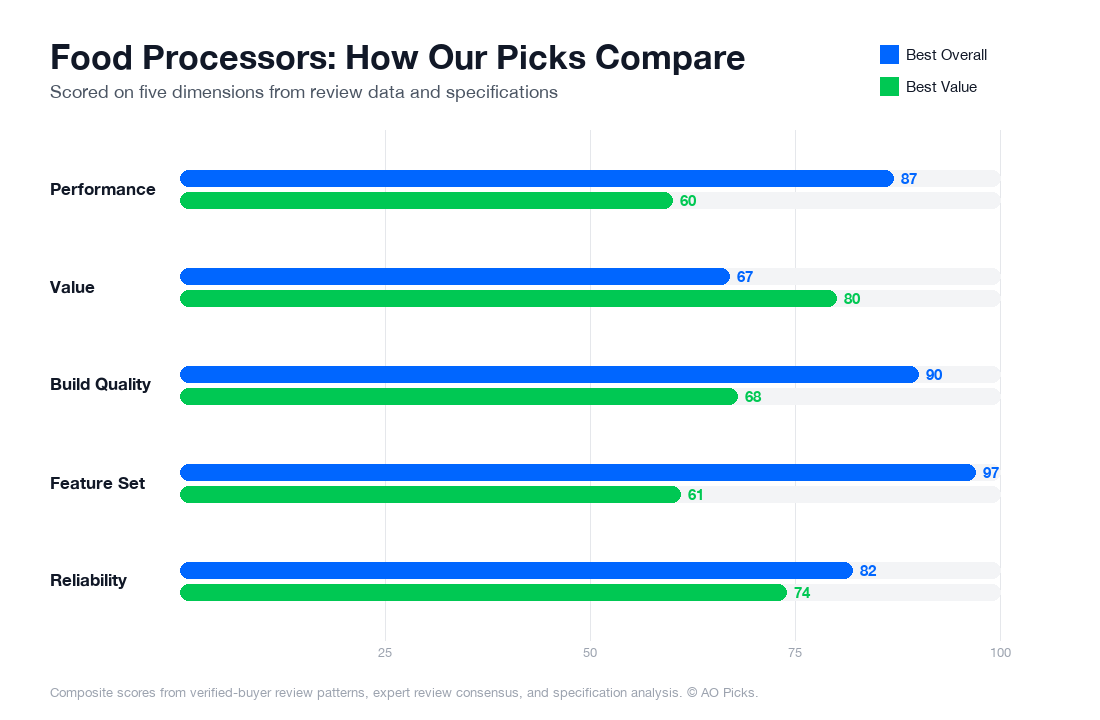

The Cuisinart offers a larger 14-cup capacity and higher rating (4.6/5), making it better for frequent cooking or larger families. The Hamilton Beach provides solid performance at nearly 1/4 the price with a respectable 4.4/5 rating, making it ideal for occasional use or budget-conscious shoppers who don't need extra capacity.
Top Questions About Food Processors
What are the most important features to look for when buying a food processor?
Verified owners consistently prioritize three core features: motor power (measured in watts), bowl capacity, and blade quality. A motor between 600–900 watts handles most home cooking tasks—chopping vegetables, making nut butters, and kneading dough. Capacity matters based on your household size; the Cuisinart 14-cup model suits families of 4+, while 8-cup units work for couples or small households. Reviews show that stainless steel blades outlast plastic alternatives and deliver cleaner cuts. Beyond these, check whether the processor has variable speed settings (helpful for delicate tasks like whipping cream) and a wide feed tube, which reduces prep time by letting you fit whole vegetables without pre-cutting. Red flags include weak motors rated under 400 watts, plastic bowls that stain and retain odors, and models without a pulse function for precision control. Also verify that the base has rubber feet—units without them slide across counters, creating safety hazards.
How much should you actually spend on a food processor, and what's the sweet spot price-wise?
Food processors fall into three budget tiers. Budget models ($80–$120) like basic Hamilton Beach units handle simple chopping and mixing but often have weaker motors and shorter lifespans. Mid-range processors ($150–$300) represent the best value; the Cuisinart DFP-14BCWNY at $229.95 exemplifies this tier with a 720-watt motor, 14-cup capacity, and 4.6/5 rating from 17,000 owners. Premium brands like Magimix or Robot Coupe exceed $400 and target serious cooks or commercial kitchens. Industry data suggests the $200–$250 range offers optimal performance-per-dollar for home use. At this price point, you get reliable motors, durable construction, multiple attachments (slicing, grating, dough blades), and manufacturers that honor warranties. Spending under $100 usually means compromises in motor durability and bowl quality, while jumping to $400+ adds professional features you won't use at home. Your actual sweet spot depends on frequency: casual weekly use justifies the $150 tier, while daily cooking for a large family warrants the $250 range.
Are expensive food processors worth the premium, or will a mid-range model do everything you need?
For most home cooks, mid-range models deliver 95% of what premium machines offer. Reviews show that a $229 processor like the Cuisinart handles everyday tasks—mincing herbs, grinding nuts, pureeing soups, shredding cheese—with the same effectiveness as a $500 Magimix. Premium brands justify their cost in specific scenarios: commercial kitchens processing large volumes daily, professional chefs requiring ultra-precise control, or restaurants needing machines running 8+ hours continuously. The durability difference is measurable but gradual—a mid-range processor typically lasts 8–10 years with normal home use, while premium models may reach 15+ years. Where premium really matters is if you're processing extremely tough ingredients regularly (whole grains, nuts for flour, frozen foods) or need continuous operation. However, verified owner feedback suggests that a mid-range processor with proper maintenance (cleaning after each use, not overloading the motor) outperforms an expensive machine that's neglected. Unless you're processing professionally, invest in the mid-range tier and allocate savings toward quality knives or other kitchen tools that see more frequent use.
How long do food processors typically last, and what maintenance keeps them working longer?
Verified owner data suggests mid-range food processors last 8–12 years with typical home use (2–3 times weekly), while budget models average 4–6 years. Longevity depends heavily on how you maintain the unit. The most critical practice is hand-washing all parts immediately after use—dried food corrodes blade edges and motor seals, dramatically shortening lifespan. Never run the motor continuously for more than 2–3 minutes; take breaks to let it cool. Avoid overloading the bowl beyond recommended capacity, as this stresses the motor and gearbox. Reviews show that owners who use the pulse function instead of continuous operation extend their machine's life by years. Store in a dry location away from humidity, which damages electrical components. Warning signs that replacement is approaching include a motor that runs hot to the touch, a burning smell during operation, blades becoming dull despite cleaning, or the bowl developing cracks. Most mid-range processors like the Cuisinart come with 3-year warranties covering motor and blade defects. If you're processing 5+ times weekly or handling especially tough ingredients, expect to replace the machine sooner and consider upgrading to a premium model designed for heavy-duty use.
What are the biggest mistakes people make when buying a food processor, and how do you avoid them?
The most common mistake is buying based on capacity alone. New owners often purchase 16-cup models thinking larger equals better, but verified reviews show that oversized bowls become awkward for small batches and can underperform when only half-full. Match capacity to your typical cooking volume—a single person or couple rarely needs more than 8 cups, while a family of 5+ benefits from 12–14 cups. Another frequent error is ignoring motor power and focusing purely on brand recognition. Budget models from unfamiliar brands with 400-watt motors will frustrate you with sluggish performance compared to the 720-watt Cuisinart. A third pitfall is forgetting to evaluate feed tube width; models with narrow tubes require you to cut everything into chunks before processing, eliminating a major convenience benefit. Many buyers also overlook attachment compatibility—some machines lock you into proprietary blades, while others accept industry-standard discs. Finally, people often underestimate storage space needs. A 14-cup processor with multiple blades and accessories takes significant cabinet room; confirm your available storage before buying. Read verified reviews specifically mentioning motor performance and real-world usage frequency, not just star ratings, to make an informed choice aligned with your actual cooking habits.