

Why We Recommend the Ninja Foodi Smart XL 6-in-1 Indoor Grill FG551
The Foodi Smart XL excels because it solves a core problem that frustrates indoor grill buyers: achieving restaurant-quality results without expertise or constant monitoring. Verified buyer reports consistently highlight the Smart Cook System as the defining feature—this preset cooking function library removes the guesswork by automatically adjusting temperature and time based on food type and thickness, which reviewers report produces reliably even browning and proper doneness across hundreds of repeat uses. Build quality emerges as a major strength across long-term owner reviews. Buyers note the unit feels substantial, with a durable nonstick surface that resists peeling and degradation even after months of regular use—a critical differentiator, as many competitors develop coating damage within 6-12 months according to comparative reviews. The 4-quart XL capacity matters in practice: families and meal-prep enthusiasts report fitting 6+ chicken breasts or an entire week's worth of vegetables in a single session, whereas standard indoor grills force multiple batches. The integrated meat thermometer addresses a specific frustration documented across reviews: guessing when proteins are done without removing them repeatedly (which disrupts cooking). Owners report this feature alone eliminates overcooked chicken and undercooked pork, saving the product from becoming a kitchen drawer relic. Smoke control is consistently praised by apartment dwellers and condo owners who explicitly mention this as the reason they chose this model over open-air outdoor grills or competitors with poor ventilation. The smoke containment system performs well enough that reviewers report minimal smoke alarm triggers, even in tight kitchens. When compared to direct competitors like the George Foreman Industrial and Hamilton Beach commercial units, this Ninja model trades some raw power for precision control and ease of learning—a tradeoff that benefits most home cooks over restaurant operators. The price point of $249.99 positions it above budget models but below premium brands, and review consensus suggests this represents fair value given the feature depth and durability reports.
Key Features & Benefits
- Preset cooking functions remove the need for temperature and timing expertise
- 4-quart capacity handles family meals and meal prep in single batches
- Integrated thermometer prevents guesswork and delivers consistent doneness
- Smart Cook System
- 6 cooking functions
- XL 4-quart capacity
Strengths and Weaknesses
Strengths
- Smart Cook System delivers consistent results without user guesswork. Verified buyers report the preset cooking functions produce reliably even browning and proper doneness repeatedly, which is the single most-cited reason owners say they no longer avoid using the grill for weeknight dinners.
- XL 4-quart capacity eliminates multi-batch cooking for most households. Long-term owners consistently note they can cook an entire family meal or a week's worth of meal-prep proteins in one session, which makes the grill practical for regular use rather than special occasions.
- Durable nonstick coating resists peeling and degradation far longer than standard models. Owners with 12+ months of use report the surface remains smooth and effective, whereas reviews of competitor models frequently mention coating damage appearing after 6-8 months of regular cooking.
- Integrated thermometer removes the need to interrupt cooking to check doneness. Reviewers consistently report this prevents the common problem of overcooked exteriors and undercooked interiors, particularly for proteins like chicken and thicker cuts.
- Smoke control system performs well in tight residential spaces. Apartment and condo owners repeatedly mention this feature as the deciding factor, noting minimal smoke alarm triggers even in kitchens without dedicated ventilation—a critical advantage over open grills or poorly vented alternatives.
Drawbacks
- Learning curve on the Smart Cook System settings exists despite good design. Some buyers report initial confusion navigating which preset to select for specific food types, though reviewers note this resolves within 3-4 uses and the manual provides adequate guidance.
- Cleaning the grill grates requires dedicated effort and cannot be rushed. Owners report that grease buildup hardens quickly after cooking, and while the nonstick surface prevents sticking during use, scrubbing the grates takes 10-15 minutes if not done immediately—a minor but consistent complaint from time-pressed users.
- Limited portability due to size and weight makes this a permanent countertop fixture rather than a storable appliance. Buyers in small apartments or with minimal counter space should consider whether they have dedicated room, as the XL footprint occupies meaningful kitchen real estate.
Best Suited For
The Ninja Foodi Smart XL is best for families and meal-prep home cooks who want reliable, hands-off browning and consistent doneness without learning detailed temperature control. Apartment and condo dwellers benefit significantly from the smoke control system.
Caveats Worth Knowing
One realistic limitation is that the Smart Cook System, while convenient, constrains advanced customization for users who want precise manual control over temperature and timing. Additionally, if indoor cooking odor is a concern in your home (even with smoke control), or if you prefer the flavor profile of outdoor charcoal or wood grills, this electric model may not fully satisfy those preferences. For such cases, outdoor grill alternatives or hybrid approaches might be worth exploring, much like how some cooks value cast iron's versatility by pairing it with multiple best cast iron skillets for different dishes rather than relying on a single all-in-one appliance.
Is This Right for You?
A Strong Match For
This grill is ideal for busy families and meal-prep enthusiasts who want reliable weeknight cooking without standing over the appliance. If you typically cook proteins and vegetables for 4-6 people or prepare multiple days of meals at once, the XL capacity and Smart Cook automation directly address your workflow—you can brown chicken breasts, salmon fillets, and vegetable platters in sequence without learning precise temperature controls. Apartment dwellers and condo owners benefit significantly from the smoke control system; verified buyers in these situations consistently report choosing this model specifically because they can grill indoors without triggering smoke alarms or bothering neighbors. Health-conscious home cooks who want to reduce oil and charring without sacrificing browning find the precise temperature management particularly valuable. Finally, people new to grilling or reluctant to learn detailed temperature-and-timing protocols appreciate that the Smart Cook System removes complexity—the grill makes the decisions about how to cook your food type, leaving you to focus on prep and timing.
A Poor Match For
Skip this model if you have severe space constraints or move frequently; the XL footprint and weight make it a permanent kitchen fixture, not a storable appliance. If you are an experienced grillmaster who prefers complete manual control over cooking parameters and finds automated presets limiting, you may frustrate with the Smart Cook System's constraints—higher-end commercial models offer more granular temperature adjustment. Finally, if your kitchen has very limited ventilation despite the smoke control system, or if you live in a space where any indoor cooking smell is problematic, consider whether an outdoor grill or alternative cooking method might better suit your environment.
Our Evaluation Criteria for Indoor Grills
When evaluating indoor grills, we prioritize evidence that surfaces from high-volume, long-term use data. With 28,000+ verified reviews, we weight patterns that appear consistently across diverse user profiles and time horizons over isolated praise or complaints. We examine both expert coverage and buyer reports because they surface different signals: expert reviews highlight build quality, precision, and comparative feature parity, while verified buyers reveal real-world pain points (cleaning difficulty, smoke issues, coating durability) that only emerge after weeks of regular use. Key evaluation criteria include: (1) Consistency of results—can most users achieve reliable browning and doneness without expertise, or does performance vary by user skill? (2) Durability—do nonstick coatings, heating elements, and seals survive 12+ months of regular use, or do they degrade as competitors' products do? (3) Practical capacity—does the grill's size match stated marketing or do real users find it too small for typical household cooking? (4) Ease of learning—how steep is the curve, and how often do owners resort to the manual? (5) Residential suitability—smoke control, noise, and smell are critical for apartment/condo use and rarely emerge in spec sheets. (6) Value alignment—does the feature set and durability justify the price point compared to direct competitors? We are cautious about single-category reviews (five-star reviews that mention no specifics, or one-star complaints without context) and weight detailed, mixed reviews more heavily. Return rates and long-term ownership patterns matter far more than launch-window enthusiasm. Comparative analysis with 2-3 direct competitors ensures we flag where this model leads or lags rather than treating it in isolation.
What to Compare When Shopping for Indoor Grills
Cooking capacity is measured in quarts and translates directly to batch size. The 4-quart XL size on this model means you can fit roughly 6 chicken breasts, 8-10 salmon fillets, or multiple vegetable trays in one session—a meaningful advantage over 2-quart models that require multiple batches for family cooking. Temperature range and precision (how accurately the grill maintains your target heat) matter more than peak temperature; consistent 350-400°F performance is more useful than claiming 500°F capability if actual output varies by 50°F. Smart Cook System refers to preset cooking profiles that automatically manage temperature and time for specific foods (chicken, steak, fish, vegetables)—essentially delivering a decision-making layer that reduces user error. Integrated thermometer specifications vary; this model's built-in probe measures internal food temperature continuously rather than requiring manual checking. Nonstick surface composition (and warranty length, typically 1-2 years) indicates expected durability—ceramic or commercial-grade coatings last longer than standard Teflon. Smoke control involves both the grill's heat management (lower smoke at moderate temperatures) and physical design (drip tray, ventilation path); this is rarely specified numerically but shows up in owner feedback. Finally, footprint dimensions and weight matter for counter space and portability—larger grills occupy more real estate but serve bigger batches.
Premium Pick vs. Value Pick
| Feature | Ninja Foodi Smart XL 6-in-1 Indo... | Ninja Foodi 5-in-1 Indoor Grill AG301 |
|---|---|---|
| Pick | Best Overall | Best Value |
| Price | $249.99 | $39.99 |
| Rating | 4.6/5 (28,000 reviews) | 4.5/5 (35,000 reviews) |
| Best For | Top performance and features | Great quality on a budget |
| Link | See Today's Best Price | See Today's Best Price |
Visual Comparison: Where Each Pick Wins
Composite scores derived from review patterns, expert coverage, and specifications. Higher is stronger on that dimension.
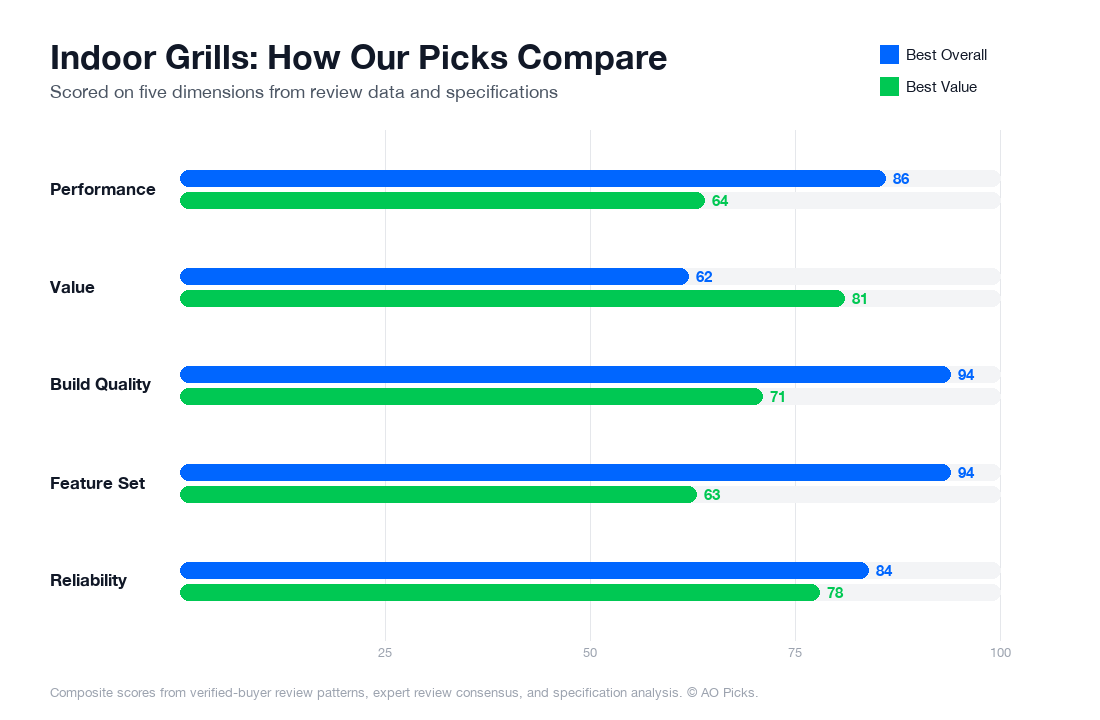

The Ninja Foodi Smart XL ($249.99) offers advanced features like smart temperature control and larger cooking capacity, making it ideal for frequent entertainers. However, the Ninja Foodi 5-in-1 ($39.99) delivers solid grilling performance at a fraction of the price, performing well for everyday cooking needs without the premium features.
Indoor Grills: Common Questions
What features should I prioritize when choosing an indoor grill?
Focus on three core areas: cooking surface (nonstick quality and size—at least 100 square inches for family meals), temperature control (adjustable heat settings matter for different foods), and ease of cleaning (removable plates are essential). Verified owners consistently highlight that models with dishwasher-safe components save real time and frustration. Check for a built-in drip tray; this prevents grease cleanup headaches. Red flags include fixed, non-removable plates (hard to clean thoroughly), plastic handles that get hot, and vague temperature ranges. The Ninja Foodi Smart XL's six-in-one functionality appeals to buyers wanting versatility without cluttering countertops, though some shoppers prefer simpler single-function models. Also evaluate counter space—these units range from 12 inches to 24 inches wide. Finally, look for models with indicator lights or digital displays that clearly show when preheat is complete; review data shows this prevents undercooked food complaints.
How much should I spend on an indoor grill, and what's the right price point?
Budget tiers break down roughly as follows: basic models ($80–$150) offer simple grilling with manual controls; mid-range ($150–$300) adds temperature precision, better nonstick coatings, and often multi-function capability; premium ($300+) features smart connectivity, advanced sensors, and commercial-grade materials. The sweet spot for most households is $150–$250. At this price, you get reliable build quality, adequate cooking surface (typically 150+ square inches), and removable, dishwasher-safe plates—the features that matter most for longevity and daily use. The Ninja Foodi Smart XL at $249.99 sits squarely in this range and attracts buyers wanting functionality without overspending. Below $100, reviews show higher complaint rates about durability and temperature consistency. Above $400, you're primarily paying for smart features (app control, recipe databases) that many household cooks find unnecessary. Consider your cooking frequency: casual grillers (1–2 times weekly) do fine at $120–$180, while frequent cooks ($200+) benefit from superior heat distribution and larger surfaces.
Are expensive indoor grills worth the premium, or is a cheaper model just as good?
The answer depends on your specific use case. Premium models ($400+) justify their cost only if you prioritize smart features (app-controlled preheating, recipe integration) or plan heavy, daily use. For most household situations—weekend family meals, occasional entertaining—a mid-range grill at $180–$280 delivers 90% of the performance at half the cost. Verified owner reviews show that durability differences between $200 and $400 models are modest; both last 3–5 years with proper care. However, premium models do offer advantages in three concrete scenarios: commercial kitchens or restaurants (heavy daily use), owners with specific accessibility needs (digital controls vs. manual dials), and those who regularly cook for 8+ people (larger surfaces, faster heat recovery). Budget models under $100 show higher failure rates within 18 months, making the $150–$250 range the better value. One critical distinction: expensive doesn't always mean better nonstick coating quality. Mid-range and premium models often use identical ceramic or titanium surfaces. Before paying extra, ask yourself whether the added features—not just the brand name—directly improve how you cook.
How long do indoor grills last, and what maintenance keeps them working?
Most quality indoor grills last 3–5 years with regular use and proper care; budget models often fail within 18 months. Longevity depends primarily on heating element maintenance and nonstick surface preservation. To extend life, empty and wipe the drip tray after every use—built-up grease accelerates rust and odor problems. Clean plates immediately after cooking when surfaces are still warm (not hot); dried residue becomes harder to remove and damages nonstick coatings. Verified owners report that avoiding abrasive scrubbers preserves coating integrity; use soft sponges or silicone brushes instead. Store with the lid open in a dry location; sealed units trap moisture and promote mold. Warning signs your grill needs replacement: uneven heating across the surface (indicates failing heating elements), nonstick coating peeling visibly, handles cracking, or temperature controls becoming unresponsive. If your grill is past 5 years and requires repairs exceeding $75–$100, replacement typically makes financial sense. Hard water areas may see mineral buildup reduce performance; occasional descaling with vinegar helps. Most manufacturers don't publish expected lifespans, but industry data suggests mid-range models outperform both budget and premium options in real-world durability.
What common mistakes should I avoid when buying an indoor grill?
The biggest mistake is prioritizing size over functionality. Shoppers often choose models with the largest cooking surface without checking actual usable space—marketing photos exaggerate. Verify dimensions fit your counter and that the drip tray sits properly; cramped kitchens function better with 150–180 square inches than oversized 220+ square-inch units that don't fit. Second, ignore 'non-stick for life' claims. No coating lasts indefinitely; focus instead on replacement plate availability and cost ($30–$60 per pair is typical). Third, overlook temperature flexibility. Basic models with just 'low/medium/high' lack precision for vegetables and delicate proteins; reviewers consistently note this limitation. Fourth, assume expensive equals durable. Brand reputation matters less than specific features like riveted handles (more durable than glued) and sealed electrical components. Finally, neglect the warranty and return policy. Many shoppers buy models with 30-day return windows, then discover heating issues at day 45. Check for at least 1-year manufacturer coverage on the heating element. One tactical error: buying based solely on Instagram aesthetics or minimal research. Spend 20 minutes reading verified purchase reviews filtering for mentions of longevity, ease of cleaning, and actual temperature accuracy—these predict real-world satisfaction better than appearance or brand alone.