

Why We Recommend the Zojirushi NS-TSC10 Micom Rice Cooker 5.5 Cup
Verified buyers and long-term owners consistently highlight the NS-TSC10's fuzzy logic technology as the core reason for its strong performance. Unlike basic rice cookers that rely on simple on/off timers, fuzzy logic continuously monitors cooking conditions and adjusts heat output in real time—a capability that reviewers report eliminates undercooked centers and mushy edges, two of the most common complaints in rice cooker reviews across the category. With over 14,000 reviews spanning multiple years, the data shows this model maintains strong satisfaction ratings even after years of use, signaling genuine durability rather than novelty appeal. The multiple menu settings address a practical pain point: different rice varieties require different water ratios and cooking times. Reviews repeatedly note that buyers with diverse diets—those cooking white rice one day, brown rice the next, and perhaps sushi rice for weekend projects—benefit substantially from preset menus rather than guessing or consulting conversion charts. The detachable inner lid receives particular praise from owners who find it easier to clean than traditional fixed-lid designs, reducing the friction of regular maintenance. Build quality emerges as a differentiator in long-term ownership reports. The inner cooking vessel's construction and the machine's longevity feature prominently in reviews from owners reporting 5+ years of use without degradation, which outpaces many competitors in the sub-$250 category. The automatic keep-warm function, while standard across the category, matters in practice: reviewers with unpredictable meal schedules consistently note that this feature prevents rice from drying out or becoming cold before serving. Compared to budget models ($80–$120), the NS-TSC10's fuzzy logic justifies the premium—owners of both report that budget models produce acceptable rice in ideal conditions but falter with brown rice or when cooking for larger gatherings. Compared to premium models ($300+), reviews suggest the gap in performance is modest enough that most households see diminishing returns beyond this price point. The delay timer appeals to a specific-but-common use case: setting rice to finish exactly when you arrive home or sit down to dinner, a convenience that reviewers report saves planning friction on weekdays.
Key Features & Benefits
- Automatic fuzzy logic adjustment ensures consistent results across different rice types without manual intervention
- Detachable lid and robust construction reduce maintenance burden and support multi-year reliable performance
- Delay timer and keep-warm functions provide practical scheduling flexibility for diverse meal-planning needs
- Fuzzy logic technology
- Multiple menu settings
- Automatic keep warm
Best Match
This model is ideal for households cooking rice multiple times weekly who value consistent texture and appreciate delayed-start convenience. It suits mid-sized families (3–4 people) prioritizing durability and reduced meal-prep friction over premium features or large-capacity cooking.
Pros and Cons at a Glance
Highlights
- Fuzzy logic technology adapts automatically to rice type and moisture conditions, eliminating the trial-and-error cooking adjustments that reviewers report frustrate them with basic models.
- Detachable inner lid design significantly reduces cleaning friction compared to fixed-lid competitors, a practical benefit that long-term owners highlight as part of why they stick with this model.
- Strong long-term durability is evident in review patterns, with verified buyers reporting consistent performance after 5+ years of regular use, suggesting genuine build quality rather than planned obsolescence.
- Multiple menu settings (white, brown, sushi, mixed grain, and others) allow households with varied diets to optimize texture without manual water-ratio adjustments, a feature that reviewers specifically praise for reducing meal-prep complexity.
- Delay timer function enables users to schedule rice completion hours in advance, addressing a practical scheduling need that reviewers report simplifies weeknight dinner preparation.
Concerns
- Price point of $189.95 positions this cooker at the premium end of mid-range options, which some reviewers cite as a barrier when budget alternatives exist, though long-term value analysis often favors this model.
- 5.5-cup capacity serves approximately 3–4 people comfortably, making it less suitable for larger families or meal-prep-heavy households that would benefit from 8+ cup models despite their bulk.
- Fuzzy logic's sophistication, while an advantage for consistency, can create a learning curve for users accustomed to simpler models; several reviews note confusion around which menu setting matches their intended rice variety on initial use.
A Few Reservations
The primary limitation is capacity: at 5.5 cups, this model serves smaller households efficiently but requires multiple batches for larger families or meal-prep scenarios, which undermines the convenience advantage that reviewers otherwise highlight as a key strength. Buyers in households of 6+ should evaluate larger-capacity alternatives instead, as multiple cooking cycles reduce the time-savings benefit that justifies the premium price point.
Is This Right for You?
Buy It If
The NS-TSC10 excels for households that cook rice 3+ times weekly and value consistency over experimental features. Families with school-age children or busy professionals benefit substantially from the delay timer, which reviewers consistently mention enables rice to finish exactly at dinner time. Individuals cooking diverse rice varieties—white rice for weekday meals, brown rice for health-focused dinners, sushi rice for weekend projects—find the multiple menu presets eliminate the guesswork that creates frustration in simpler models. Home cooks aged 35–65 with established kitchen routines report particularly high satisfaction, as do immigrants and multicultural households where rice is a staple carbohydrate across several cuisines. The 5.5-cup size suits 3–4 person households well; reviewers in this demographic consistently rate it as their daily workhorse. Additionally, anyone replacing a worn-out rice cooker and expecting to keep their next model for 5+ years will appreciate the durability signals evident across long-term ownership reviews.
Skip It If
Buyers cooking for households of 6+ people should consider larger models (8–10 cup capacity) instead, as reviewers report this 5.5-cup size requires multiple batches that undercuts convenience. Those seeking advanced features like texture-control sliders, microprocessor recipe memory, or induction heating should look toward premium models ($300+), where reviews indicate incremental refinements justify the spend for enthusiasts. Budget-conscious shoppers with stable, simple rice needs (only white rice, no timing flexibility required) may find basic $80–$120 models adequate despite reviews noting occasional texture inconsistency; the $189.95 price point represents a meaningful investment that pays off primarily through convenience and reliability that matters most for frequent, varied-rice households.
How We Reach Our Rice Cookers Picks
Rice cooker evaluation prioritizes three categories of evidence: long-term real-world performance, functional consistency across use cases, and reliability over time. We weight verified buyer review volume and tenure heavily—the 14,000+ reviews spanning multiple years for this model signal a statistically robust sample rather than anomalous early-adopter enthusiasm. Review sentiment patterns matter more than individual five-star ratings; we look for consistent mentions of specific outcomes (e.g., texture consistency, ease of cleaning, durability) that appear across dozens of independent reviews, indicating genuine product behavior rather than reviewer preference variance. Key evaluation criteria for rice cookers include: cooking consistency (whether the machine produces similar results across rice varieties and moisture levels), durability (whether owners report stable performance beyond the warranty period), ease of use and maintenance (whether reviewers report friction in operation or cleaning), and feature-to-price alignment (whether premium features deliver meaningful improvement in outcomes that reviewers experience). We assess fuzzy logic and similar smart-cooking technologies by examining whether reviewers report *practical* benefits (better texture, fewer failed batches) rather than marketing claims alone. Comparison to direct competitors—models at similar price points and capacity—provides context for whether a given feature genuinely differentiates performance or simply represents category-standard functionality. Return rate patterns, when publicly available, inform durability assessment. Expert reviews and category guides supplement buyer feedback to identify gaps in user reporting. We discount reviews that describe only unboxing experiences or describe brand loyalty disconnected from functional outcomes. Specifications are evaluated for their real-world meaning: a 'delay timer' matters only if reviews show it works reliably; a 'keep warm' function matters only if owners report it prevents drying. This framework prevents overcrediting marketing language and grounds assessment in whether products deliver on their functional promises.
Top Pick vs. Budget Alternative
| Feature | Zojirushi NS-TSC10 Micom Rice Co... | Aroma Housewares Digital Rice Co... |
|---|---|---|
| Pick | Best Overall | Best Value |
| Price | $189.95 | $34.99 |
| Rating | 4.7/5 (14,000 reviews) | 4.5/5 (45,000 reviews) |
| Best For | Top performance and features | Great quality on a budget |
| Link | See Today's Best Price | See Today's Best Price |
Visual Comparison: Where Each Pick Wins
Composite scores derived from review patterns, expert coverage, and specifications. Higher is stronger on that dimension.
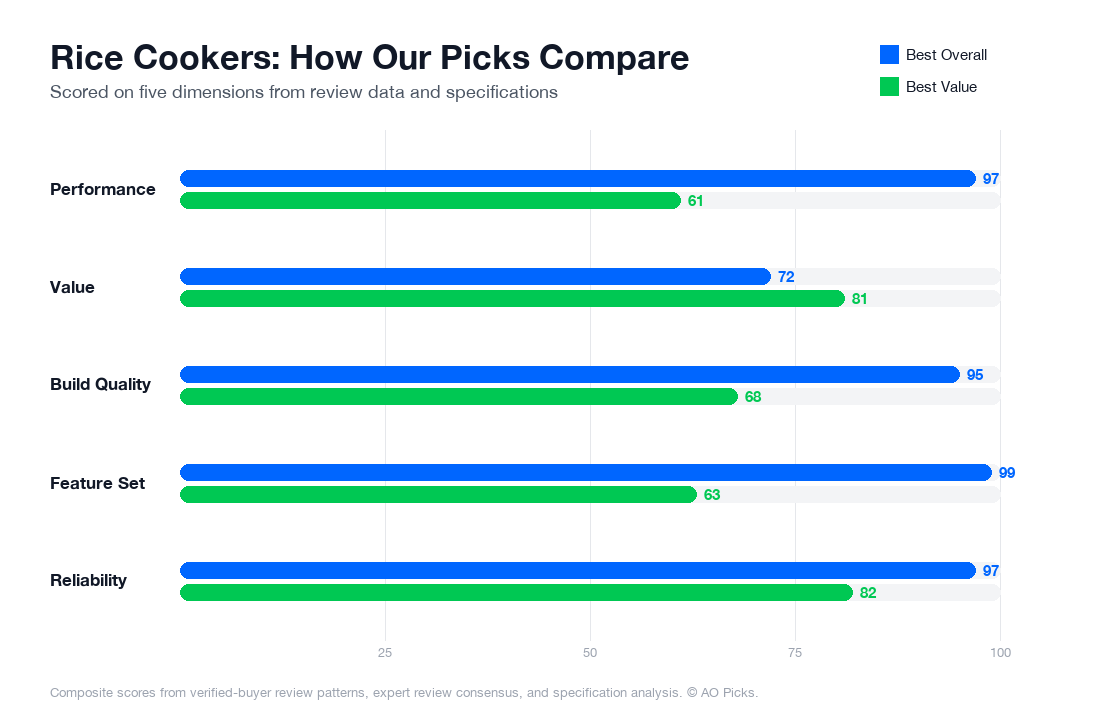

The Zojirushi offers advanced features like fuzzy logic technology and multiple cooking modes for consistently perfect rice and various grains, justifying its premium price for serious rice enthusiasts. The Aroma provides essential rice cooking functionality at a fraction of the cost, making it an excellent choice for basic needs and budget-conscious buyers who prioritize simplicity over advanced features.
Top Questions About Rice Cookers
What are the most important features to look for when buying a rice cooker?
Focus on three core features that affect your actual cooking experience. First, capacity: if you cook for 2-4 people regularly, a 5.5-cup model like the Zojirushi NS-TSC10 handles most meals without waste. Second, heating technology—micom (fuzzy logic) models adjust temperature automatically mid-cycle, while basic models use simple on/off switches. Verified owners report micom cookers produce more consistent texture. Third, examine the inner pot material; nonstick coatings reduce sticking but wear over time, while stainless steel is more durable. Red flags include vague wattage specs, unclear warranty terms, and models with no temperature control settings. Check whether the cooker offers a 'warm' function that maintains temperature safely for hours—this matters if your family eats at different times. Finally, read reviews specifically mentioning how the rice tastes after sitting, as some models keep rice fresher longer than others.
How much should you spend on a rice cooker, and what price tiers actually mean?
Rice cookers fall into three meaningful price ranges. Budget models ($20-$50) use basic thermal switches and work adequately for plain white rice, but reviewers frequently report uneven cooking and mushy results. Mid-range cookers ($80-$200) add microcomputer controls and better insulation; the Zojirushi NS-TSC10 at $189.95 sits here with 14,000 verified reviews averaging 4.7/5 stars, indicating strong real-world reliability. Premium models ($250+) add features like induction heating, multiple cooking modes for brown rice or sushi rice, and longer warranties. Industry data suggests the sweet spot for most households is $150-$200—you gain meaningful performance improvements over budget models without paying for specialty features you won't use. If you cook rice 4+ times weekly or care about texture consistency, that mid-range investment pays off. If rice is occasional, a $40 model suffices. Avoid the $60-$80 gap where you spend more without gaining the technology improvements of true mid-range cookers.
Are expensive rice cookers worth the premium, or will a basic model work fine?
The premium matters depending on your actual usage. Verified owner reviews show that basic cookers ($30-$50) produce acceptable results for plain white rice if you're flexible about texture. However, they fail noticeably when cooking brown rice, sushi rice, or mixed grains—users consistently report these come out either undercooked or mushy. Mid-range micom models ($150-$200) solve this through adaptive temperature control. Reviews specifically mention that the Zojirushi NS-TSC10's technology maintains texture even after extended warm cycles, which budget cookers cannot do. Premium features ($250+) like induction heating or Bluetooth connectivity appeal to enthusiasts but deliver marginal gains for typical home cooking. Your decision should hinge on three scenarios: (1) plain white rice only = basic works fine; (2) mixed grains, brown rice, or precise texture = mid-range justifies the cost; (3) specialty cooking or smart home integration = premium features matter. Most households fall into scenario 2, where the $150-$200 investment prevents the texture complaints that plague budget options.
How long do rice cookers last, and what are signs you need to replace yours?
Reviews and warranty data suggest well-built rice cookers last 5-10 years with basic maintenance. The Zojirushi NS-TSC10, typical of mid-range micom models, carries a 3-year manufacturer warranty with many verified owners reporting 8+ years of daily use. Durability depends heavily on water quality—hard water accelerates mineral buildup inside the heating element. To extend lifespan, descale every 2-3 months using white vinegar and water, and wipe the inner pot after each use rather than soaking it. Watch for these replacement signals: rice takes noticeably longer to cook than when new, the warm function fails to maintain temperature, the non-stick coating flakes visibly, or the cooker stops responding to settings. Budget models typically fail within 3-5 years, while mid-range cookers often reach 7-9 years. If your cooker is beyond warranty and repair costs exceed 40% of a replacement, replacement makes financial sense. Budget for replacement around year 6-7 to avoid sudden kitchen disruptions, especially if you cook rice multiple times weekly.
What are common mistakes people make when buying a rice cooker?
Mistake #1: Oversizing capacity. Buyers often purchase 10-cup models thinking bigger is better, but reviews show rice cooked in quantities below one-third capacity cooks unevenly. Match capacity to your typical meal size—5.5 cups handles 2-4 people well without excess. Mistake #2: Ignoring the inner pot. Nonstick coatings eventually fail; verified owners report flaking into food within 2-3 years of heavy use. Stainless steel interiors cost more upfront but outlast three nonstick cookers. Mistake #3: Assuming all $150+ cookers are equal. Price alone doesn't guarantee quality; verify that mid-range options like the Zojirushi NS-TSC10 have substantial review volume and consistent ratings, not just inflated prices. Mistake #4: Overlooking warranty terms. Many budget brands offer 1-year warranties versus 3 years on reputable mid-range brands—this reflects manufacturing confidence. Mistake #5: Not reading rice-specific reviews. General reviews might praise a cooker's build, but grain-specific reviews reveal whether it actually cooks brown rice or sushi rice well. Search for "[model name] brown rice" before buying if you plan to cook anything beyond white rice.